Hiển thị các bài đăng có nhãn science fiction. Hiển thị tất cả bài đăng

Người đăng: vanmai yeu em on Thứ Tư, 7 tháng 11, 2007


Number 214


The Space Siren has such a lovely rumpus


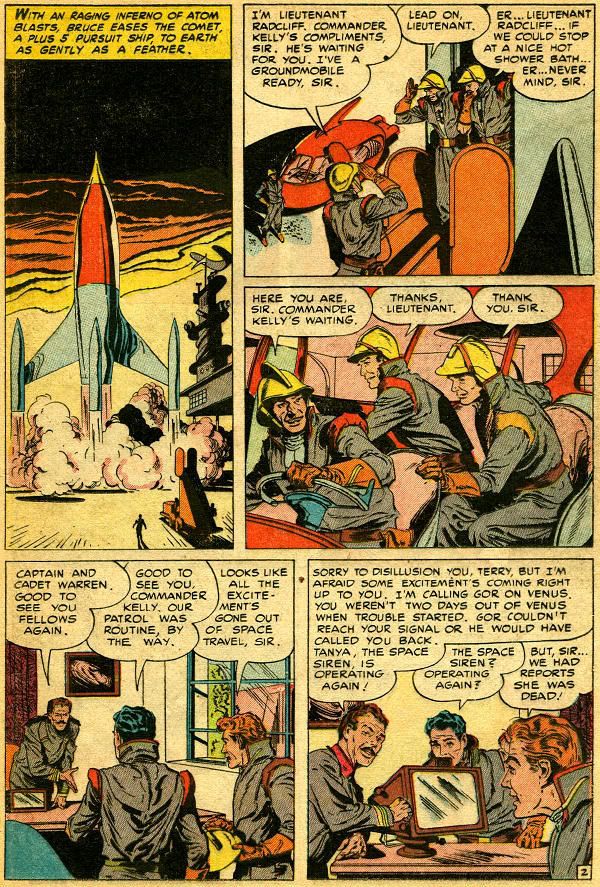
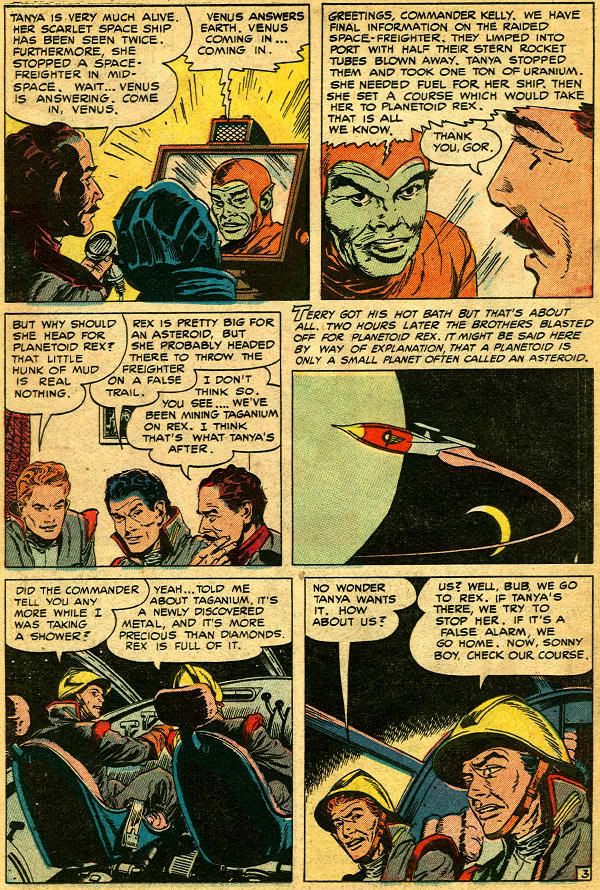
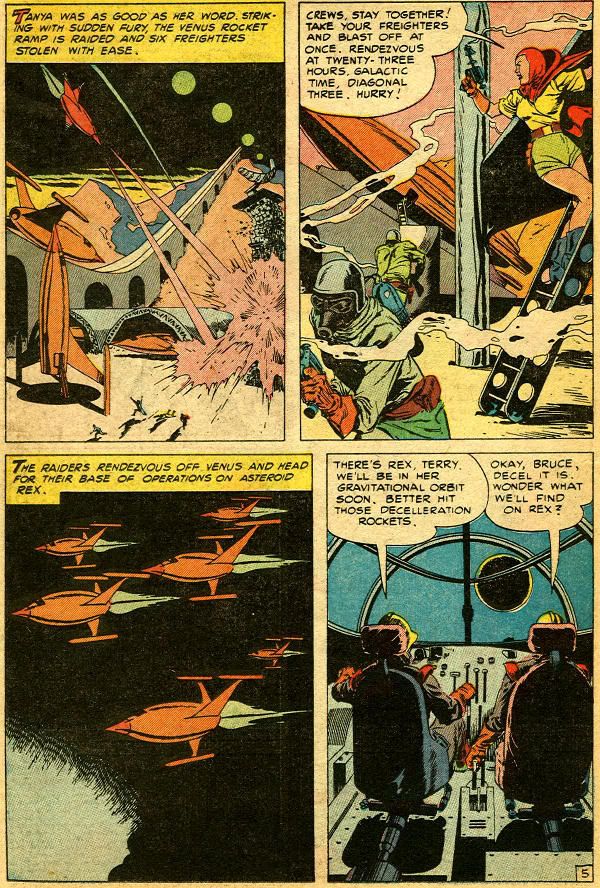
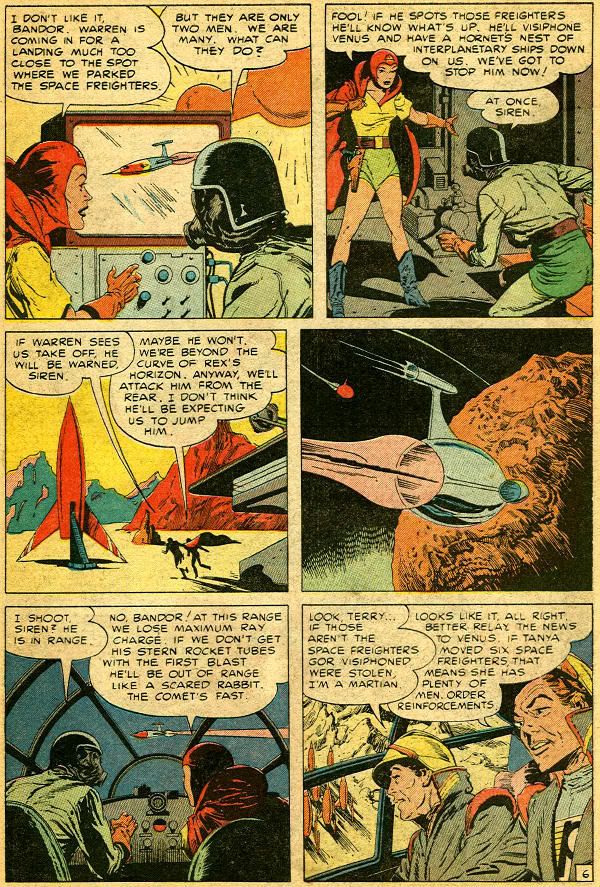
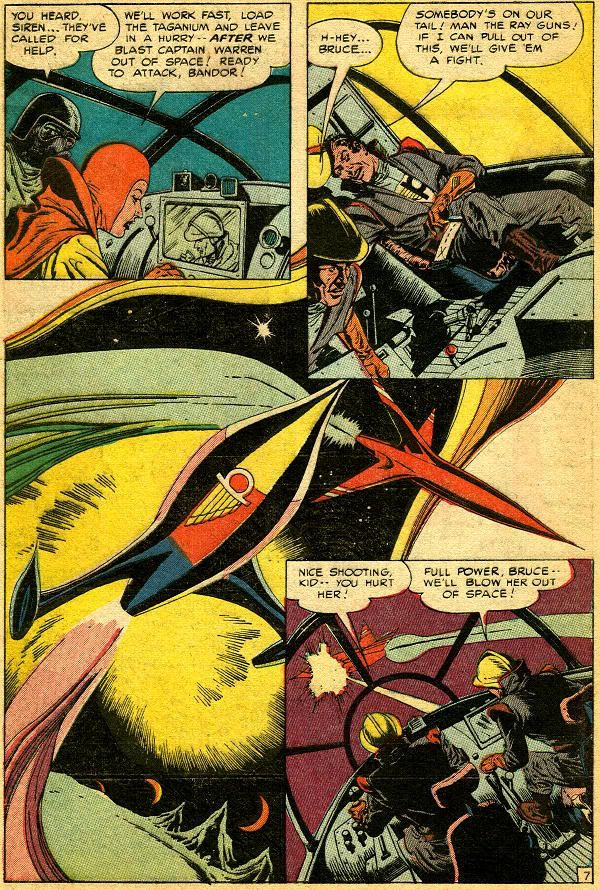
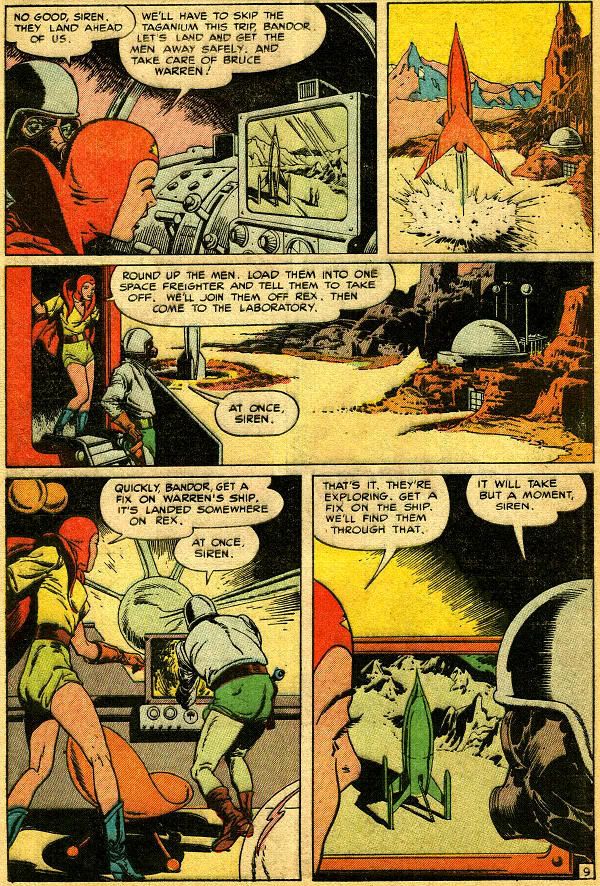
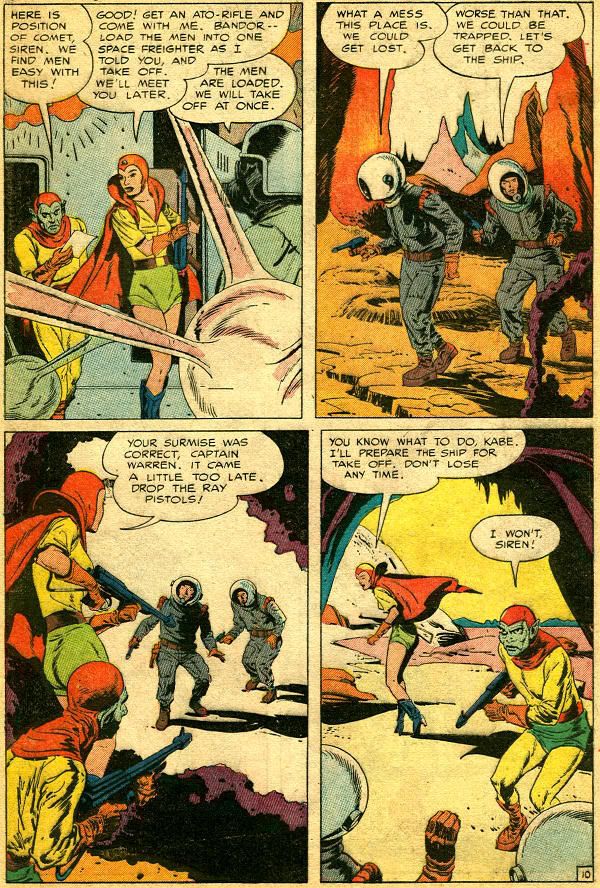
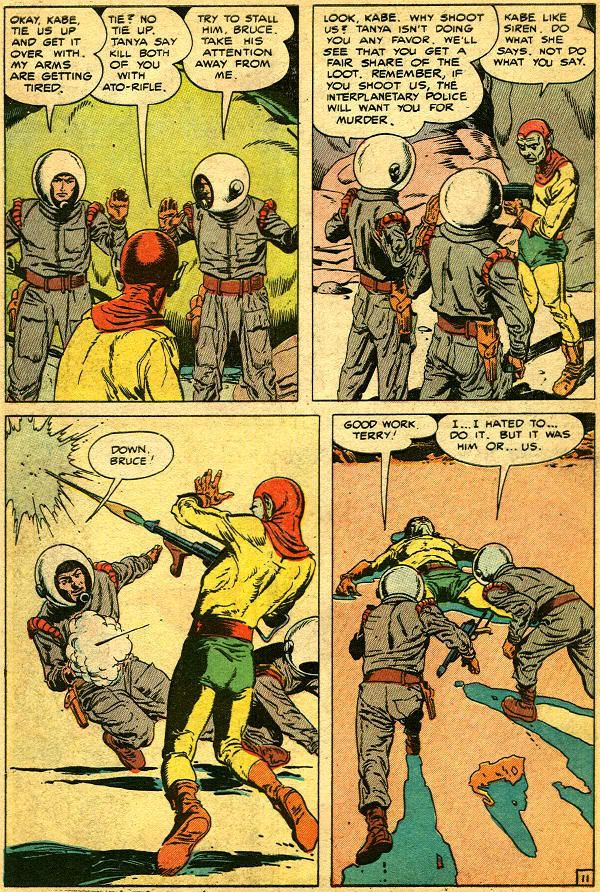
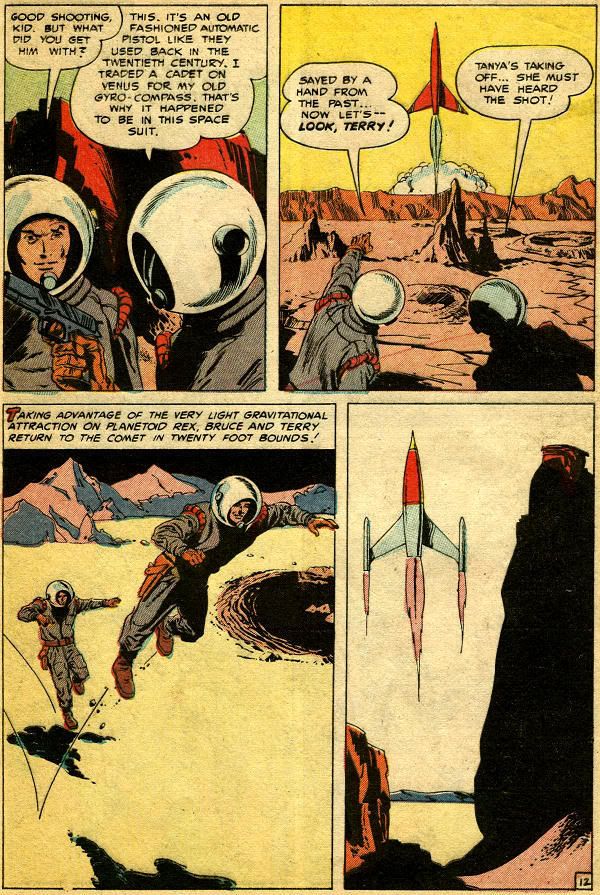
"Rumpus On Rex," drawn by Reed Crandall, is from Buster Brown Comic Book #30. There is no copyright information, no publisher listed, much less a date, for this shoe store giveaway comic.The Overstreet Comic Book Price Guide and Grand Comics Database tell us that Tanya the Space Siren appeared in Buster Brown issues 29-32. From the look of the artwork it appears to be mid-1950s. Smilin' Ed McConnell died in 1954. I assume it was produced in his era.

Crandall's artwork is, as usual, superb. He could draw sexy women! Tanya is a real hottie, warming the Interplanetary Police rocket tubes, no doubt. As much as I enjoy Crandall's depiction of the leggy Tanya, my amazement is that this was aimed at kids. I'm sure it caught the attention of the boys of that era. For those of us over-aged kids, Tanya looks great, too.

After I originally posted this, George Freeman added in the comments section that the inking was by Ray Willner.

The Grand Comics Database lists "Rumpus On Rex" as reprinted in 1998 by AC Comics for Golden Age Greats #12.

Page 1 / Page 2 / Page 3 / Page 4 / Page 5 / Page 6 / Page 7 / Page 8 / Page 9 / Page 10 / Page 11 / Page 12 / Page 13

More about

Người đăng: vanmai yeu em on Thứ Sáu, 21 tháng 9, 2007


Number 192


Death On The Earth-Mars Run!


Over the past few days I've been wondering if there's ever been a comic book artist who went as far in the art world as Everett Raymond Kinstler. He's a man who, in the early 1950s was drawing sci-fi potboilers like "Death On The Earth-Mars Run" for Avon's Strange Worlds #8, and by the turn of the 21st Century had painted the portraits of five U.S. Presidents, having two of them chosen as official White House portraits.
Offhand I can't think of anyone else who reached those heights after a background in comics.

Kinstler wasn't ashamed of his comic book work, either. He signed it when he did it; he mentions the comics work in his autobiographical materials. Kinstler was very influenced by James Montgomery Flagg, who is most famous nowadays for his iconic World War I poster image of Uncle Sam, pointing and saying, "I Want You!" In his pen and ink work Flagg was known for his flourishes with a flexible pen point, but that was the style of the day. By the time Kinstler used the Flagg-style in his comic book work it was passé. That didn't bother Kinstler, though, and it helped to make his work some of the most instantly recognizable of any comic book artist.

"Death On The Earth-Mars Run" strip isn't signed. Not my copy, anyway. I scanned it from a reprint in Skywald Comics' Heap #1, dated September, 1971.There may be some other changes as well, dictated by the Comics Code, but I don't have the first printing with which to compare. It looks like Kinstler didn't spend a lot of time on it, but it's a fun read, anyway. Some of it is also similar to the work that Alex Raymond was doing on Flash Gordon in the mid-1930s. The whole story has an old-time feel to it; more like something published 20 years earlier. Nothing wrong with that; not when Everett Raymond Kinstler was wielding the pen.


More about

Người đăng: vanmai yeu em on Thứ Năm, 2 tháng 8, 2007


Number 169


Jet Powers and the Fleets of Fear


With this Pappy's entry we say goodbye to Jet Comics. We've posted a story a week for the past 16 weeks. This final entry in the saga has Jet Powers not only breaking up a royal Martian plot, but taking on invaders threatening Mars and then Earth. Whew. What a guy!

The story is the second part of the story begun in Jet #3. It's not the final Jet Powers story. Jet Powers (the comic book character) outlived Jet Powers (the comic book) by coming back as an Army air ace. I have one of those stories and will run it sometime in the future. If you want to see all of the Jet Powers stories posted so far click on the "Jet Powers" link at the bottom of this page.

My personal assessment of the four issues of Jet, published in 1950 and '51, is that I liked the character and I felt the best issue was #2 (the first one I encountered, back in 1959). I'm puzzled as to why Jet only lasted four issues. Declining sales could have been the reason this series was dropped, there was a lack of interest on the creative and/or editorial end, or the book was dropped in favor of other projects. In those days ME Comics was doing a lot with their Western comic books like Ghost Rider, Tim Holt and The Durango Kid. ME was a small player in the comics field, with a limited number of titles, but they had a successful line with what it was they did the best. Despite my quibbling complaints over some of the stories in Jet, it was probably better than most of other publishers' outputs in those days. I'm proud of my Cosmic Aeroplane-pedigreed copies of the four issues and I'll keep them forever. I've been happy to share them with you and hope you've enjoyed them.


More about

Người đăng: vanmai yeu em on Thứ Tư, 25 tháng 7, 2007


Number 164


Space Ace Gets Woody!


This is the last Space Ace story from Jet Comics #4, the final issue.

Not only the last Space Ace, but because of the artwork it's the best of the series. Wally Wood inked over Al Williamson's pencils. What a combination they made. I wish they'd done a lot more work together. Wood's bold inking replacing Williamson's tentative inking of this period really makes a difference in how dynamic the story looks.

As for the story itself, well, it's Space Ace, after all…ace criminal of the spaceways, blah blah blah…gets into a jam over a woman, then gets himself out, blah blah…meantime getting lots of reward money or some jewelry or something good, blah blah…and then gets a full pardon for all his crimes, et cetera, et cetera...nice life!

As usual, some of the most entertaining bits of business are the little things that scripter Gardner Fox was good at: his pseudoscientific-sounding creations, like Ace's electric space pants (!!!) Wouldn't they give you a shock if you had to — you know — go to the bathroom? Not only that, he has the ability to turn them into a key to unlock a cell door. Or how about the paralysi-ray? Or Space Ace finding big tanks of nitrous oxide — laughing gas— so conveniently? Or how about describing Ace's fighting ability as being like a "Plutonian tigercat"?

I'm not an expert on all Golden Age comics (duh), so I just found out that ME published a Space Ace comic in 1952. I was also surprised to find out that Space Ace appeared in ME's Manhunt as far back as 1947. Well, hit me with a paralysi-ray! There's always something new to learn in this crazy comic book business.

I found this cover on the Internet:


More about

Người đăng: vanmai yeu em on Thứ Năm, 19 tháng 7, 2007

Number 162


The First Man In History Who Could Not Die!


Oboy, here's another story from Jet #4. Except that Jet only appears as a vignette in the splash panel. He doesn't star in this story, but says if we write in he'll show us more of this type of story. He calls us "boys and girls," too. Apparently no boys and girls wrote him back then in 1951, because there were no more issues of Jet. I'm not sure why a comic with the potential Jet had in issues #1 and 2 would flame out so quickly, but sadly, it did.

It could have been editorial problems, maybe not knowing exactly what direction to send the book. I thought it had a strong premise at its beginning: a two-fisted scientific genius with a bunch of futuristic gadgets and a beautiful Asian girlfriend fighting off evil using his own wits and gizmos. Mix together some concepts cobbled from newspaper comic strip stars Flash Gordon and Buck Rogers, then a dash of real-life Einstein and Thomas Edison. For some reason Jet never got back to its initial level. It's a pity, really, but there's no accounting for the marketplace. In 1951 science fiction was popular, but not as popular as other genres. Horror was raising its ugly head, thanks to EC and its line-up of titles, and science fiction was represented amongst the titles on the market, even from EC, but they didn't sell well compared to other genres. Even romance comics outsold science fiction. Believe it or not, romance outsold almost everything! That seems almost science fiction-y to me, but it's true.

This story is a standalone, and is similar to what writer Gardner Fox would do for editor Julius Schwartz in titles like Mystery In Space and Strange Adventures.*

The story of Gar San, Myrza, and the surprise ending using a heretofore unseen character, Tanda Set, is lightweight. There's really no explanation for why the female character is in disguise as a newspaper writer, or why she's in the same place pilot "Johnny Wilson" is brought to hospital. The whole story is contrived, for lack of a better word. Still, with artwork by Bob Powell it can't be all bad. Myrza is a hottie, 1951-style. The story might be lacking in the logic department, but it's fast moving and maybe some boys and girls of that era liked it, even if they didn't write in asking for more.


*Unlike most other science fiction comic books, science fiction sold well enough for DC to publish for many years. It likely had something to do with Schwartz's genius for gimmicky covers and plot hooks.
More about

Người đăng: vanmai yeu em on Thứ Năm, 12 tháng 7, 2007


Number 159


Jet Powers Puts Them To Sleep


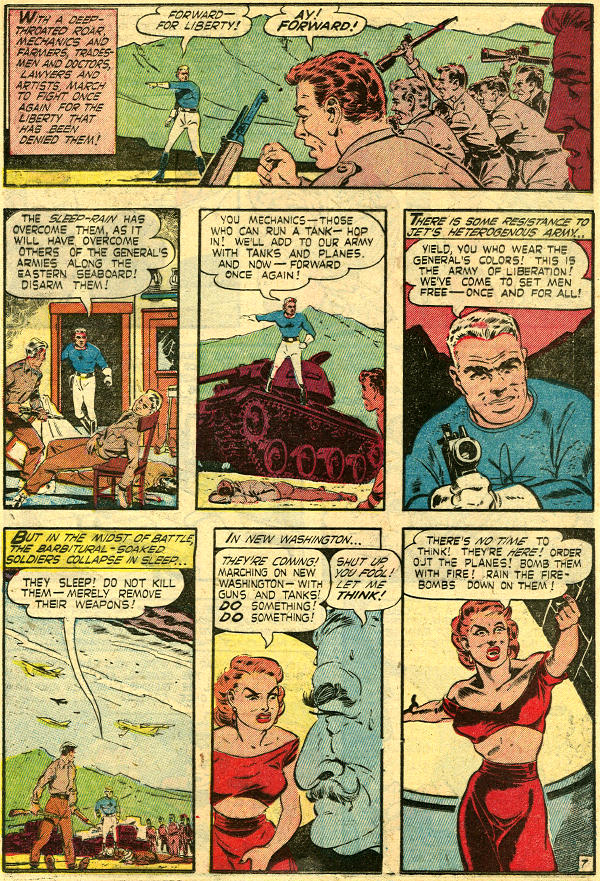
Anarchy! Murder! Looting! Chaos! "The Rain Of Terror," is from Jet #4, ME Comics, 1951, written by Gardner Fox and drawn by Bob Powell. It's a follow-up to "The Dust Doom" in issue #3. I explained in my last entry for Jet Powers about the unique way they had with continuity and continued stories in Jet Comics. You can check out my last couple of postings by clicking on "Jet Powers" in the links at the bottom of this page.

The title refers to an attack by the villains of this post-apocalyptic story, a "former torch-singer," now called The Red Queen, and a general who has been dishonorably discharged from the Army. They crush a rebellion against their subjugation of the population with a rain of napalm--jellied gasoline--one of the worst anti-personnel weapons ever invented. Jet Powers rallies support and attacks the Red Queen and her general buddy with a rain of his own. Jet's rain being more humane, of course.

Su Shan, the sexy Chinese woman Jet met back in #1 (when she was an accomplice to the diabolical Mr. Sinn), is here in a couple of panels, along with Jet's new friend, Jimmy, who survived the dust doom. Su Shan tells Jimmy, "What a man!" referring to Jet, which leads me even further to believe that when he isn't saving the world, he and Su Shan are entertaining each other on that lonely mesa in the desert Southwest where they're shacked up. What can I say? Jet's a virile scientific hunk, and she's a sexy Asian woman in the Dragon Lady class.

Jet #4 is the last issue of the series. In that strange way of Golden Age comics and their re-naming of titles to fool the Post Office, it turned into American Air Forces with #5. Jet Powers had a role as an air ace, minus the science fiction elements. I have one of those stories, from a 1960s reprint book, and I'll present that after I post the whole of Jet #4. Be patient, Jet-fans. In a few weeks you'll have all of the Jet catalogue I own at your fingertips.


More about

Người đăng: vanmai yeu em on Thứ Hai, 9 tháng 7, 2007


Number 158


Tara Is A Wonder


A reader has reminded me that in Pappy's #144 I promised to show stories from Wonder Comics #16, dated February, 1948. This is the lead story, "Tara," an outer space strip in the Fiction House-Planet Comics mold. The art is attributed to Gene Fawcette.

There's an old story about writers in the pulp era of the 1930s, who with a change of setting from Tortuga to Venus, cutlasses to rayguns and pirate ships to rocket ships, could turn a standard pirate tale into science fiction. That's pretty much the case with this Tara story. You don't have to use a lot of imagination to put it back on earth sailing along the bounding main in the 18th Century, especially with the stilted dialogue. Anytime a villain spouts lines like, "Swine! Ye comb the universe and bring back none but these cabbage faces…?" or a hero shouts out, "A quick death with the taste of steel in thy throat for this sacrilege, pirate cur!" you've got something entertaining on a whole other level.

I've included the two-page text story from this issue, because even though it's Tara and her pals, the dialogue is definitely more modern.

Finally, the splash panel is a classic of the type with the huge looming villainous figure, and be sure to check out the cover of Wonder Comics #16, which can found by using the link in the first paragraph.


More about