Hiển thị các bài đăng có nhãn Bernard Baily. Hiển thị tất cả bài đăng

Number 1285: Daring Love of Daring Ditko

Người đăng: vanmai yeu em on Chủ Nhật, 23 tháng 12, 2012

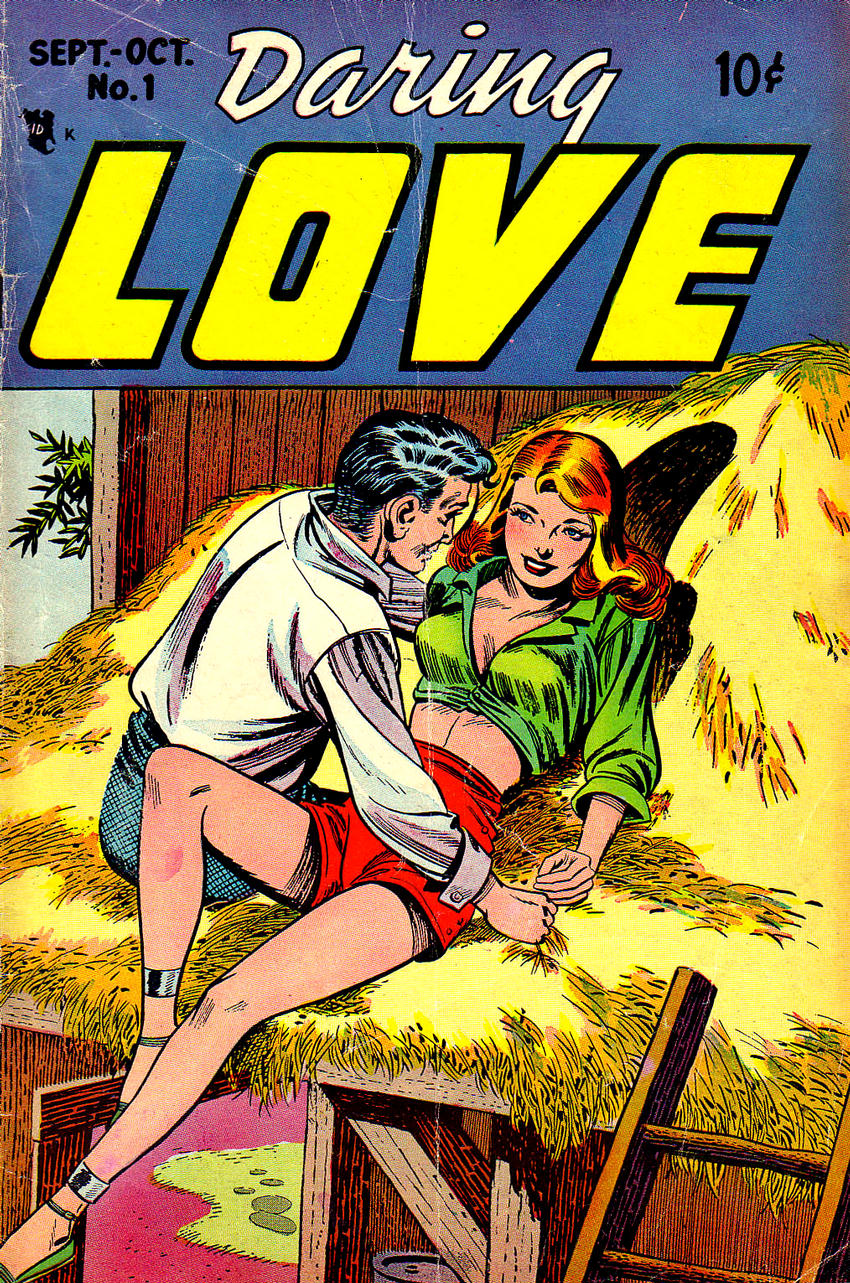
Even if Daring Love #1 (cover dated Sept.-Oct. 1953) was not the obscure (Overstreet says “scarce”) love comic that contained Steve Ditko’s first published story, it might be known for its cover by Bernard Baily, which illustrates the historic Ditko tale.

It’s not the kind of sex we see in our porn-saturated age,but harkens back to a simpler time, when a picture like this and its implications would evoke an immediate reaction. You saw a picture of a couple in a hayloft and you just knew...they were gettin' it ON!

For its time Daring Love was aptly named.


**********

While we’re on the subject of Steve Ditko, Craig Yoe’s book, Ditko Monsters Gorgo will be released on February 12, 2013. I’ve read a pre-release PDF copy of the contents and it was enough to send me into nostalgic nirvana. Gorgo was a comic book I loved and bought when it came out on the comic book rack, but only the issues drawn by Ditko. (Craig has wisely chosen not to include the non-Ditko issues.)


Something I remembered about the artwork was Ditko’s underwater scenes, which I found striking at the time, and still impress me.

From the PDF copy:


I was also particularly impressed with Ditko’s design sense and dramatic staging.


This is a book I highly recommend, and if you’re a Ditko fan you’ll love it. It’s available from the usual booksellers, or you can ask your local comic book store to get it for you.
More about

Người đăng: vanmai yeu em on Thứ Tư, 8 tháng 9, 2010


Number 804


What happens when you die?


Not being a religious person, I don't have any philosophy of what happens after I've quit the planet. No one who has been deceased for any length of time (say, six months or a year) has come back to tell us exactly what's going to happen. So if you're inclined to believe in an afterlife you may slant it to your own needs, your prejudices, your own religious beliefs or your desperate need to believe your life isn't a light bulb that burns out and is discarded, mourned only by the moths that fluttered around it.

That gets us to this afterlife story, drawn by Bernard Baily for Fawcett Comics' This Magazine Is Haunted #1, in 1951. Three things horror comics did well: present stories of people who deserve being killed, the dead coming back as walking corpses seeking revenge, or people dying and going to hell or some variation thereof. In "Stand-in For Death" a man is dead and in hell but doesn't yet know it. That's another tried-and-true formula, but done by Baily it takes on a nice aura of creepiness, and makes me think, after I die what if all those people who for years have told me 'go to hell' get their wish...?


More about

Người đăng: vanmai yeu em on Chủ Nhật, 25 tháng 7, 2010


Number 778


Americommando and the Little One


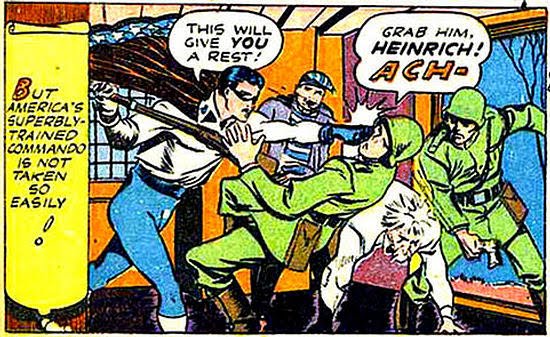
Americommando was a character in his third incarnation: He had been Tex Thomson from Action Comics #1 to #33; he was Mr. America until #54, and then none other than President Roosevelt sent him to commando school and he became Americommando.

Created and drawn by Bernard Baily, an artist working in comics since their earliest days, and also co-creator of Hourman and Spectre. His villain in these consecutive stories from 1943, Action Comics #57 and #58, is a grotesque character, half Japanese and half Prussian...and wow, you couldn't get much more villainous than that combination in those dark days of World War II. (As always, these racist caricatures can be painful to look at with modern sensibilities, and all I can say is they were created in a different time.)

Americommando didn't last out the war, losing his position in Action by #74 in 1944. Baily went on to be an editor, writer, artist and publisher, and eventually ended up back at DC Comics. He died at age 80 in 1996.


More about

Người đăng: vanmai yeu em on Thứ Hai, 3 tháng 5, 2010


Number 730


That's "Baily" without an "e"


Bernard Baily, whose last name is often misspelled as the more common "Bailey," began work in the comics in their earliest years. His claims to fame included the Spectre, which he co-created with writer Jerry Siegel, and the Hourman, which he drew during that era.

These covers of More Fun, scanned from the DC Archives edition of the Golden Age Spectre, are from the first two episodes of that spectral superhero.


Baily went on to do several other features, was a publisher in the 1940s and had an art service that produced issues of horror comics like Mister Mystery and Weird Mysteries, among others. When it came to gruesome and horrible, Baily was up there with the best horror artists in the business. These covers are from that period.


The story I'm showing is from Suspense Detective #5 from 1953, the last issue of a series of mystery/horror comics from Fawcett. In the latter part of Baily's career he went back to DC Comics. I showed one of his unique and distinctive DC stories in Pappy's #495.


More about