Hiển thị các bài đăng có nhãn horror comics. Hiển thị tất cả bài đăng

Người đăng: vanmai yeu em on Thứ Sáu, 26 tháng 10, 2007


Number 209


Hanging around with Dick Ayers


Here's a gruesome little tale, taken from Ghost Rider #10, 1952. Dick Ayers was at the peak of his powers in this story. His storytelling and drawing ability were at their best during the early '50s, in my opinion. It's obvious that Ayers loved the subject material he drew, whether it was western, or horror, or both, like this story.

Ayers drew a guy hitting the end of a rope really well. If you don't like gruesome pictures, then don't look. Showing a hanging was one, amongst many, of the things that got comics in trouble. Twenty years later, in a freelance job for the non-code Eerie Publications, he drew another gruesome hanging scene, this time with popping eyeball.
ME Comics didn't publish horror comics, so Ghost Rider was the closest they got to the horror comics genre. However, "The Hangman," not part of the official Ghost Rider canon, is a good example of a horror comic story. Take away the western setting and it would fit right into an Atlas horror title.


More about

Người đăng: vanmai yeu em on Thứ Ba, 16 tháng 10, 2007


Number 204


The rope-a-dopes


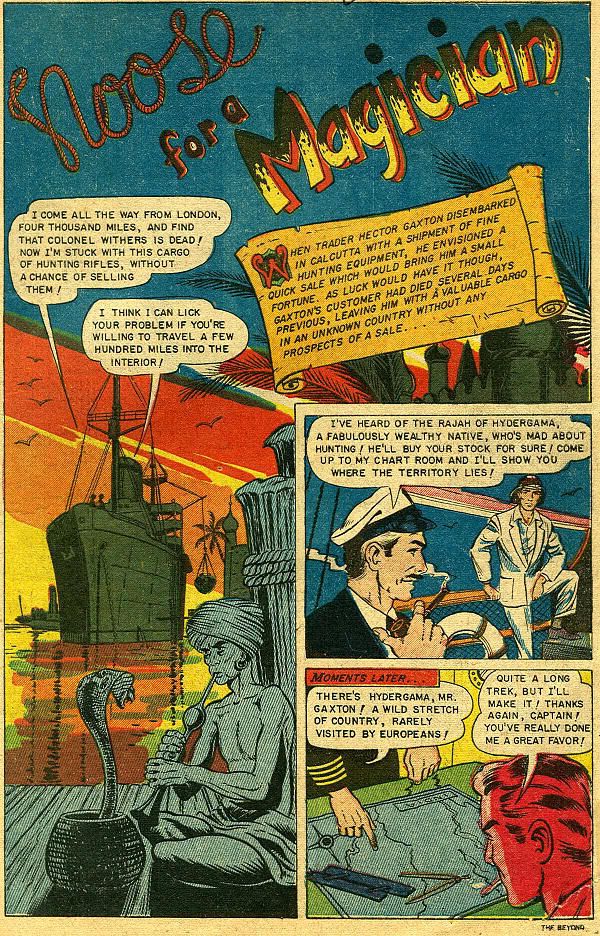
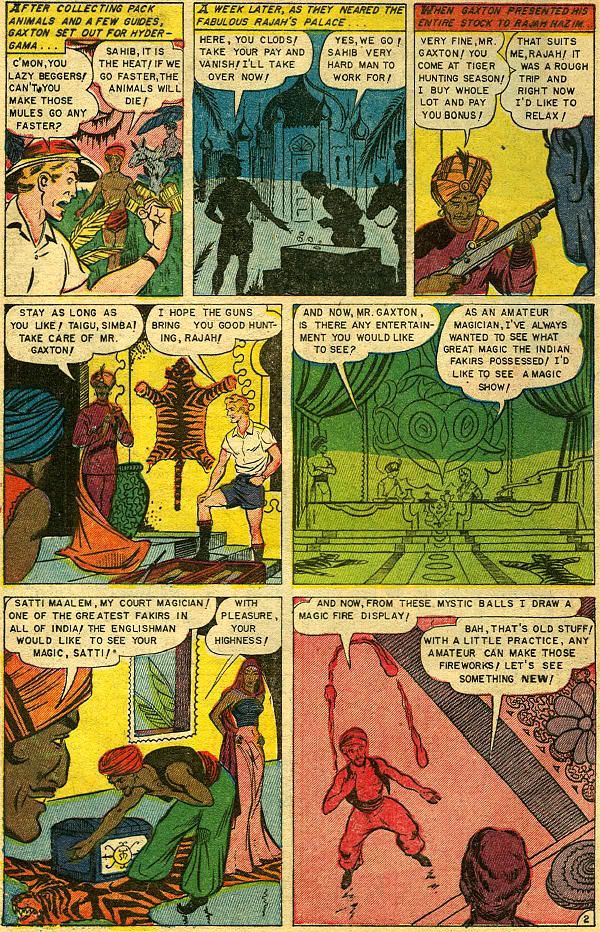
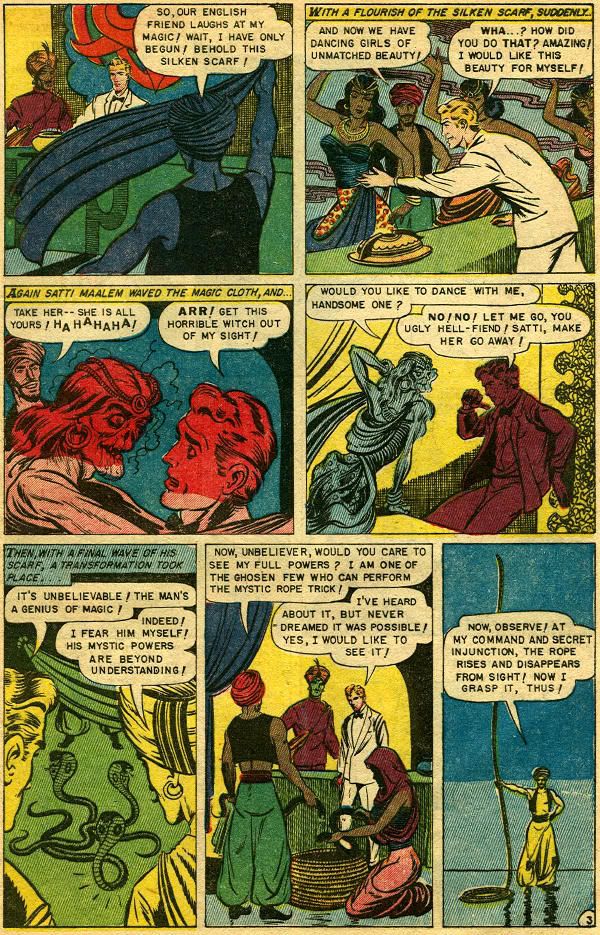
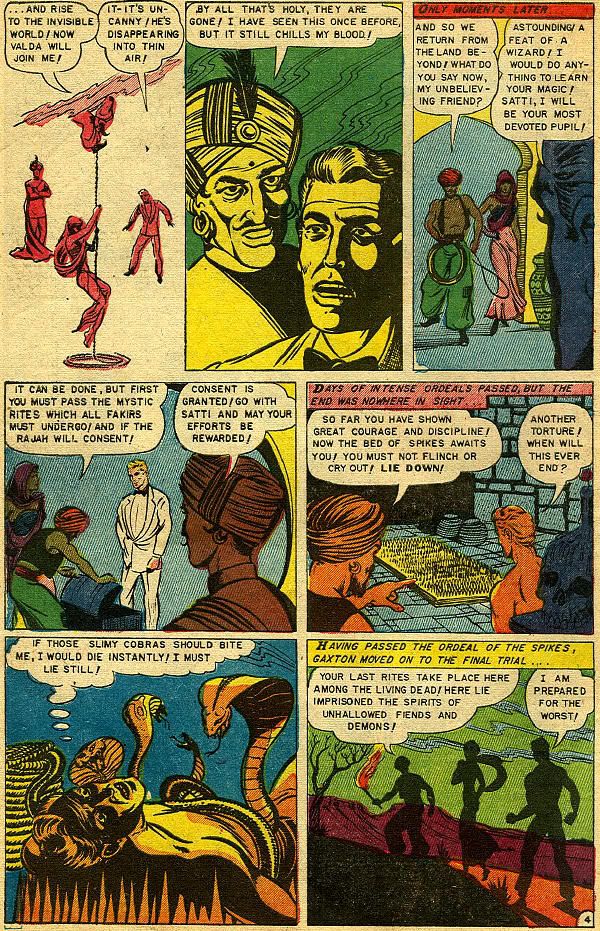
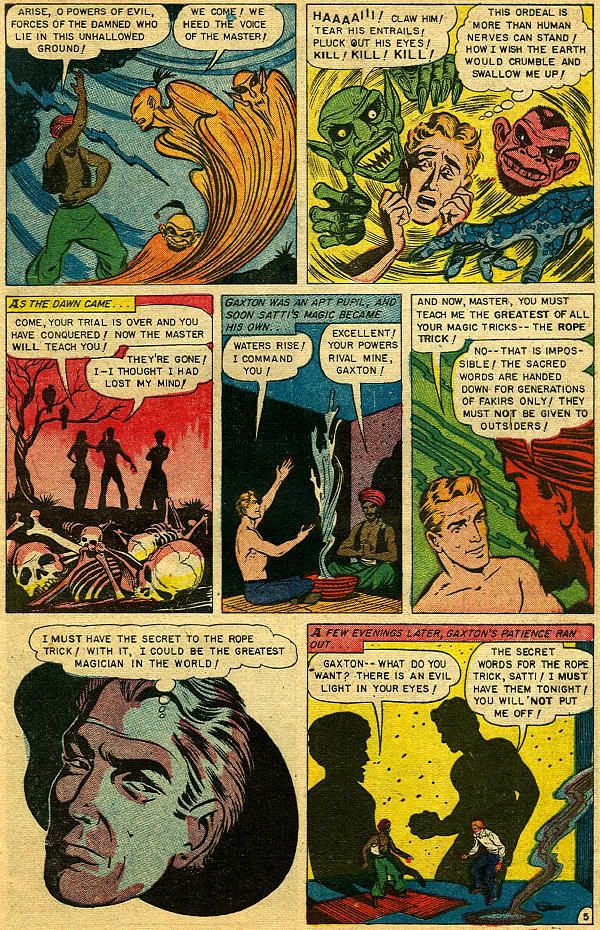
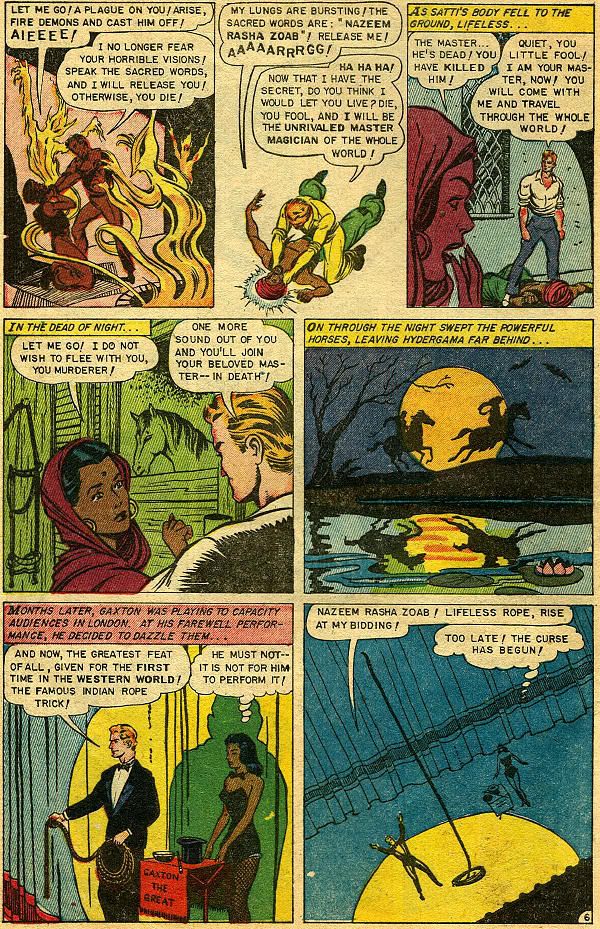
"Noose For A Magician" is from a coverless issue of Beyond. I don't know the issue number.

I also don't know the artist. Except for the fact that the main character follows Pappy's First Law of Horror Comics: "The main character shall be as unpleasant and unredeemable as possible," there's not a whole lot I know about this story! If you want to send me corrections or information that will enable me to go back in and include it for later readers to this blog entry, please contact me. This is why blogging is more handy that printing. Unlike a mistake in print, a blog is fixable.

Our little horror story from Beyond uses the legendary Indian rope trick as its hook. Here's a two-page text story from the Story of Magic issue of Classics Illustrated The World Around Us to tell you about the Indian rope trick. Click on the pictures for full-size images. For those of you not wanting to wade through the text, here's the short course: the Indian rope trick, as it's known in legend, doesn't exist.Something I like about Ace, publisher of Beyond: the coloring. They had an interesting way of laying whole colors over panels. It's very attractive.

Page 1 / Page 2 / Page 3 / Page 4 / Page 5 / Page 6 / Page 7

More about

Người đăng: vanmai yeu em on Thứ Hai, 3 tháng 9, 2007


Number 184

Historic Horror


It's uncommon for a horror comic story to have a background in historical events, but this story, "All The King's Men," from Amazing Ghost Stories #15, has just that.

From what I've been able to research on Henri Christophe, king of Haiti, I wouldn't recommend using this story as the basis of a high school term paper, but it gives the story something exotic. Setting a story in Haiti without it being expressly about voodoo seems almost sacrilegious. Voodoo is practically the exclusive reason for stories set in Haiti. However, the comic is called Amazing Ghost Stories, and this story does have some voodoo, but the historical background using Haiti's only king is what drives the plot.

The Citadelle, shown in the story, actually exists, and is shaped like a ship, just like the character claims and the artwork shows. Unlike the story, in the encyclopedia entries I read, Christophe committed suicide using a silver bullet, not a gold bullet. Maybe he thought he was a werewolf.

The artwork is by the excellent Bob Powell, whose artwork is up to its usual high standards. St. John was the publisher of this comic, which was the continuation of the title Nightmare, and ran for three issues on its own, just before the Comics Code was implemented in 1955.


The cover is by Matt Baker, and has a voodoo theme, although it appears unrelated to this story.

Some publishers, St. John included, appear to have been spooked by the witch hunt against comics, and anticipated the Code by toning down their comics. This story probably would not have appeared in a post-Code title without some changes, but it isn't as gory as it could have been for the time it was published. The main character is a typical horror comics character, though: an irredeemable killer who gets what's coming to him.


More about

Người đăng: vanmai yeu em on Thứ Hai, 20 tháng 8, 2007


Number 178


Sex and Skeletons Part 4


Haunted Thrills, published by Farrell, a publisher which hung around the periphery of comics even after the Comics Code was instituted, had a nice selection of skeletons and skulls on its horror comics covers. Some symbolic, some representational.

I especially like the taxi driver cover on issue #15. I'll bet jouncing over bumpy roads with this guy gave new meaning to bone-rattling. When he jawboned with the passengers, he really jawed.

I've also included a copy of Canadian publisher Superior's Strange Mysteries #15. Not only does it have a big symbolic skull, it's got bony hands reaching for a girl with a Bettie Page hairdo, a red dress, and some of the worst looking and un-sexiest sandals I've ever seen.


More about

Người đăng: vanmai yeu em on Thứ Hai, 6 tháng 8, 2007


Number 171


Sex and Skeletons Part 3: Don't Look Behind You!


Remember when you were a kid and had to get up at night? I remember those nights, having to walk to the bathroom in the dark, with the floor creaking, the wind outside moaning, tree branches tapping the windows. Tap, tap, tap. What was really a walk of a few yards in my safe, suburban house, became a midnight walk past a lonely graveyard.

"There's nothing behind me," I'd tell myself. "Mom and Dad are in the other room. If I need to I can holler for help…" I just knew if I turned my head even the slightest I'd see that I was being closely followed by a monster or a ghost or…choke!…a skeleton!

I'd do what needed doing, then walk as fast as possible back to my room, get into my bed, throw the covers over my head, all without turning so I wouldn't see a grinning rack of bones looming over me.

The folks on these covers should probably not turn their heads either. If you don't turn around, the skeleton will just go away. At least that's what I told myself. But then, I didn't test whether it was true or not by actually turning my head and peeking…


More about

Người đăng: vanmai yeu em on Thứ Hai, 30 tháng 7, 2007


Number 167


Sex and Skeletons Part 2


Dem bones. Dem bones. Dem dry bones. Or how 'bout dem living dry bones! Yow!

Of course we all know that skeletons aren't out walking around; we all know that when the tissue finally decomposes and there's nothing to hold it together, a skeleton is nothing more than a collection of loose bones. We all know that these horror comics covers with their living skeletons are just symbolic. But still, ulp. We'd all have a jolly time if one of these horrors suddenly popped up in front of us, wouldn't we?

These covers have to do with revenge, a major theme for horror comics of the early 1950s. Here's a butcher who regrets meating a couple of bony guys, displeased by the shop's customer service.


Here's another, by artist Hy Fleishman, of a skeleton getting his revenge on a mountain climber. (The climber whose sleeve is being held seems much too passive for someone confronted with such a sight.)


Another couple of covers have to do with revenge from a murdered spouse. In those cases the publishers got themselves into a tricky spot. First of all, the covers have a sub-theme of adultery. So not only did the enemies of comics get to see gruesomely awful covers, but they could take in that the couple being visited by the skeleton were probably having sex and killed the spouse to get him out of the way. Next to those the butcher and mountain climber covers seem relatively tame.


The husband on the cover of Dark Mysteries #4 seems pretty well decomposed for a guy just buried yesterday, doesn't he?


Here's a fella who's being presented to a woman, but not for a formal introduction, we surmise. We don’t know what he's done to deserve this treatment but it's gotta be bad. We don't see her head but we get to see some boobs. Another great Russ Heath horror comics cover. His skeletons look very scary. Considering what's got this poor chump, she must really be something for his mouth to be gaping so wide.


More about

Người đăng: vanmai yeu em on Thứ Sáu, 27 tháng 7, 2007

Number 165


Sex and Skeletons Part 1


Publishers have known since printing was invented that what attracts readers are images of sex and death. Horror comics of the 1950s were continuing a rich tradition. They had a lot of precedents to guide them, and by the middle of the 20th Century several of the comic book publishers had been involved in publishing pulp magazines--no strangers to sex and death--and some were even concurrently involved in publishing paperback books with lurid covers.

The cliché says you can't judge a book by its cover, but in reality you sell one by the cover.

I've picked out some of my favorite horror comics from the '50s, culled from places on the Internet, eBay, etc., even some from my own collection. All of these have something in common: they all show skeletons, since time immemorial the most common symbol of death, and an image that evokes a lot of reactions and curiosity. And speaking of curiosity, young kids looking over the comic covers in the '50s couldn't pass up the opportunity to ogle a sexy babe. Comics used the old damsel-in-distress motif a lot. They used bondage a lot and they used red dresses a lot, too. Not only were the red dresses eye-catching on the newsstand, they were also a symbol of a hot chick. They meant bad girl, a symbol for a prostitute, or at the very least, someone willing to have sex.

The covers also fell into sub-categories, looking for inspiration from other covers. Comic book publishers, or at least the artists, were looking to other artists and covers for inspiration; they swiped both ideas and artwork. Here are two sub-themes I've noticed while looking at my computer file of images. The Bill Everett cover of Atlas' Venus #17, dated December, 1951, appears to have been at least partially inspired by the cover of Chamber Of Chills #21 (actually, the first issue) by Harvey Comics' workhorse Al Avison, cover dated June, 1951.


I've found three covers of skeletons being married to "normal" folks. Adventures Into Darkness #6, is the earliest, from 1952, also the one to show a guy marrying a skeleton girl. In this case I'd say his bride went to some extremes to lose weight so her dress would fit! Journey Into Mystery #6 and Mysterious Adventures #17, both from 1953, reverse that, with a girl marrying a skeleton. These gals picked some real stiffs to drag to the altar! Since Pappy's is a high-class blog we'd never make a joke about these covers reminding us of wedding night boners. We could, but of course we won't.


More about

Người đăng: vanmai yeu em on Thứ Bảy, 16 tháng 6, 2007


Number 147


Stan Lee and Joe Sinnott's Witch In The Woods


When Stan Lee wrote "The Witch In The Woods" in 1953 for Menace #7, comics were under direct assault by parents and teacher groups, from the pulpit and even from investigators in the government. Considering the avalanche of criticism burying the comics industry Lee's satiric story seems tame, not so much a 'repel all boarders' defense as a gentle and funny rejoinder to the critics.

Lee is right that Brothers Grimm stories, gathered as they were from European folktales, are often cruel and nightmarish, especially for children. But comics were available on practically every newsstand, in every drugstore and mom-and-pop store in the country. In the early 1950s I could walk two blocks and find three stores that sold comic books. Almost every kid had access to comics and they sold in the millions every month. On the other hand, unless I went to the library or bookstore I'd have a hard time finding a copy of "Hansel and Gretel." Stories by the Brothers Grimm were considered literature. Comics weren't. Even so, it wasn't the story material that bothered the do-gooders, it was its marketing and availability to children.

"The Witch In The Woods" is a good story, anyway. Lee did a fine job with the familiar tale and its framing device. Joe Sinnott's artwork is, as usual, top-notch. He made his real fame with his inking of Jack Kirby in the 1960's, but he was an above average artist in his own right.

You can find other postings with Joe Sinnott artwork by clicking on his name in the links below.


More about