Hiển thị các bài đăng có nhãn Charles Biro. Hiển thị tất cả bài đăng

Number 1599: “I’m a lumberjack, and I’m not okay...”

Người đăng: vanmai yeu em on Thứ Tư, 2 tháng 7, 2014

There should be a lesson in this crime story from Boy Comics #32 (1947) but I'm darned if I know exactly what it is. Regarding the two college dropouts who ride the rails to a logging camp looking for a meal and end up with jobs, it could be there is danger there, and not just because being a lumberjack is a really dangerous job. It also has to do with not messing with the boss's wife, especially a blonde who dresses in nylons and high heels in a logging camp and longs to see the sights of New York. Or it could be the lesson that some people — like the boss's wife — will stab someone in the back. Literally. Finally, it could be that an executed prisoner should be checked for signs of life before putting him in a coffin.

Crimebuster, the titular hero of the tale, pops up here and there throughout most of it. He doesn’t show up until page 7.

This is a tale of a wrongful conviction, and there is probably a lesson there, also. Police should always take a closer look, and not just the word of the hot blonde and a guy about to run off with her. It is nicely illustrated by Norman Maurer.


More about

Number 1518: Bad example

Người đăng: vanmai yeu em on Chủ Nhật, 2 tháng 2, 2014

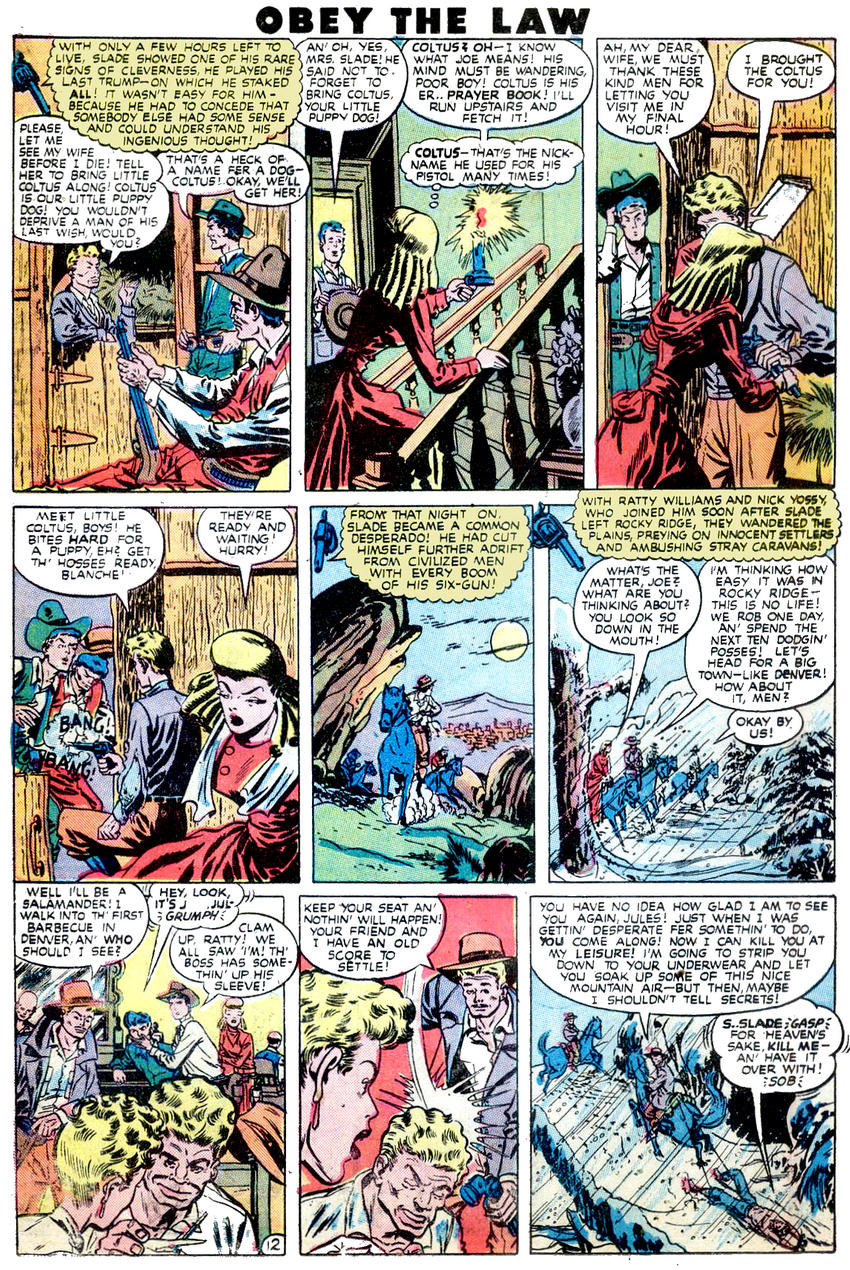
Joe (also called Jack) Slade has either a bad reputation as a Western outlaw, or he wasn’t that bad, depending on who you listen to or what you read. If you google the name you get a couple of versions of the life and career of Slade. The story about Slade I’m showing today is strictly in the bad man camp. But that isn’t the reason I’m showing this story from Desperado #1 (1948). It has to do with the declaration by publisher Lev Gleason, shown here, as to an internal self-censorship code for their line of comic books.

As you can see, there are specific instructions to follow, like number 10, “blood must not be seen flowing from the face or mouth. . .” Then you turn to page 3 of the story and what do you see? Blood flowing from a face. The story is excessively violent; killings pile up, and despite instruction number 2, “sadism or torture . . . will not be accepted,” on the final page a panel shows a half-nude man tied to a tree in a snowstorm, kept alive “in the freezing air” while pleading for death. In the history of comic books and the late forties-early fifties response to calls for censorship or outright banning of crime comics altogether this response from a publisher, with its “much needed form of self-imposed censorship,” may be the most extreme fubar in evidence. Had Dr. Wertham seen this story and the attendant message he may have devoted a chapter of Seduction of the Innocent to the hypocrisy.

Oh yeah...one more thing as long as I’m complaining. I hate the gimmick of the gun telling the story. Anthropomorphizing an inanimate object — another outrage!


More about

Number 1422: Brother Rats

Người đăng: vanmai yeu em on Thứ Hai, 19 tháng 8, 2013

Another sensational crime further sensationalized by Charles Biro and George Tuska, from Crime Does Not Pay #49 (1947). (Thanks to Darkmark for the issue number correction.) The DeAutremont brothers were Oregon lumberjacks who tried to rob a train in 1923, killed three men, and then fled.


It took four years, forensics work and wanted posters to bring the brothers to justice. All of them were caught, all were sentenced to long terms in prison. The panel of the calendar leaves shows 1942, by which time all three brothers were serving their sentences. The sequence that follows, of Hugh DeAutremont as a soldier in the U.S. Army serving in the Philippines and being recognized, actually happened in 1927. It is a reminder that when you see the word “true” in a crime comic, better doublecheck the story. You can read more about the DeAutremonts here.


I posted this story several years ago, but these are new scans:


More about

Number 1388: Tough guy Tuska

Người đăng: vanmai yeu em on Thứ Sáu, 21 tháng 6, 2013

A story about George Tuska has gone around for a long time. (It is also in semi-fictional form in The Dreamer by Will Eisner.) A woman — memory tells me it was Toni Blum — who wrote scripts for the artists in the comic shop bullpen was the subject of talk by the guys. Tuska liked her. Bob Powell apparently said something sexually insulting about her and Tuska got up from his board and punched Powell to the floor. In another report I read, Tuska, who was a big guy — and Powell was not — stood over Powell and said in the voice of Lennie (Lon Chaney Jr in Of Mice and Men), “You shouldn’t ought to have done that, Bob.” True, or exaggerated? I dunno. Good story no matter the truth? Hell, yeah!

Tuska did the artwork on this lead story from Crime Does Not Pay #56 (1947). Cover by Biro.

Tuska, in my opinion, was at the absolute top of his illustrative skills when he did stories for Charlie Biro at Crime Does Not Pay. Biro was a demanding editor who made the artists draw everything, and that was even though the stories were burdened with text, captions and overloaded speech balloons. Still, Tuska managed to get all of the characters and violence into the panels. And speaking of violence, the sensitive among you need to be warned of some of the panels: a knife slices a cheek, a woman is shot.

Violence like that was part of what inflamed adults about crime comics being sold to children. Something a bit more subtle in this story is the message about being a squealer. Guys who tell on criminals meet a bad end. Remember that, kids.


 More classic Tuska: Butt Riley! Click on the picture.


**********
Your eyes will pop!

Another thing to cause concern amongst crime comic critics of the era is this ad from the same issue of Crime Does Not Pay: additional reading material from a third-party publisher. Five books, four of them concerned with crime. I don’t know for sure about the kids in 1947, but I sure would like to read them, and get the “hidden secrets, helpful information, inside ‘dope’.” That could be interpreted as ways to commit crimes. But there is one book, How Detectives Catch Crooks, that would be especially helpful. We still have that today: television programs about crime-busting through forensics, showing police methods, have helped some criminals.

It’s human nature to want to know about “Big-shot Gangsters, their crimes, careers and deaths!” and I’m no different. But I don’t plan to emulate them. I don’t commit crimes because I’m not a criminal, no matter how many books I read or TV shows I watch about crime. I suspect that’s true about most people, or despite all the crime-saturated entertainment the crime rate would be a lot higher than it is.


More about