Hiển thị các bài đăng có nhãn Tales From The Crypt. Hiển thị tất cả bài đăng

Người đăng: vanmai yeu em on Thứ Hai, 19 tháng 7, 2010


Number 775


Gothic Ghastly


Brrrrr. On a hot July day there's a chill running down my spine. It's from looking at the original "Ghastly" Graham Ingels artwork for "A Sucker For A Spider," published in Tales From the Crypt #29, 1952.

Yes, I know this is a formula EC Comics story, where the murderer is ironically dispatched the same way as his victim. But what lifts it above the ordinary plot is the art, which is deep in the gothic tradition of dark shadows, an old house, overgrown vegetation. It adds to the creepiness if you're afraid of spiders.

...and you are afraid of spiders, aren't you...?

I got these scans from Heritage Auctions, Original art shows close up how Ingels did his atmospheric work. Consider the large, scary spiders in several panels. Or page 5, panel 4, with a cinematic shadow cast through a doorway. On the last page white paint is used effectively to render the terrifying image of a man bound up by the web of a giant spider.

It's all just so...Ghastly.


More about

Người đăng: vanmai yeu em on Thứ Sáu, 14 tháng 8, 2009


Number 575


Dr. Judas and the Wannaketa spell for zombie making


I hadn't read this story since I bought Eerie Publications' Tales From the Crypt one-shot* in 1968, and at the time I didn't understand or appreciate its perverse sense of humor. Dr. Judas, for a fee, will resurrect a loved one after death, but there is a problem with the resurrectee...it's a zombie.

In the New Testament Judas was the betrayer, and the one he betrayed was the one who could resurrect the dead. I love Dr. Judas' line at the grave, "Yes, I think the spell of Wannaketa should be used! Wannaketa, the first zombie master!" Who? Wannaketa? That sounds like a story in itself.

"Forever Dead" is truly strange, with a bizarre and funny ending. It was originally done by the Jerry Iger shop, probably for the Ajax/Farrell line, but I don't know what specific title.


*Speaking of resurrections, since titles usually can't be copyrighted, Eerie Publications probably thought they were OK titling a magazine Tales From the Crypt after the presumably defunct EC comic book title of the 1950s. However, someone using an active title could be considered unfair competition. Eerie Publications might have gotten a letter from EC publisher Bill Gaines' lawyers telling them to cease and desist. The title, Tales From the Crypt, licensed from Gaines, was used by Ballantine just four years earlier for one of their EC reprint paperbacks, and it may have been licensed by the time of this title usurpation for the British film that came out a couple of years later. Whatever happened, Eerie Publications' Tales From the Crypt Volume 1, Number 10 (Eerie Publications never numbered their first issues #1) was a one-shot.

More about

Người đăng: vanmai yeu em on Thứ Hai, 11 tháng 5, 2009


Number 521


Go Johnny Go!


I'm partial to the writer-artists in the EC crew: Feldstein, Craig and Kurtzman. There was a real harmonic convergence of talent at EC.

Johnny Craig was one of the slowest EC artists; like Kurtzman a perfectionist, he reworked his drawings until he got them right. It meant he didn't get as much work in, so he increased his income by writing his own material. A few issues before the horror comics were killed by EC he was given the job as editor of Vault of Horror, writing all the stories and drawing the lead.

Here are a couple of my favorite Craig stories. I read them first at age 12, and while I 'got' "Star Light Star Bright" from Vault of Horror #34, "The Tryst" in Shock Suspenstories #11 partially zipped over my head. I went to the dictionary to look up the word "tryst." Sex is the basis for the story. I knew because the young girl--"fresh out of high school," as we read on page one--is sitting on the older guy's lap in her nightgown, asking for a baby. That looked pretty hot to me at such a tender age, even if I was just a bit vague on the whole process. (I grew up sheltered, which is probably why I am the dirty old man I am today.) I understood the jealousy angle, but I didn't have the life experience to put everything, the husband's obsessive possessiveness and controlling behavior, into context.


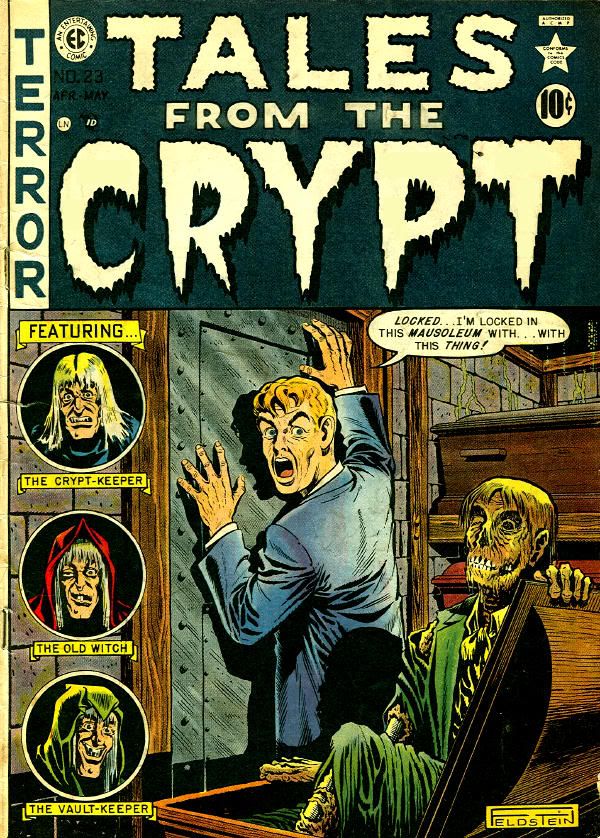
"Star Light" is like "Reflection of Death," my favorite Feldstein story from Tales From the Crypt #23. It's told in a straightforward narrative style, then switches to the main character's point of view, then back to the reader's POV, then finishes with the main character's. There's no sex at all in this story. (Unless you count Hartley Quimb's name, "Quim" being one of those old-time euphemisms for female genitalia.) At one time I read that the casket scene in "Star Light" was inspired by a similar movie scene, but can't find anything about it in my EC reference material. If you know what movie it was please let me know.


More about

Người đăng: vanmai yeu em on Thứ Sáu, 10 tháng 4, 2009


Number 503


My favorite Feldstein


EC Comics led the way for horror comics, and Al Feldstein led the way for EC. I never cared for his science fiction, but for some reason his chunky-funky style of art seemed perfect for horror. Maybe it's because he could draw such ordinary looking folks and such horrific walking corpses. As a writer he was great, taking an idea, writing it directly on the artboards, and having it end up just where it was supposed to. If he stuck to some formulas, well, so be it. Comics weren't considered great literature, and a product had to be turned out consistently.

"Reflection of Death" is my favorite Feldstein horror story. It starts in straight narrative fashion, switches to the main character's point of view, builds to a big shock, back to narrative, then back to the POV. Maybe Feldstein didn't think of it as more than just a routine job, needed to fill eight pages, but seeing it the first time was a revelation for me in the art of comic book storytelling, and gave me an appreciation of Feldstein's stiff figures. Get it? Stiff? Har-har-har.

Because the splash page of my copy of Tales From The Crypt #23, from 1951, has been vandalized by some long ago owner, I've included the black and white splash from the Russ Cochran hardbound EC library. I've also included an ad I tore out of a magazine years ago and placed in that volume.

It shows that someone else also had an appreciation for Feldstein's art.


More about

Người đăng: vanmai yeu em on Thứ Bảy, 14 tháng 10, 2006

Number 38


COVERING IT: Classic Golden Age Comics Covers


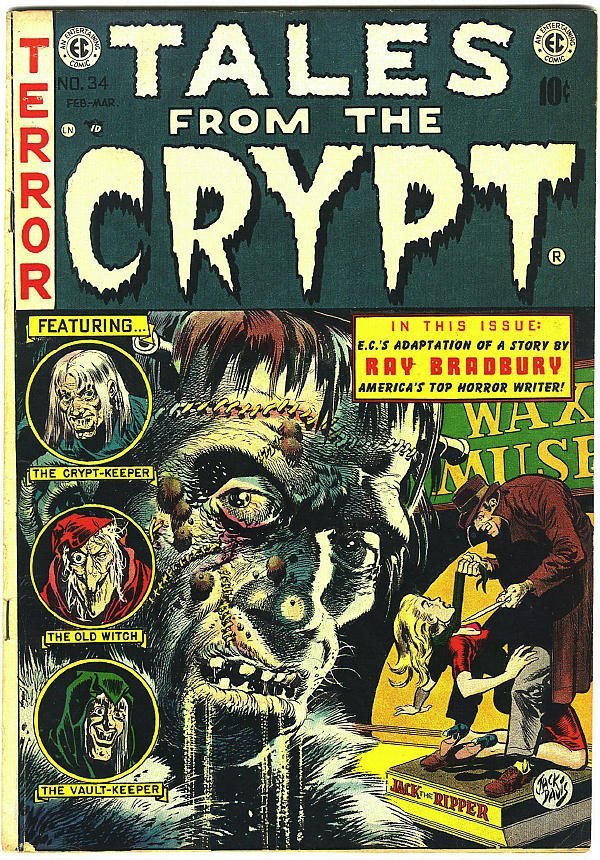
At EC Comics Jack Davis was a great amongst greats. It turned out that he probably had more commercial success after the crash of the original EC line, because he could draw absolutely anything. During the run of EC his distinctive style stands out, even amongst his talented peers, especially on covers of Tales From The Crypt.


Click on pictures for larger images

Davis took over the cover assignments from Al Feldstein, whose art was kind of stiff, but poster-like; perfect for covers. Davis added a touch when he brought his dynamic, action-filled art to the covers and they popped off the newsstands.

During that run as cover artist, Davis did three classic monster covers in a row. Tales From The Crypt #34 features the Frankenstein monster, #35 a werewolf, and #36 is a vampire. So I'm showing them all to you here.

In 1970 super-Golden Age comics fan Tom Fagan told me he thought Davis's cover of #35 was "the greatest werewolf cover ever." I wouldn't dispute that then or now. No matter what the subject matter, humor, horror, you name it…the tall guy from Georgia could draw it.

More about

Người đăng: vanmai yeu em on Thứ Sáu, 11 tháng 8, 2006

Number 9

COVERING IT: Classic Golden Age Comic Book Covers, Part II.

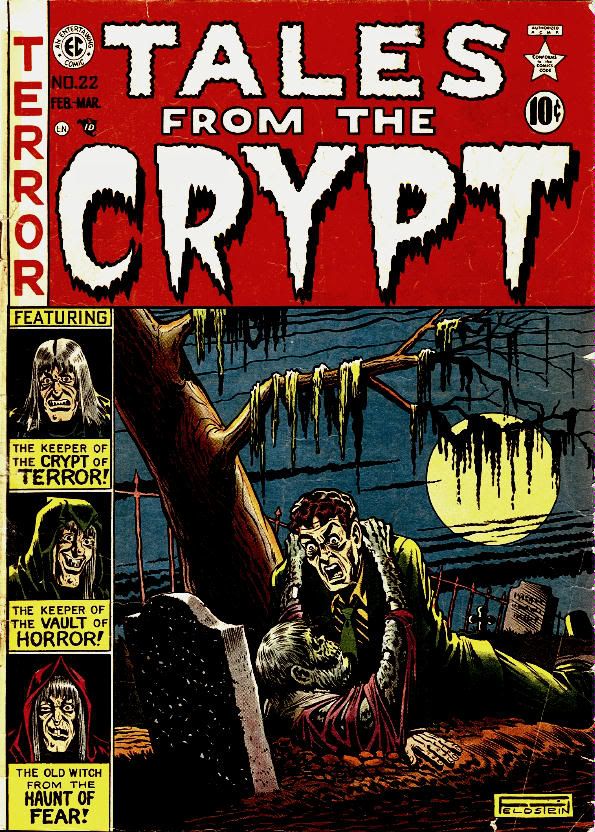
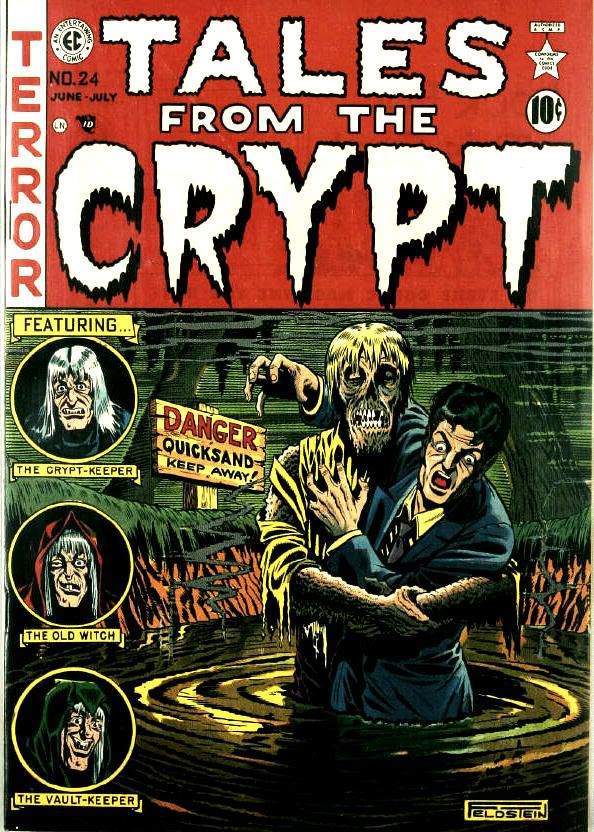
These three classic covers of Tales From The Crypt, all drawn by editor/artist Al Feldstein, form a terrifying triptych of living guys and living dead guys.

These sent shivers through readers encountering these comic books for the first time in the early 1950s. They sent shivers of pleasure through me when I saw them for the first time ten years after their original publication. "These are neat-o," I thought, in my own unoriginal but expressive adolescent way.


Click here for full-size image. (204K)

Two of these covers (#22 and #23) are from my collection, and #24 is taken from the Internet. I was impressed by the lead story in #23, written and drawn by Feldstein, called "Reflection of Death." I first saw it in a Ballantine paperback reprint in 1964. The story embodies (get it? bodies?) those elements which brought EC Comics fame and infamy: graphic images of rotting corpses, lurching around in a grotesque parody of life. Booo-hahaha! I loved it then, I love it now.


Click here for full-size image. (217K)

Of the three covers, #24 seems to be the weakest, and not because of the drawing, which is typical Feldstein, straight to the point. Even though his figures were stiff (and his stiffs were figures!) his sense of design and graphic simplicity, with bold inking, made his covers stand out on the crowded newsstands. No, the reason I think it's the weakest is because when examining the cover, even when factoring in the you're-never-gonna-see-this-in-real-life sight of a corpse hauling a guy into a pool of quicksand, the victim isn't fighting back.


Click here for full-size image. (182K)

I don't know about you, but if some raggedy, stinking, rotting corpse was somehow brought to life and dragging me into a quagmire I'd be fighting back, with whatever means possible! I'd be scratching, kicking, punching and the whole time screaming like a little girl. I sure wouldn't have a neat suit and a tie that's still straight. By the time some zombie got me into the swamp we'd both be the worse for wear. I ain't going down without a fight, not even with a walking dead guy whose muscles have probably decomposed along with most of the rest of him.

Ah, but this is an EC COMIC, you say, and that excuses a lot. In EC Comics the writing was usually good enough, the plots compelling enough, the artwork sensational enough, that the reader would be sucked right into the fantasy. The best horror stories don't have to be probable, just carry their own kind of internal logic. It's kind of a satisfying fantasy, really--vengeance after death, that is--but it's available only in comic book stories like these. So once you get past that you can accept these stories as little cautionary tales, preaching to the readers in their own gruesome way that evil will be answered by evil. An eye-for-an-eye was never truer than in an EC Comic, where justice was done, even from beyond the grave.
More about