Hiển thị các bài đăng có nhãn Alex Schomburg. Hiển thị tất cả bài đăng

Number 1573: Erling and Hanley

Người đăng: vanmai yeu em on Thứ Sáu, 9 tháng 5, 2014

In late March I showed some great comic pages by the late Alan Hanley, scanned from pages published in Alan Light’s The Buyer’s Guide to Comics Fandom in the mid-1970s. Today I’ve got more Hanley in the form of his re-drawings of the origin of Jon Juan, a comic written by Jerry Siegel and drawn by the inimitable Alex Schomburg. I posted the Schomburg version that Hanley used for his drawings, along with another Jon Juan story in 2011. Just click on the thumbnail:


Hanley’s version:


One of my favorite cartoonists appearing in TBG was George Erling, who had a really funny and appealing style. George’s comic strips were filled with surreal characters inspired by cartoonists like Herriman, Holman, Ahern and other screwball cartoonists of a bygone era, yet brought up to date in an underground comix/homage style. These “Clark the Collector” strips are from 1976 and '77. Both Hanley and Erling had the ability to remind one of the past while staying in the present; the best of both worlds.


More about

Người đăng: vanmai yeu em on Thứ Tư, 21 tháng 9, 2011


Number 1021


The World's Greatest Lover


Jon Juan, which came out in 1950 under the Toby Press imprint, was either a one-shot or failed after one issue. Or maybe Alex Schomburg, who did the artwork for Jon Juan, decided drawing pages of comic books wasn't his thing. He'd done some of the most famous and greatest covers of the Golden Age. Here are two of my favorites, one done during World War II, one after.


Jerry Siegel, hyped on the cover as "the originator of Superman," wrote Jon Juan. I'd heard of the comic, but had never seen it until I ran across it in an IW reprint comic from 1958: Dream Of Love, where these two stories appeared and where I got my scans.

Jon Juan is an Atlantean, a great lover, thawed out of the ice he had fallen into when jealous men tried to kill him. He goes throughout history making love. Wow, what a vocation! "He's just a gigolo, and everywhere he goes"...errr, anyway, I give Siegel credit for some very funny writing. I'm sorry Jon Juan wasn't a hit. The idea of a guy going throughout history chasing women appeals to me, and it's obvious Jerry Siegel had a way with the flowery dialogue of a romantic swain. As Jon Juan himself puts it, "Can I help it if their neglected women cast lovelorn glances in my direction? Can I be blamed if my nimble tongue sought out the proper words to solace thwarted femininity?" I couldn't have put it better myself.


More about

Người đăng: vanmai yeu em on Chủ Nhật, 10 tháng 6, 2007

Number 144


COVERING UP: Xela Xes: Wonder Comics by Alex Schomburg


In the war years Alex Schomburg was in demand by comics publishers for his covers. The eye-popping, continually inventive scenes of superheroes clobbering nasty Nazis and Japanese made the books fly off the racks. Several publishers used him. After the war he toned down his approach somewhat; there were still covers of superheroes clobbering gangsters or crooks, but the covers weren't as cluttered with men and machines.

These five covers he did for Nedor in 1947 and 1948 are some of his best. He used airbrush as his medium. I don't know whether that was his idea or the publishers, but whatever, these covers worked. He must've felt his airbrush artwork was different enough to sign a pseudonym, so he became Xela.

Three of the covers shown here have the typical damsel in distress (D-I-D) covers. Those are the ones featuring the character Wonderman. The blonde on the other covers is Tara, a Fiction House-styled babe with boyfriend trailing as she adventured on various planets. It's interesting that when women are the titular (no pun intended) characters, they can be shown kicking butt. Otherwise it's the tried and true D-I-D cover: muscular hero coming to the rescue of voluptuous babe.

And voluptuous they are…I'm not sure who did this sort of thing better, but the girls on these covers are pin-up lovers' dreams. I also like the fact that each of the covers could be a poster, and that there are no cover blurbs or speech balloons to deface the artwork. Schomburg's--Xela's--artwork speaks for itself. No words were needed.


More about

Người đăng: vanmai yeu em on Thứ Năm, 7 tháng 12, 2006


Number 64


COVERING UP: Classic covers of Golden Age Comics: Remember Pearl Harbor


Today is the 65th anniversary of the bombing of Pearl Harbor, the event which propelled Americans into WWII. The nature of the attack was such that it caused an instant reaction in the public. Outrage.

All media, and all popular media, immediately responded. Comic books were no exception.
Here are some examples of comics published right on the heels of Pearl Harbor. The first, Remember Pearl Harbor, drawn by Jack Binder for Street and Smith Publications, is a patriotic cover: Uncle Sam rolls up his shirt sleeves and strides across the Pacific to kick some butt!

Comics, by virtue of their cartoony origins, used their ability to caricature to present the enemy as inhuman, vampire-toothed, claw-fingered. It wasn't enough to just use the common stereotype of the day, buck teeth and thick glasses, to represent the Japanese. To reflect American anger, they had to be demonized.

The next two, Captain America #14, May 1942, drawn by Al Avison, and Young Allies #3, Spring 1942, drawn by Al Gabrielle, fall into the demon enemy category. On the Young Allies cover Gabrielle draws both types of caricatures: the demon, drooling and sharp-toothed, and the buck-toothed, thick glasses stereotype. Timely Comics used this sort of cover with great success and other publishers soon followed suit.
As a bonus, here's the original art to a cover by Alex Schomburg. Of all of the artists who did comic book covers during the war years, Schomburg really stands out for his excellent drawing ability and his ability to draw fantastic scenarios, with American heroes beating up on Axis gangsters in fantasy settings. This particular cover shows Schomburg's signature type of situation. It's also funny that Schomburg used to label in English the science fiction-styled weapons the enemy is shown using. Other artists copied his formula, but there was only one Schomburg.


Click on pictures for full size images.

More about

Người đăng: vanmai yeu em on Thứ Tư, 29 tháng 11, 2006


Number 60


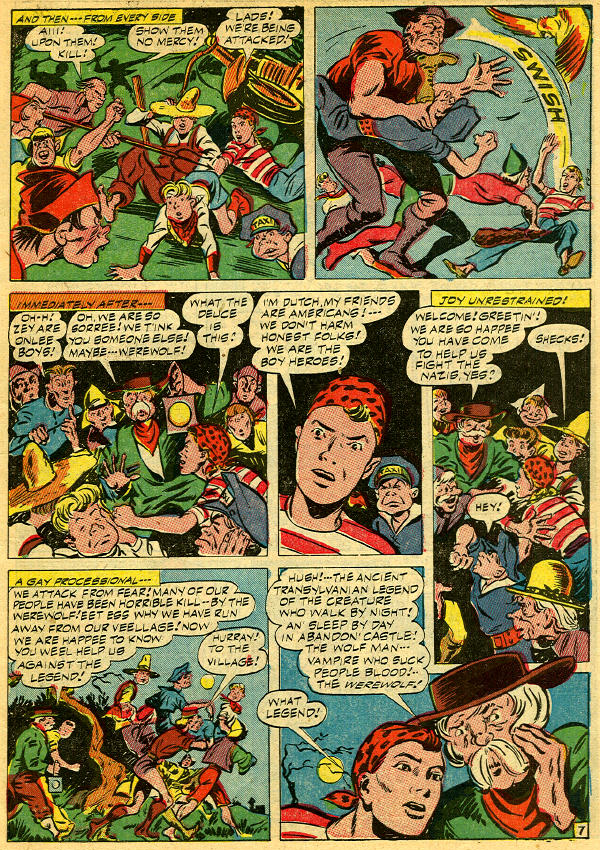
Boy Heroes: Terror In Transylvania


Kid heroes were all the rage in the 1940s, especially during the war years. Simon and Kirby came up with Boy Commandos, Timely had the Young Allies, and Harvey Comics had the Boy Heroes.

I'm sure there were a lot of kids during that period that wished that somehow they could be part of the war, could help defeat the enemy. The comics provided a great fantasy outlet. Some of these kid groups stayed around for a time after the war, but didn't last much into the 1950s. About the only kid group that was published during the 1950s I can think of is Simon and Kirby's Boy's Ranch. That's off the top of my pointy little head. I might be missing someone, and I'm sure one of you will let me know if I am.

The Grand Comics Database guesses the Kirbyesque artwork might be by Louis Cazeneuve, with a question mark.

The cover of All-New Comics #10, September 1944, where this story appeared, is another Alex Schomburg action fest. It didn't matter whose heroes he was drawing, or what company it was for, Schomburg put in a lot of detail and his covers are a true joy to study.


More about