Hiển thị các bài đăng có nhãn Captain America. Hiển thị tất cả bài đăng

Number 1566: Commie Smasher

Người đăng: vanmai yeu em on Chủ Nhật, 27 tháng 4, 2014

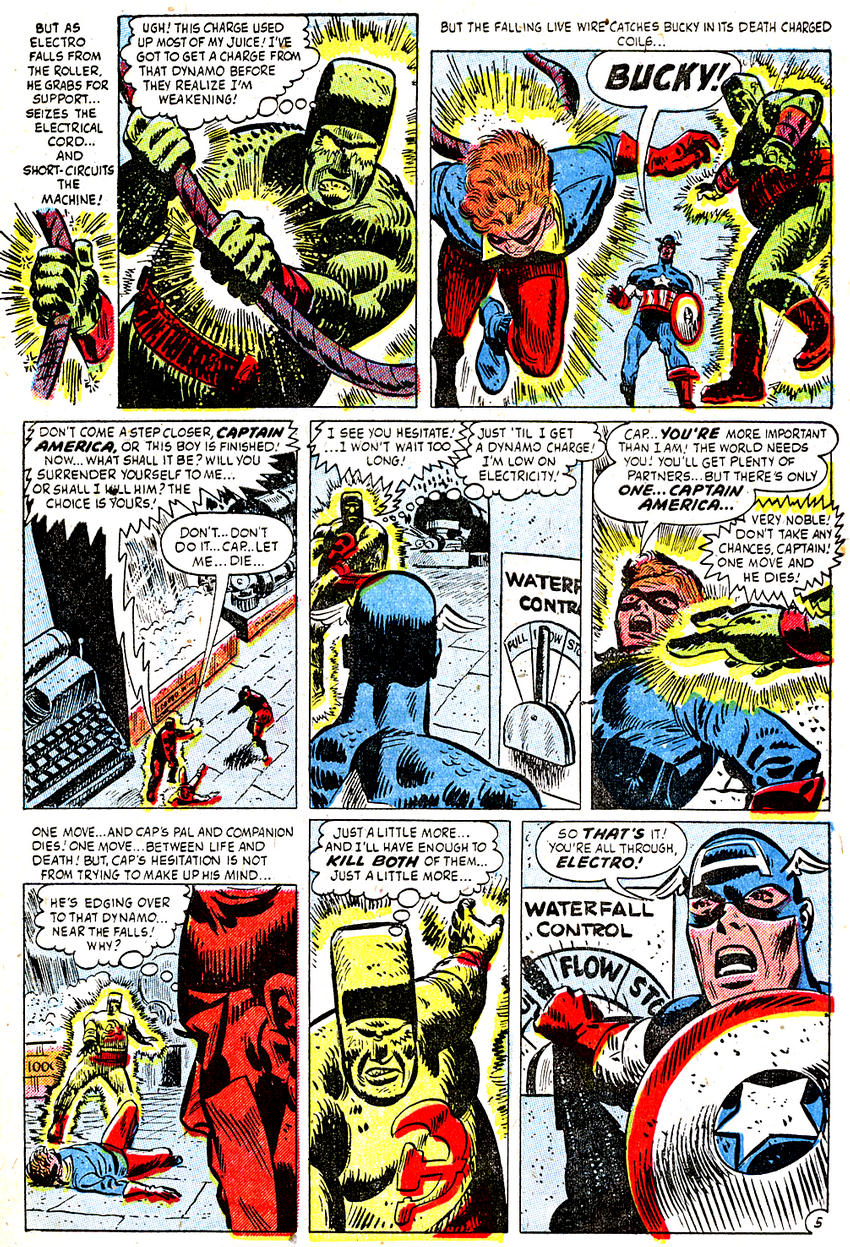
I like the fifties Atlas versions of their triad of superheroes, Captain America, Human Torch and Sub-Mariner. I thought the artwork was very good. John Romita’s work on Captain America stands out for me. He had been drawing comics since 1949, but when he did this issue of Captain America #78 (1954 —  the last issue until the sixties) he was a mature-in-style but young-in-age 24-year-old comic artist with the work he would be most recognized for still a decade and more in the future.

Since Cap was the patriotic hero he needed enemies of America on which to beat, and in the fifties that meant communists. At that time communist activity in the U.S. was mostly done in secret, but in the lead story the communist monster wears his hammer-and-sickle on his chest. Knowing your enemies by what they wear worked in World War II, when a swastika meant there was an enemy due for a butt-kicking. By 1954 the enemy was much more savvy than to wear his affiliation on the outside. Still, this is a comic, and symbols in comics give instant identification between good guys and bad.


More about

Hawkeye Versus Captain America

Người đăng: vanmai yeu em on Thứ Tư, 25 tháng 1, 2012

As I have discussed in the past, heroic characters in the Golden and Silver Age for the most part didn't require a motivation. They fought against crime and injustice simply because they were heroes. This is part of what makes Batman and Spiderman so unique; they did have strong personal motivations. Hawkeye, on the other hand, did have a motivation, but it was an odd one: He wanted the acclaim that comes along with being a hero. Remember, the first we see him is when he's simply a carnival side-show act:
When a carnival ride goes haywire, Iron Man appears to save the passengers, and Hawkeye experiences the green-eyed monster:
So he puts together a uniform and some gadget arrows and goes into the hero business. But things go off the rails almost immediately, as the cops mistake him for the accomplice of a smash and grab artist. While getting away, he is picked up by the Black Widow, who recruits him to the cause of international peace:
Which turned out to mostly involve attacking Tony Stark's industrial plants.

Awhile later, after the apparent death of the Black Widow, Hawkeye decided to try out for the Avengers. He showed his suitability for the team by breaking into their HQ and tying up Jarvis:
But as it happened, the Avengers were in no position to turn down new recruits, as in that same issue, Iron Man, Thor, and Giant Man all decide to take a leave of absence from the team. Quicksilver and the Scarlet Witch, reluctant former members of the gang of Evil Mutants also join up, with Captain America assuming the leadership role. It was this last factor which grated on Hawkeye:
And over the next year or two, Hawkeye frequently bickered with Captain America, questioning both his decisions and his right to command the group. Indeed, it often seemed as though the only reason Steve Rogers kept his position was because Quicksilver also wanted to lead and the Scarlet Witch, with the deciding vote, formed a crush on Cap. Oh, and no particular surprise, Hawkeye didn't have the noblest of reasons for wanting to run the show; he sometimes admitted to himself that he just wanted the glory of being known as the leader of the Avengers.

There was another aspect of the quarrel between Hawkeye and Cap that was interesting. Despite appearing physically the same age, Cap was from a different generation. Hawkeye was brash and arrogant, while Rogers was cautious and a bit stodgy.

At first, I confess that I found their verbal jousting a bit tedious. Stan Lee's arguing characters tended never to resolve their differences. JJJ always hated Spiderman and the feeling was mutual. The Thing constantly bickered with Johnny and Reed.

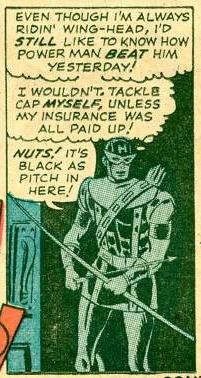
But then a funny thing started to happen. Gradually, over a period of several years, we began to perceive that Hawkeye was starting to appreciate Captain America. Here's a hint of it:
And when Hawkeye failed to stop Powerman and the Swordsman from escaping because he didn't want to risk hurting the Black Widow, we got this scene:
That's characterization done right, because it's positive for both characters. We see Cap's understanding and Hawkeye's guilt at having treated him badly. In the next issue, Cap agrees when Hawkeye asks to tackle the Widow and her henchmen alone.

And while Hawkeye did not give up the occasional jibes about Captain America being Methuselah, you definitely began to get the feeling that it was pro-forma; that there was no real antipathy between the pair.  It was a nice moment of growth and change.
More about

Captain America Comics 70th Anniversary Special #1 (One-Shot)

Người đăng: vanmai yeu em on Thứ Tư, 7 tháng 10, 2009


Captain America Comics 70th Anniversary Special #1 (One-Shot)
CBR | Apr 1, 2009 | 50 Pages | 37.7 MB
Leading off a series of celebratory specials commemorating Marvel’s 70th Anniversary, James (STARMAN, SUPERMAN)
Robinson and Marcos (AMAZING SPIDER-MAN) Martin bring you an untold story of the living legend. In the days before he becomes Captain America, a scrawny kid from Brooklyn named Steve Rogers shows the world that you don’t need a super-soldier serum to be a hero. Plus a classic Captain America tale from the Golden Age by Joe Simon and Jack Kirby. One-Shot/All-New & Reprints. WRITER: JAMES ROBINSON; PENCILS: MARCOS MARTIN; INKS: MARCOS MARTIN; COLORED BY: JAVIER RODRIGUEZ; LETTERED BY: VC; COVER BY: MARCOS MARTIN

Download MIRROR #1

Download MIRROR #2
More about

Captain America. Issue 45

Người đăng: vanmai yeu em on Chủ Nhật, 4 tháng 1, 2009


Captain America. Issue 45
English | CBR | 13 MB

Download HERE

Download HERE
More about

Người đăng: vanmai yeu em


Number 447


"C'mon you yellow Ratzis!"


As a young comics fan in the early 1960s, some of the first World War II-era comics I saw were by Al Avison and Al Gabrielle, carrying on the work of Joe Simon and Jack Kirby on Captain America. Avison and Gabrielle were part of the shop that produced those popular comics, and carried on when S & K left to go to DC. I loved the frantic action, legs flying out of panels, heroes and bad guys alike flying through the air in the endless fistfights that filled the pages. It was heady stuff for a kid raised with the more sedate post-Code comics.

Al Avison worked for many years in the industry. He was a true professional and an artist who worked in several styles, often imitating other artists. He did many covers for Harvey Comics, working in the style of Chester Gould on the Dick Tracy reprints, for instance.

The Grand Comics Database shows that "The Cobra Ring Of Death" was published in Captain America #22 from 1943, and again in The Golden Age Of Marvel Comics, a one-shot published in 1997. It doesn't show this printing, which was in Captain George's Comics World #23-24, a double issue from 1969. George Henderson, a publisher and store owner in Toronto, Canada, had gotten ahold of some black and white photostats from Timely Comics of the 1940s, and published them in his fanzine.

The Grand Comics Database guesses the writer was Stan Lee.


More about

Người đăng: vanmai yeu em on Thứ Sáu, 23 tháng 5, 2008


Number 314


Captain without wings


The movie, Iron Man, is a big hit. We can expect at least one big superhero blockbuster every summer. We have more than usual this year, with a couple more coming up later this season. I have seen Iron Man, but haven't read the comic book since its earliest days when it was drawn by Don Heck. I didn't remember much about the character so I had no expectations or prejudices going in. It was a fun couple of hours.

In the early 1940s when superheroes were new movie studios took notice. Consider this version of Captain America. That character I know. They took the name and the basic costume and changed everything else. Giving the studio complete creative control would've come with the contract that was signed with the publisher. I can imagine how Jack Kirby and Joe Simon reacted when they saw their original creation and concept so screwed over. From Steve Rogers to…Grant Gardner? From a GI buck private living in a tent with a young boy (!!) to a fighting District Attorney with a female helper? No shield? No chain mail? They also dropped the wings from Cap's hood. Oh well, I never understood the wings, so that meant not all of it was bad.

This article is from Jim Warren's Screen Thrills Illustrated #7, February 1964:

*******

There's Money in Comics! There's Money in Stan Lee!

Marshal McLuhan's The Mechanical Bride, sub-titled "Folklore of Industrial Man," came out in 1951, and the edition I have is a reprint from 1967. McLuhan--much studied and quoted in universities, I might add--had several things to say about 1940s comic strips and comic books as part of the folklore of the mid-Twentieth Century.

The one constant between 1951, 1967 and now is the ubiquitous Stan Lee, who was attained near folklore status himself. He popped up in a Hugh Hefner pose, pipe in hand, to proclaim to the readers of Writer's Digest that "There's Money In Comics!" which became the subject of a McLuhan essay in The Mechanical Bride. At the time Lee was busy editing and writing dozens of comics, flooding the market with coat-tailing imitations of popular magazines like Crime Does Not Pay, and anything else that happened to be selling at the moment. He would supplement his income by self-publishing the book, Secrets Behind The Comics, which he sold from his apartment address, and for an article like "There's Money In Comics!" in a magazine aimed at writers.

I read that Lee had gotten a settlement with Marvel Comics , which the article said was worth millions of dollars. There's money in comics, indeed!

When his 1947 article appeared in Writer's Digest, comic book writers didn't get royalties for their work. If they wanted to eat that month they kept the pages flying from their typewriters. Lee was in a better position than most because he was also paid as an editor. He kept his job even when Martin Goodman, who owned the publishing company, ordered Lee to fire the permanent bullpen staff of artists and writers. From then on work done for Atlas Comics was on a piecemeal, freelance basis. I imagine Lee was one of the few who was pulling down a salary.

Flash forward over 60 years and Lee, born in 1922 but keeping the Grim Reaper at bay, appeared in a cameo in Iron Man, in what I perceived in the few seconds it flashed before me, as that Hefner-type again, with women. It was Stan Lee in another of his cameo appearances. I wonder if Lee got paid for this bit or did it because his fans have expectations, and because he wants to remind everyone that he was there when Iron Man was born in the comics back in '62. As far as money goes for a cameo, he probably doesn't need it. He gets money, he gets adoration, he gets adulation. There's more than money in comics…if you're Stan Lee.
More about