Hiển thị các bài đăng có nhãn Ralph Mayo. Hiển thị tất cả bài đăng

Number 1500: New year, same old comics

Người đăng: vanmai yeu em on Thứ Tư, 1 tháng 1, 2014


For those of you joining us on New Year’s morning, how are you feeling? Tongue feel like someone stuffed a towel in your mouth? Head throbbing, joints aching, memory-loss from New Year’s Eve festivities? Well, go take a nap and come back when you feel better.

For the rest of you who did not over-indulge (including me), welcome to the first posting of 2014.

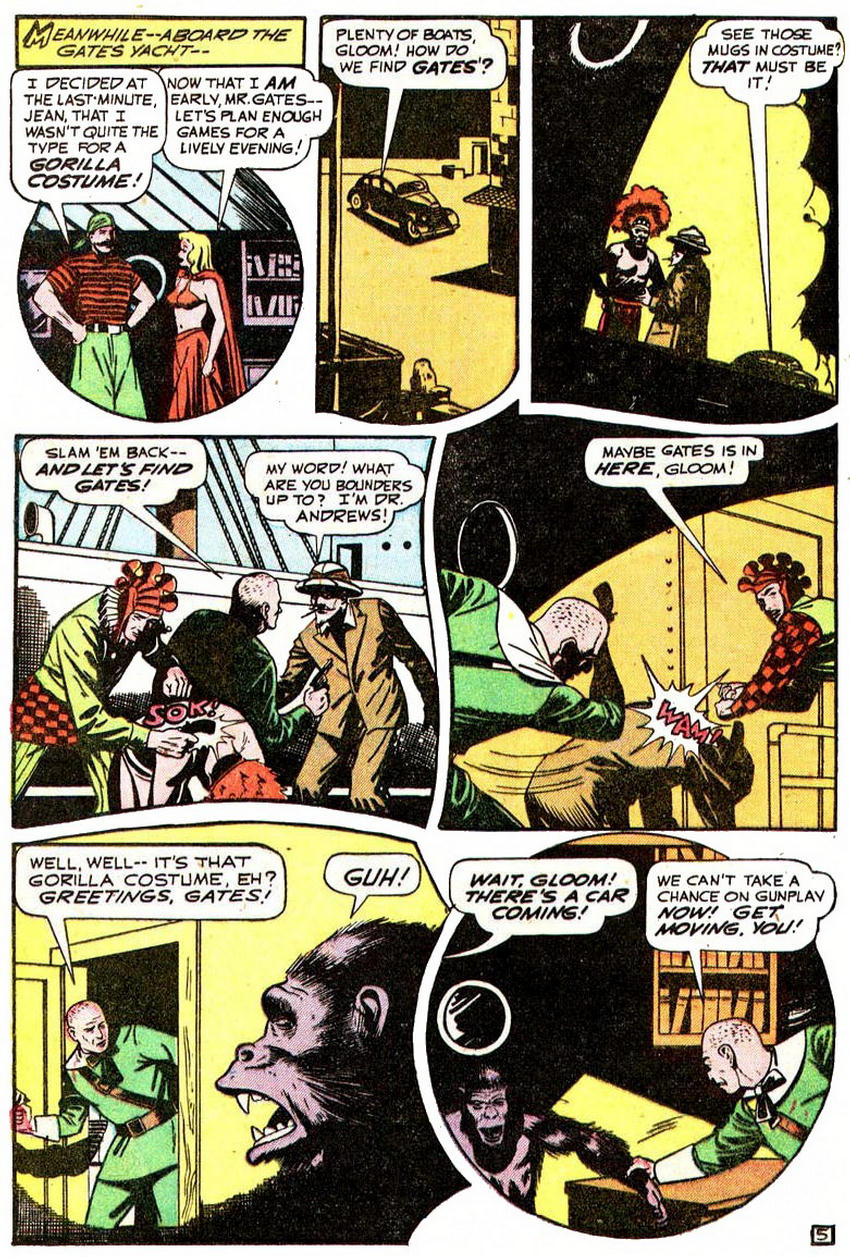
The Black Terror was a 1940’s character who had many artists over the years, and many adventures I consider silly. The Black Terror story I’m posting today, while silly, is one of my favorites. The art is credited by the GCD to Ralph Mayo and it has a gorilla. That’s good enough for me. I consider the panel I have excerpted from the story (above) to be some sort of oddball classic. The story is from Black Terror #20, 1947:


**********

I showed another Black Terror story last May. Click on the thumbnail.


More about

Người đăng: vanmai yeu em on Thứ Tư, 23 tháng 3, 2011


Number 917


Technology wipes out crime!


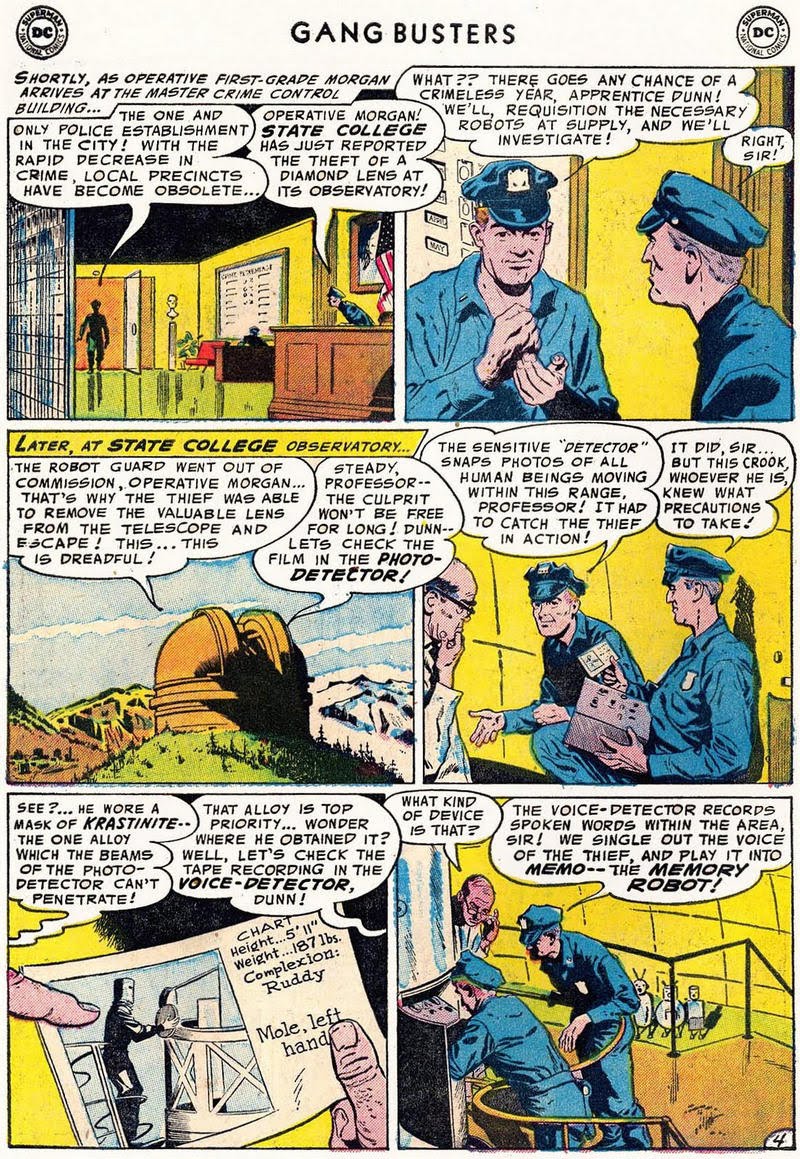
This short strip from Gang Busters #51, 1956, "The Detective of Tomorrow!" is prescient about advances in fighting crime, or even speeding motorists. Using a humanoid robot as a Photocop is cute for 1956, but in the Twenty-First Century the real Photocop is a camera designed to nab you in the act of speeding or going illegally through a red light.

The story, drawn by Ralph Mayo, is extrapolating based on technology known 55 years go, and is way too optimistic that crime will be eradicated by technology. What we have found is that technology can breed its own kind of criminal. We've also found that much technology is going through a period where society has to decide if its intrusiveness goes over the line from a right to privacy to protecting the public welfare. Like, I hate Photocop. If I'm nailed for speeding, let it be the old fashioned way, by a human cop.


An issue later, in Gang Busters #52, a public service announcement itself extrapolates the future. In this case 1976. Allergy sees himself hawking tickets on rocket ship rides. Tourism in space is still quite a ways off, although people like Sir Richard Branson are working on it. There is something special going on in the panel with the girl: a young woman has made a medical breakthrough, rare to show in the days of stay-at-home moms and few working professional women. She's communicating through what looks like a flat panel computer monitor. Now that's prescient. But then we get to the panel with Tom, who might "invent something for those big electronic machines." Uh, yeah, Tom, they're computers. If you want to work on them you should learn what they're called. He's also being congratulated by a Richard Nixon lookalike.

More about

Người đăng: vanmai yeu em on Thứ Sáu, 12 tháng 3, 2010


Number 699


The man who came to stay


Ralph Mayo was a very talented artist who worked for various comic book companies in the 1940s and '50s. According to Al Williamson in the book Hidden Lands, Mayo had lost his apartment when comic book work was hard to get in the 1950s. Williamson took him in to his home, where Mayo slept on a cot. Mayo helped Al by collaborating with him on several jobs for Stan Lee, including Jann of the Jungle. Mayo got on his feet, got a room, and then one day didn't show up at Williamson's studio. Mayo, a young man in his mid-forties, had died in his sleep.

Williamson said Mayo was from the UK, had sailed from England to the States in 1940, and when he put in his papers for citizenship something went amiss. He said to hell with it and just never left the U.S.

Most recently I showed Mayo's work on a Johnny Quick story from DC.

This story, "The Phantom of Marco's Villa," is a short supernatural story from St. John's Authentic Police Cases #5, 1948. You can see Mayo's skill at drawing women, which came in handy for his stint on jungle girl comics like Jann.


More about

Người đăng: vanmai yeu em on Chủ Nhật, 28 tháng 2, 2010


Number 692


Speed freaks!


A popular character like DC's The Flash was ripe for imitation. An early imitator from 1940 was Quicksilver, although the story below doesn't seem to show much in the way of super speed. It was toward the end of Quicksilver's run in National Comics #71, published by Quality. Don Markstein's Toonopedia has some observations on Quicksilver:
. . . There was no explanation of how he got his super power or why he put on a costume and mask to fight crime.

. . . he also didn't have a personal life or even a name other than Quicksilver (unless you count "The Laughing Robin Hood", which is what newspapers sometimes called him), and was never seen out of costume. He lived with his young Chinese servant, Hoo Mee, in a cave, fitted out with living quarters and a chemical lab, in Oakwood Park, which was located in an unnamed urban area.
This particular story was drawn in fine fashion by Dan Zolnerowich.

Johnny Quick was a knockoff of the Flash by DC Comics, themselves. Johnny was the creation of Mort Weisinger. Johnny said a magic formula for his speed. This episode is drawn by comic book journeyman Ralph Mayo. Again, from Toonopedia:
Johnny's real name was Johnny Chambers. An orphan, he'd been raised by a family friend, Professor Ezra Gill, a scientist who dabbled in Egyptology in his old age. In translating an ancient scrap of papyrus, Gill discovered a "speed formula", capable of bestowing blinding speed on its user. He considered himself past the stage of life where such a thing would be useful to him, and so passed it on to Johnny, to be used in the cause of justice.

It wasn't a "formula" in the usual sense, but worked more like a magic word. By saying "3X2(9YZ)4A", Johnny gained the power of super speed — to the point where he could even fly short distances, which may not have made sense aerodynamically but didn't seem to bother comic book readers of the time. Saying "Z25Y(2AB)6" would return him to normal.
The final story is a previously unpublished story of The Flash. They're scanned from the 100-page Super Special, The Flash #214, from 1972.


More about