Hiển thị các bài đăng có nhãn Superboy. Hiển thị tất cả bài đăng

Swiped and Then Swiped Again

Người đăng: vanmai yeu em on Thứ Ba, 8 tháng 7, 2014

Mort Weisinger's enthusiasm for swiping story ideas from earlier issues of Superboy does not seem as high as it was for Adventure Comics, but here's a pretty impressive example of a double swipe.  For starters, here is the cover to Superboy #52 (October 1956):


And Superboy #85 (December 1960):

As you can see, in both cases, Superboy is startled to discover another super-powered boy on an alien planet. He changes into civilian clothes and confronts the lad:


The other boy comes from a startling place:

Clark realizes how the other boy got his powers:

So it looks like Superboy is finally going to have a super-powered buddy.  But as they start off together, something happens:

Superboy eventually realizes that it's his presence that is causing the other superlad to lose his powers, and thus he must leave, resulting in a sad ending:

Weisinger recycled that ending in Superboy #87 (March 1961), in a Krypto story.  Krypto rescues a beautiful female dog:


You've gotta love that he calls her Toots. She doesn't have super-powers, but it turns out that Krypto knows where she can get some:

And so she drinks from the pool and becomes super. Unfortunately:

Krypto soon realizes that he is no longer super when near Kolli, and so we get the same ending as in the two Superboy tales:
More about

A Wink from Clark

Người đăng: vanmai yeu em on Thứ Ba, 1 tháng 7, 2014

Reading through the Silver Age Superboy, I noticed how many stories ended with this:


The winks tend to happen at the end of secret identity stories; I'm sure there are plenty of examples in Superman as well.

This is somewhat akin to the "Ending with Iris" bit in the Flash, and the "Bah!" responses from the Joker; a way of letting us know the story is over.

Update: Kirk House points out in the comments that the practice of ending the story with a wink from Clark may have originated with the Superman cartoons of the early 1940s from the Fleischer studios.  Here's the first one in that series, which does indeed end that way:

More about

Some Lesser Swipes

Người đăng: vanmai yeu em on Thứ Tư, 18 tháng 6, 2014

As I mentioned the other day, I have been working my way through the mid-1950s Superboy issues looking for more swipes by Weisinger and company.  I came across two more, although these were not quite as blatant.  First:


Despite the rather obvious swipe of the cover concept, the stories themselves have only a superficial similarity.  In the Superboy story, Clark was unaware that his teacher had instructed the class to wear Superboy costumes for Superboy day in Smallville, because he had been absent from the classroom when the order was made.  In the Supergirl story, a TV producer had given everybody at Stanhope copies of her uniform (including Linda), but hers was damaged when she used it on a mission in her other identity.  The latter story turns out to be an effort by the TV guy to expose Supergirl's secret identity.  In the former, Clark sweats it out that the reason he was chosen to be dressed in plainclothes was that someone had guessed his secret, but it turns out instead that hidden inside his jacket was a letter signed by everybody in town thanking Superboy.

It's comparable to these two stories with identical titles:

Same concept, different execution. In the first story (from Superboy #50) a gang of crooks have come to Smallville to hide out with their loot, although one of the underlings is worried about the rumors that a young lad has super powers has recently been making things tough for the local criminals.  The boss, as shown, finds the concept of a Superboy to be ridiculous, although he soon learns otherwise.  In the later story, Superboy goes to a nearby old West town where the local hoods haven't heard of him.
More about

You Can't Judge a Book By Looking At the Cover?

Người đăng: vanmai yeu em on Thứ Năm, 1 tháng 12, 2011

I decided to test that old saw by looking at the covers of several books I haven't read in many years and don't remember the story. Of course, I do have an advantage in that I know Weisinger's tricks.
Looking at the cover: My guess here is that Superman XXX didn't really commit those crimes; they were misinterpretations of actual events that were harmless.

Inside the book: Close. Superman did not commit those crimes. The other man on the cover is a descendant of Luthor, who oddly enough runs a Superman museum in the future. While he's not evil like his ancestor, he's upset at the Lad of Steel for helping out a competitor and thus is showing him an illusion created with that helmet he's wearing.
Looking at the cover: I'd guess it's some sort of trick to fool the aliens.

Inside the book: Nope, it's an effect of Red Kryptonite.
Looking at the cover: Must be Red K again.

Inside the book: Dingdingding, although Weisinger did throw a curve at me. It's an imaginary tale about what might have happened if Superboy had been exposed to Red Kryptonite on the day he announced his presence to the world.
Looking at the cover: It's clearly some sort of fakeout. We know that nobody could invent anything that would harm Superboy other than Green K. I'm going to guess in this instance that it's a plan to fool some crook.

Inside the book: Bzzt! It's the adult Luthor, who has brought back Superman's Fortress of Solitude in time to Superboy's era, complete with weapons from Kandor that can harm Kal-El.

BTW, note the bit about the Agony and the Ecstasy.  It's clearly intended as a reference to a 1965 movie of the same title.
Looking at the cover: Mort gives this one away. Since Superboy and Clark are one and the same person, they must have been split somehow, and Red Kryptonite seems the logical culprit.

Inside the book: Dingdingding, but with still another curve. In the story, Superboy is turned into a monkey by Red K, and later grows enormously in size. Beppo, the super-monkey is affected by the same Red K, and turns into a human. While human-sized (he later grows giant, just as Superboy had) the scene on the cover happens.

Overall I was 3 for 5.
More about

Superboy #11

Người đăng: vanmai yeu em on Thứ Ba, 22 tháng 11, 2011

Superboy #11
2011 | English | 23 pages | CBR | 11.6MB
In SUPERBOY #11, Jeff Lemire and Pier Gallo bring the saga of "The Hollow Men" to its explosive conclusion! Superboy, Lori, Simon and Psionic Lad must fight for the very soul of Smallville hundreds of miles beneath the town's surface!
Download MIRROR #1

Download MIRROR #2
More about

Người đăng: vanmai yeu em on Chủ Nhật, 23 tháng 10, 2011


Number 1039


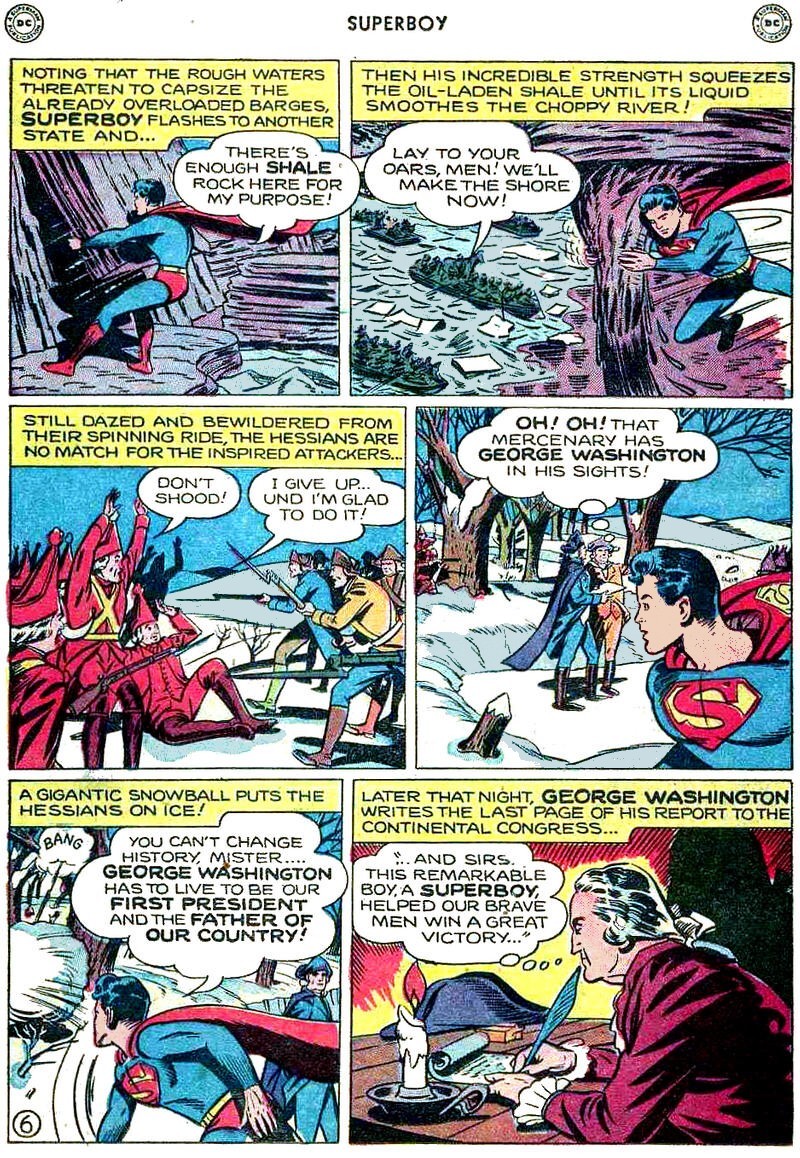
Fredric Wertham, George Washington and the Boy of Steel


I'm showing this Superboy story because it was mentioned in the infamous Seduction of the Innocent by Fredric Wertham, M.D. When you've read the story I have a couple of pages from SOTI scanned with pertinent paragraphs highlighted. Then I have my own opinion of what Wertham said.

I continue to be fascinated by Wertham. He'd be an interesting person to study even if he hadn't gotten into the business of condemning comic books. Click on the Fredric Wertham link in the box below for more of what I've had to say about Dr. W.

"George Washington's Drum" is drawn by John Sikela and Ed Dobrotka, and is from Superboy #2, 1949:


***********

What did Fredric Wertham have against Superboy?

It's safe to say that Dr. Fredric Wertham, author of Seduction of the Innocent, never met a comic book he didn't hate. He found fault with Superman, who reminded him (a German emigré) of the Nazi superman. Wonder Woman was frightening to boys, Batman and Robin were a homosexual wish dream. The list goes on. Wertham slandered them all.

He also had ways of exciting emotions of his core audience, parents, teachers, even government officials, in his battle against comic books. In the two pages I've scanned from SOTI he used the universal propagandist's tool, turning his enemies' own words against them. He quoted an article from the Child Study Association of America, and quickly established it was written by a writer who worked for the publisher of Superman.* He ridiculed the writer's choice of comic books as being unrepresentative of comic books sold to kids. He gave the writer's words to number 10, Jungle Comics, a twist. As quoted by the article writer, "sometimes women are featured in these stories as captives or intended victims." At the bottom of his paragraph scoffing at this writer's claims he inserted this zinger, ". . .and she tries to make parents believe that the sexy wenches in the jungle books are just "fair maidens"!) The article writer didn't say anything about sexy wenches or fair maidens. Those are Wertham's words, poisoning the well with a negative buzzword ("wenches") and sarcasm ("fair maidens").

Wertham went into the argument against comics with his guns firing, and had the comic book publishers ducking for cover. The industry as a whole knew there were a lot of things in comic books that kids probably shouldn't see.** But kids also went to movies, listened to the radio, and presumably read other material that may have things they shouldn't hear or see. What kid hasn't? (By the way, it's called growing up.) By zeroing in on comics Wertham kept the hatred focused, even if he went askew at times with his arguments. To him the Superboy story focused on a "uniformed superman-youth" rather than "the father of American democracy [George Washington]." But of course it did. It's not a history lesson. It is entertainment, a fantasy like other fantasies of time travel. It used historical characters and events for its own purposes, which is what fiction does. This was his answer to the article writer's claim that "History is often a dull subject. . . .Through comics it could be made a fascinating study." He used the Superboy story as an example of kids getting the wrong historical information from comics. I think the kids who were old enough to read the story had heard of George Washington*** and knew that Superboy going back in time was just fantasy, an extension of the whole concept of a Superboy.

Wertham caps off this paragraph by throwing something in that blindsides the reader: "Similarly, it must be admitted that a lesson about anthropoid apes is less 'dull' when accompanied by a picture of the animal about to rape a girl." Where were we talking about apes raping girls? What does that have to do with George Washington or Superboy or American history? Well, nothing, but in Wertham's mind they must have had equal value: Superboy helping George Washington=ape raping girl. He threw everything into his argument: ridicule, slander, misquotes, non sequiturs and conclusions coming from...where? Of course, he was a prominent psychiatrist, a social reformer, the de facto leader of the anti-comics movement, and if he threw things into his argument that didn't make sense to you, well, maybe you just read too many damn comic books!

*The writer he refers to is presumably Josette Frank, a consultant on children's literature to the Child Study Association of America, as listed in comics published by DC.

**Some self-righteous publishers would say it was the "irresponsible publishers" who put out the disreputable comics. That usually meant EC and its imitators.

***Kids my age during the 1950s and '60s had access to wonderful books like the Landmark series of history books for young readers, when we could tear ourselves away from our historically inaccurate comic books, that is:

More about

Smallville's Crooked Contractors

Người đăng: vanmai yeu em on Chủ Nhật, 3 tháng 7, 2011

Did you ever notice that Smallville had the shoddiest construction projects imaginable?

From diving boards:

To dams:

To walls:

To the bleachers at Smallville High:

It often seemed like Smallville contractors intentionally built their projects as cheaply as possible, perhaps in the knowledge that Superboy would bail them out of any structural failures. Indeed, one wonders if his move to Metropolis resulted in dozens of deaths due to building collapses.

And don't even get me started about the enclosures at the Smallville Zoo:


Incidentally, that second panel comes from one of those stories where the Kents adopt a second boy with super powers.
More about