Người đăng:
vanmai yeu em on Thứ Hai, 22 tháng 10, 2012
“Katy Keene in ‘A Breezy Day’” is a breezy story. It exists for the purpose of cheesecake, showing Katy's legs and stocking tops. I will go on record as saying there is nothing wrong with that.
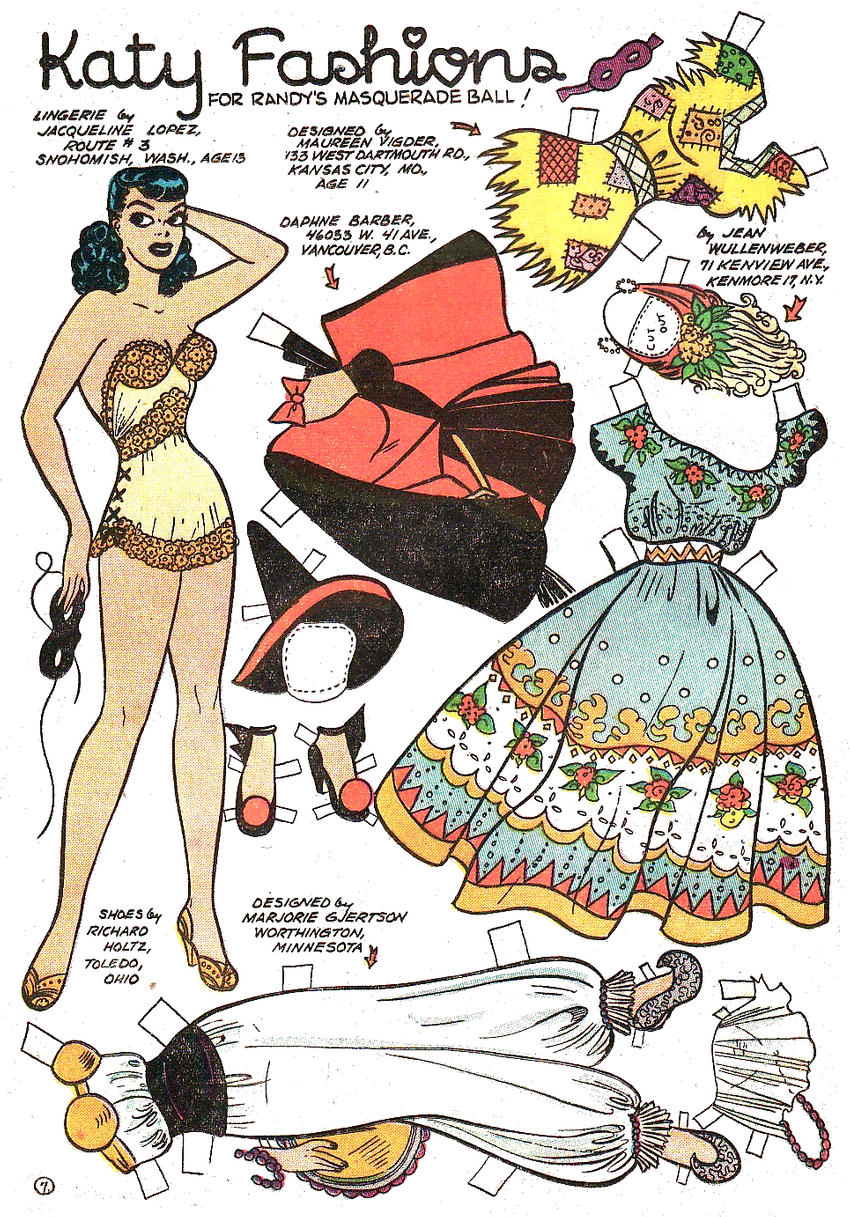
Bill Woggon created Katy Keene in 1945, and the strip was popular for nearly 20 years, spawning a whole industry of Katy Keene comics and paper dolls,. Budding fashion designers sent their designs to Woggon, hoping to see their creations on Katy,* and their names in print. Woggon got free material for his comics. It was a great idea.
From Wilbur #12, 1947:
*The name mentioned here for the designer of Katy's dress, “Ward Montgomery of Chicago,” is a joke on the Montgomery Ward department store chain. Like Sears and Roebuck, Montgomery Ward also used catalog ordering services for rural customers. It went out of business in 2001. In 2004 an online retailer bought the trademarks.
Người đăng:
vanmai yeu em on Thứ Tư, 5 tháng 9, 2012
Katy Keene had a relatively long run in comics, 1949 to 1961, produced by her creator, Bill Woggon. She was revived by others in 1983 and was published until 1990 by the same folks at Archie. On the other hand, Kitty, drawn by a favorite of mine, Lily Renée, was a one-shot from 1948.
Paper dolls were popular, and I've seen comic books where someone cut them out, thereby damaging the book beyond repair. But I think to do it they'd need sharp eyes and a sharper pair of scissors to follow the outlines of the tiny images published in comic books. If you want to use my scans to print your own go ahead.
Kitty was drawn in 1948 by Lily Renée for St. John with a cleaner, less complicated style than that required by Fiction House, where she drew Werewolf Hunter, Señorita Rio* and the Lost World features. I'd think Kitty would be a natural character for Renée, who wasn't far out of her teens (born 1925). Although born in Austria and a war refugee who became an emigrant to the U.S., she captured the American bobby soxer very well. She claimed she dressed Rio in clothes she wanted to wear, so a paper doll fashion comic book seems a natural.
In 1953 St. John changed Kitty's name to Lucy, and reprinted the story (whiting out Renée's signature) in Lucy the Real Gone Gal #1.
Bill Woggon got a lot of mileage out of simple storylines about supermodel Katy, her tomboy little sister and several boyfriends. He also helped future fashion designers by providing an outlet for them. They supplied the creations, Woggon drew them up and published them in his comics. Woggon, born in 1911, died in 2003.
I picked this story to show because Katy wears a leopard costume. There is just something about a girl in a cat suit...
From Katy Keene #2 (1950):
From Kitty #1 (only issue, 1948):
*I've posted several stories by Renée, but the latest was this one where I told a little of her story: Pappy's #1175.
Người đăng:
vanmai yeu em on Thứ Năm, 3 tháng 3, 2011
Much of what seems bizarre to modern (i.e., younger) comics fans is actually quite explicable to those who understand the kid culture of the 1960s.
The lovable but scary monster is a classic example. What were Casper, the Friendly Ghost, or the Addams Family, or the Munsters? Kids sympathized with Frankenstein as the villagers torched him alive in that old windmill. There was also the Beany and Cecil cartoon series about a boy and his friend the giant sea serpent, or Bizarro, the Superman supporting character I blogged about recently. Of course, it is not entirely as if this archetype has disappeared; the Iron Giant is a more recent example of the phenomenon.
There are good reasons why such characters are popular with youngsters. First, because kids are often the only ones who see the monsters the way they really are. The Casper theme song makes this explicit:
"Though grown-ups might look at him with fright, the children all love him so..."
And indeed, Millie is pretty much played the same way: In addition, a well-intentioned but misunderstood character probably fits the way a lot of kids feel about themselves. They want desperately to be helpful but adults reject their assistance. (Often for good reason, as a kid's idea of help can turn out to be far more trouble than it's worth.)
Most of the adults quickly realize, however, that Millie really is a friendly monster. When the cops go to arrest her, they find her escorting an old lady across the street. But there must be a villain in the piece, and it turns out to be Mr Gotrocks, the town banker: But when Millie pokes her head in the window, even Mr Gotrocks is won over. BTW, I am not sure where the name Gotrocks (usually spelled Gottrox) became a synonym for "very rich", but it's been around for quite a while. Here's a 1915 movie that features a character named "Patrick Gottrox - the Pickle King," which fits:
Gottrox decides to let Millie live in the old haunted house he owns, which nobody else will inhabit. Although he's wealthy, he's not anti-union: But the union men won't work on the house because they're afraid of the ghosts. So the banker decides to have Millie haunt the haunts. She quickly cleans out the nasty ghosts and makes friends with Goodie, the (tickled) pink ghost. Goodie promises the union members professional courtesy: The third segment is called "Millie Does the Twist." The Twist, of course, was a dance craze in the early 1960s:
That song is the only one to hit #1 twice; it reached the top in 1960 and in 1962. Chubby Checker later tried to get folks to do "The Fly", but they remained grounded:
At any rate, Millie's twisting causes havoc in the city: And the city responds by banning the dance.
Later still, Millie goes to Hollywood where she becomes a star. Jealous, other monsters invade Hollywood, but Millie shows that while remaining lovable, she can still pack a punch:
The producers are ecstatic and the writers are working overtime on scripts for Millie. But she develops a bit of an artistic temperament: So they rewrite the script to be Millie's life story as we've seen it in this comic, and Midway prospers. The End.
Comments: Obviously this is a very basic comic, intended for small readers. The art (by Bill Woggon) is appropriately cutesy. I did like some of the little touches, like the way he gave Millie a beret when she goes to Hollywood. There is a minimum of conflict in the story, which again may be appropriate for the age level this was aimed at.
Người đăng:
vanmai yeu em on Thứ Hai, 26 tháng 4, 2010
Number 726
Happy Birthday, Katy Keene and Mrs. Pappy
I've mentioned before in this blog that Mrs. Pappy does not like comic books, nor does she read them. Still, she remembers Katy Keene from her youth, and because Katy Keene is having a birthday, I thought I'd let them share the celebration.
Katy has her birthday in Suzie Comics #60, from 1947. Mrs. Pappy was born on this day in 19........errrrrrr, on second thought, maybe I'd be better off not saying.
Người đăng:
vanmai yeu em on Thứ Hai, 8 tháng 12, 2008
Number 429
That keen Katy Keene
Mrs. Pappy, despite living for nearly 40 years with me, a man who hoards moldering piles of old paper in the form of comic books, professes to have never read a comic book in her life. That's only right. That's providing balance in nature. I read 'em, she ignores 'em. However, when she glanced over to see me scanning these Katy Keene stories she said, "Oh wow! Déjà vu!" Apparently her life hadn't been entirely free of comic books. She goggled at the pin-ups, then went back to her What Not To Wear TV show, back to ignoring what I was doing.
Katy had a strong appeal for young girls, but also attracted a readership of some (wink-wink, nudge-nudge) boys. These stories are from Wilbur #36, from 1951, and Katy Keene #62, 1961. You can see the difference in the inking styles over the 10-year span, but the story styles remain the same. Real simple stuff with pictures of fashions. Writer-artist Bill Woggon made a living off this for years.
In the 1980s there was a brief revival of Katy. I still didn't see the appeal--well, I am struck by the leg show panel above with the high heels--but I'm not the reader they were going after. What helped make Katy Keene a success was that the feature invited reader participation. Looking for your fashions and your name in a Katy Keene story was strong incentive for a reader to keep coming back. I think it also helped that for its (mostly) pre-pubescent fan base of young girls, considering the stories were full of girls and guys dressed up in the latest styles, it was also sexless. Katy's boyfriends seem like manikins; safe for those young readers. I assume a lot of Katy's fans were more like the homely little sister, who aspired to be like Katy.