Hiển thị các bài đăng có nhãn Lev Gleason. Hiển thị tất cả bài đăng

Number 1518: Bad example

Người đăng: vanmai yeu em on Chủ Nhật, 2 tháng 2, 2014

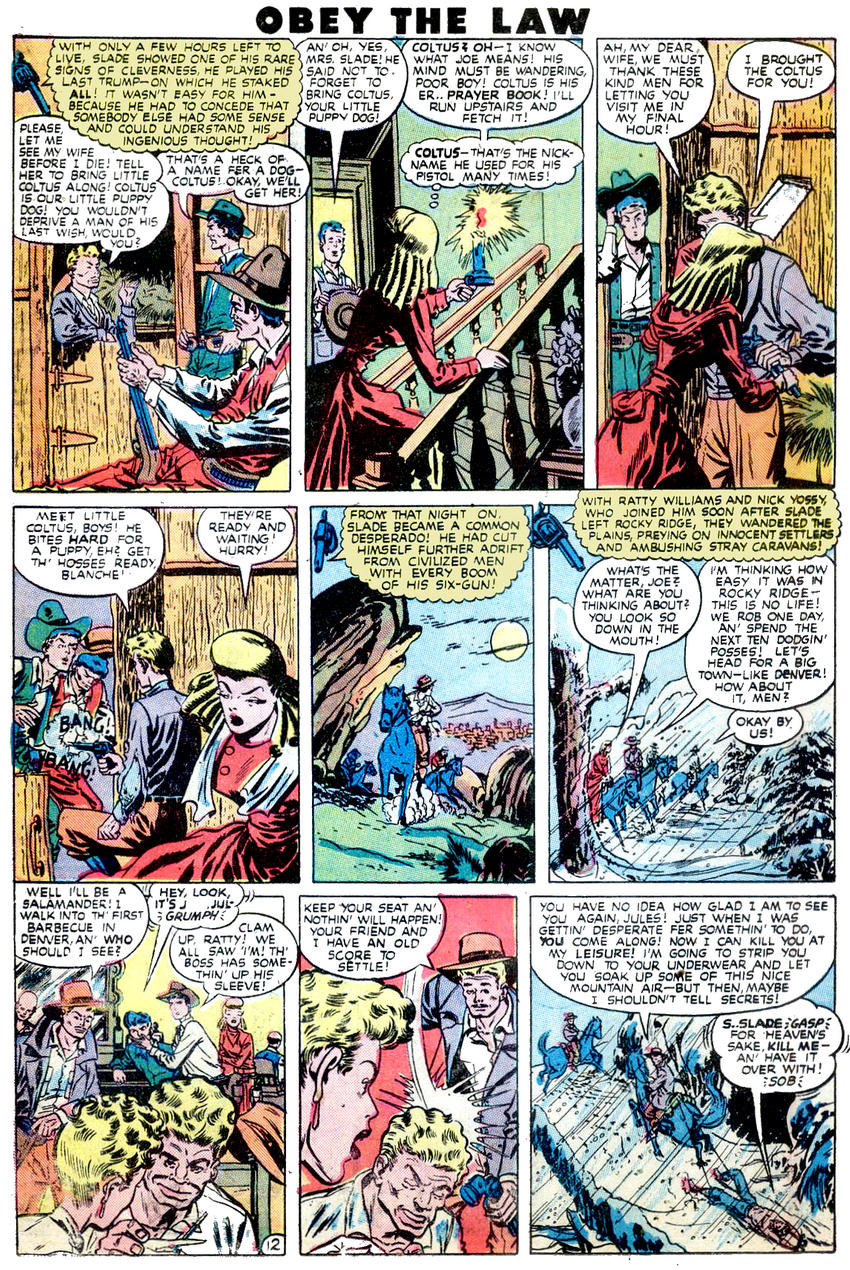
Joe (also called Jack) Slade has either a bad reputation as a Western outlaw, or he wasn’t that bad, depending on who you listen to or what you read. If you google the name you get a couple of versions of the life and career of Slade. The story about Slade I’m showing today is strictly in the bad man camp. But that isn’t the reason I’m showing this story from Desperado #1 (1948). It has to do with the declaration by publisher Lev Gleason, shown here, as to an internal self-censorship code for their line of comic books.

As you can see, there are specific instructions to follow, like number 10, “blood must not be seen flowing from the face or mouth. . .” Then you turn to page 3 of the story and what do you see? Blood flowing from a face. The story is excessively violent; killings pile up, and despite instruction number 2, “sadism or torture . . . will not be accepted,” on the final page a panel shows a half-nude man tied to a tree in a snowstorm, kept alive “in the freezing air” while pleading for death. In the history of comic books and the late forties-early fifties response to calls for censorship or outright banning of crime comics altogether this response from a publisher, with its “much needed form of self-imposed censorship,” may be the most extreme fubar in evidence. Had Dr. Wertham seen this story and the attendant message he may have devoted a chapter of Seduction of the Innocent to the hypocrisy.

Oh yeah...one more thing as long as I’m complaining. I hate the gimmick of the gun telling the story. Anthropomorphizing an inanimate object — another outrage!


More about

Number 1422: Brother Rats

Người đăng: vanmai yeu em on Thứ Hai, 19 tháng 8, 2013

Another sensational crime further sensationalized by Charles Biro and George Tuska, from Crime Does Not Pay #49 (1947). (Thanks to Darkmark for the issue number correction.) The DeAutremont brothers were Oregon lumberjacks who tried to rob a train in 1923, killed three men, and then fled.


It took four years, forensics work and wanted posters to bring the brothers to justice. All of them were caught, all were sentenced to long terms in prison. The panel of the calendar leaves shows 1942, by which time all three brothers were serving their sentences. The sequence that follows, of Hugh DeAutremont as a soldier in the U.S. Army serving in the Philippines and being recognized, actually happened in 1927. It is a reminder that when you see the word “true” in a crime comic, better doublecheck the story. You can read more about the DeAutremonts here.


I posted this story several years ago, but these are new scans:


More about

Number 1358: Boyoboy, it's the Little Wise Guys!

Người đăng: vanmai yeu em on Thứ Hai, 29 tháng 4, 2013


We have a theme week going, ”Boyoboy! Week” featuring kid gangs of Golden Age comics. Today we have the longest running of all, the Little Wise Guys from Daredevil Comics.

The group of youngsters first appeared in 1942, and lasted until publisher Lev Gleason closed his comic book line in 1956. This war-themed story is from Daredevil Comics #29 (1944), and Daredevil doesn’t appear until page 10 of the 16-page story. Oh, the ignominy —  the title character upstaged by a bunch of street kids!

The story features a torture scene, and off-camera more tortures and murders are alluded to. The cover, signed by Charles Biro, does not represent a scene in the book, but it is one of those covers sure to attract attention on the newsstand.

Drawn by Carl Hubbell, one of Biro’s regular artists, with script credited to editor Biro.


More Daredevil! First without the Little Wise Guys, and then one with them. Click on the pictures to go to the posts.


More about

Number 1322: Crime and/or Punishment

Người đăng: vanmai yeu em on Thứ Hai, 25 tháng 2, 2013

For day two of Pappy’s Crime Wave week (see yesterday's post for an explanation) we have the standard crime comic; i.e., what most people, especially censors, bluenoses and joykillers, meant when they pointed at something and said, “That's a crime comic!”


Crime and Punishment #1* came out in late 1947 and became the companion publication to the standard-bearer of the genre, Crime Does Not Pay. The publisher was Lev Gleason, the editors Charles Biro and Bob Wood, just like Crime Does Not Pay. We find the same kind of contents in the latter magazine as we do in the former...panel after panel of lurid criminal acts and in the last couple of panels some sort of moral and the criminal’s just due. He (or she in many cases) either ended up on the gallows, in the electric chair, or died a violent death by either cops or fellow crooks.

The contents of crime comics varied with American crime mixed in with crime in other countries. In this case we see Dan Barry’s great artwork on “Danny Iamasca, Dutch Schultz’s Triggerman” and Jack Alderman’s ink-heavy art on “The Butcher of Düsseldorf.” A note about crime comics: Their use of the word “true” doesn’t mean their version of truth got in the way of telling a good story. Truth may have figured in there somewhere, but not at the expense of cheap thrills. An exception might be made in the case of Peter Kürten, the Butcher of Düsseldorf (also called the Düsseldorf Vampire). His many crimes were so depraved the scripter and artist restrained themselves in telling the story. And that’s the truth.


C.H. Moore had a regular gig doing these informational pages. They were quite good. Moore used a style perfected by sports cartoonists in newspapers and also in the famous “Ripley’s Believe It Or Not.”

*There’s internal evidence that the title of the comic was originally Obey the Law but was changed to Crime and Punishment during production.

More about