Hiển thị các bài đăng có nhãn William M. Gaines. Hiển thị tất cả bài đăng

Người đăng: vanmai yeu em on Thứ Tư, 9 tháng 11, 2011


Number 1049


"Dat takes care of dat!"


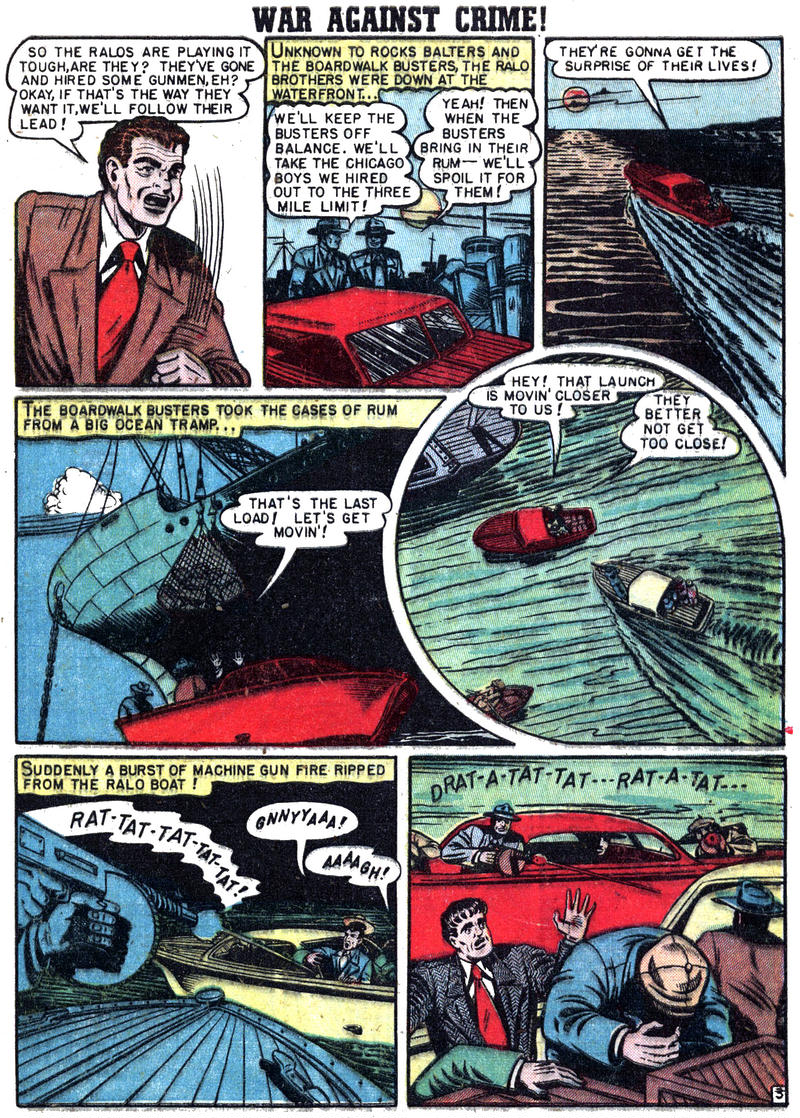
As I understand the stories from the history of EC Comics, after founder M.C. Gaines died in a boating accident in 1947, and his son, Bill, took over the editorial chores, one of his first hires was Al Feldstein. Feldstein had been an artist on teenage comics ( Fox's Junior). That was the direction they were headed until they stopped that project and went out for crime, love and Western fare. Al did stories in all three genres.

"Machine-Gun Mad Mobsters" is from War Against Crime #4, 1948. Al's artwork, while noirish, seems a little stiff, but a year or so later when he was drawing horror comics that was appropriate. He drew lots of stiffs.

The first two pages of the story in my copy of this comic are damaged, so I scanned them from Russ Cochran's 2000 reprint. The rest is from the 1948 printing.


More about

Người đăng: vanmai yeu em on Chủ Nhật, 6 tháng 12, 2009


Number 644


"Reflection" redux


In April I posted the horror story, "Reflection of Death," from Tales From the Crypt #23, in Pappy's #503. It's one of my favorite EC stories, told in a POV style by Al Feldstein. I think that 1951 story helped set the overall tone for the horror comics that Bill Gaines and Feldstein were trying to do. Some years later, after the Comics Code came about, Gaines started a line of magazines. Feldstein re-wrote the story for Terror Illustrated #2, an attempt to mix EC comics and prose fiction. Except for Mad Gaines flopped in the magazine business.

Feldstein wrote the story under the name, Alfred E. Neuman (yuk, yuk), and used the art talents of George Evans. In my opinion the original incarnation of "Reflection of Death" worked; by the time of this re-working the plot seems predictable and the writing pedestrian. The artwork, however, is a good enough reason to look.


More about

Người đăng: vanmai yeu em on Thứ Sáu, 16 tháng 10, 2009


Number 611


Eat it raw!


Here's a scary story about meat. It's from Tiny Tot Comics #7, 1947. If this story had been shown to me when I was a kid it's possible I could be a vegan today. It's drawn by Tiny Tot regular Burton Geller. We'll have some more by Mr. Geller in the future, but nothing this bizarre.

Tiny Tot was an EC Comics title, back when Max Gaines was the publisher/editor, and when EC stood for Educational Comics. Max Gaines died in the summer of 1947 from a boating accident. The company wasn't doing very well, and at the behest of Max's widow was taken over by their reluctant son, Bill Gaines. Bill dumped the kiddie books, although he retained the use of the name Tiny Tot as one of the various names used in the indicia as publisher of record.

A couple of years later EC Comics published titles like Tales From the Crypt, Haunt of Fear and Vault of Horror. It was in Crypt #32 that another story of meat was published. "T'aint the Meat, It's the Humanity," was a story of greed, in the best EC tradition. During World War II meat was rationed. Butcher Zach Gristle was offered some black market meat and was able to make a big profit for himself. Unfortunately, some of the meat was tainted, and led to the confrontation with Mrs. Gristle, shown in the panels below. It was one of the more gruesome EC endings, but also ghoulishly funny.

"Peter and Pinky in Meat Land"* was also gruesome in its own way, but not so funny. "Raw meat...raw meat anyone? Eh, eh..."


*The title sounds dirty to me.
More about

Người đăng: vanmai yeu em on Thứ Tư, 5 tháng 8, 2009


Number 570


The Basket


Picto-Fiction was an attempt by EC publisher, William M. Gaines, to save his comic book business and avoid the Comics Code by going upscale to the magazine market. Picto-Fiction, including Terror Illustrated, Crime Illustrated, Confessions Illustrated and Shock Illustrated, were a mixture of art and story, not comic books, but not traditional magazines either. Picto-Fiction failed because it didn't reach the readers of either the comic book or prose fiction market. On the other hand, Mad, his non-Picto-Fiction magazine, succeeded beyond anyone's dreams.

"The Basket" is from Terror Illustrated #1, December 1955. It's adapted from a story in the 10¢ comic book, Haunt of Fear #7. In its original form it was drawn by Jack Davis. Graham Ingels handles the assignment here.

Hairy Green Eyeball presented a whole issue of the Picto-Fiction Crime Illustrated here.


More about

Người đăng: vanmai yeu em on Thứ Bảy, 20 tháng 1, 2007


Number 84


COVERING UP: Classic Covers of Golden Age Comics


Is Decapitation in Bad Taste?

On April 21, 1954, EC Comics publisher Bill Gaines took his place before a Senate subcommittee investigating the excesses of comic books. Gaines took a chance by testifying: No one who watched the U.S. Senate during the period after World War II would have failed to notice the House Un-American Activities Committee hearings by Senator Joe McCarthy, and the Senate's own excesses, ruining lives and careers of people who testified.

Comics had been under fire for many years--just about as many years as they had been popular--and Bill Gaines' father, Max Gaines, had been sensitive to such criticism. His own comic book lines, All-American Comics, with popular characters like The Flash, Wonder Woman, etc., and his new business, Educational Comics, were kept as clean as possible with some pretty strict self-censoring. It wasn't until he died and his son, Bill, took over that Educational Comics became Entertaining Comics and put their stamp on quality in art and story, if not in subject matter.

Crime and horror comics were successful, and were the target of PTA groups and parents. The comics were put under a public microscope and received much criticism.
So it's hard to tell why Bill Gaines put his own neck on the block (ho-ho), unless he had told himself that by dint of a calm testimony and his own sincerity he could convince some publicity-wise senators that as a publisher he felt he wasn't doing anyone any harm. When it came to whether his comics were in good taste, and a copy of Crime Suspenstories #22 was held up this exchange occurred:

Senator Kefauver: Here is your May 22 issue [sic]. This seems to be a man with a bloody ax holding a woman's head up which has been severed from her body. Do you think that is in good taste?

Mr. Gaines: Yes sir, I do, for the cover of a horror comic. A cover in bad taste, for example, might be defined as holding the head a little higher so that the neck could be seen dripping blood from it and moving the body over a little further so that the neck of the body could be seen to be bloody.
Ah, poor Bill Gaines. He claimed later he was on dexedrines, a diet pill, and not really responsible for what he said, but when they held up that cover he must've felt his own head under a bloody ax. He knew then that he had been set up, not only by the Senate subcommittee, but by his own publishing practices. It wasn't long before the publication of Seduction Of The Innocent by Dr. Fredric Wertham, M.D., an anti-comics polemic and a very influential book. The comic book industry felt the heavy weight of public opinion finally crush them, and the Comics Code was born. Unlike the belief of some uninformed fans, the government did not censor comic books,nor were they ever likely to censor them. It would have been clearly unconstitutional to do so, but a self-regulation seemed at the time to be in everyone's (especially the publishers) interests.

I think Bill Gaines was a brilliant publisher by surrounding himself with so much talent. He did that throughout his publishing career and made a tidy living at it. If he had a problem during his EC Comics days it was pushing against public opinion. When the public starts book burnings of your product, when distributors return the boxes unopened because no seller wants to handle your product, then you have failed. You've made a point, but by doing so you have also hurt yourself.

EC is often held up as the benchmark of how good comic books could be, and I'm firmly in that camp. I own many of the original comics, I own the complete hardbound, slip-cased series' of New Trend issues, I own all of the comic-formatted reprints. I'm a solid EC fan, but even jaundiced by my own opinion of how good EC Comics were, I can see where they dug the pitfalls they later fell into.

Oh yeah…EC wasn't the only company to publish decapitation covers. In 1939 the pulp magazine, Strange Stories had a doozy of a decapitation cover by Norm Saunders.


Click on pictures for full-size images.

In this cover the bad taste guidelines explained by Gaines are fully illustrated, with blood dripping from the neck of the female victim. But that was a pulp magazine, not usually associated with children, and that was the problem with comic books. Their readership was a little young--according to their parents--to be exposed to such things as headless bodies and bodiless heads, whether the publisher decided they were in good taste or not.
More about