Hiển thị các bài đăng có nhãn Silver Streak. Hiển thị tất cả bài đăng

Người đăng: vanmai yeu em on Thứ Năm, 13 tháng 12, 2007


Number 232


It's not easy being green


Pity the Green Claw. He's green, he's really, really tall, and his breath is so bad he shoots flames out of his mouth. No wonder he's in such a bad mood all the time. If ever a guy needed a woman…

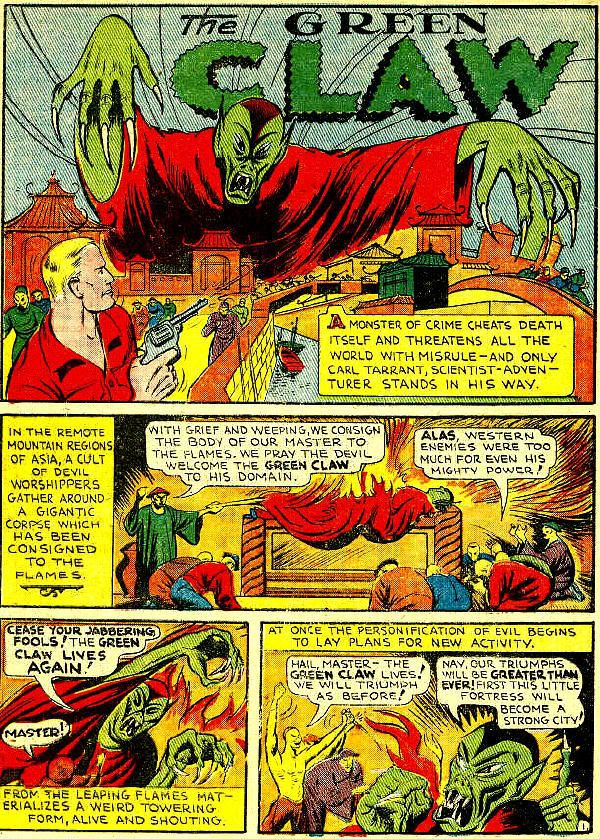
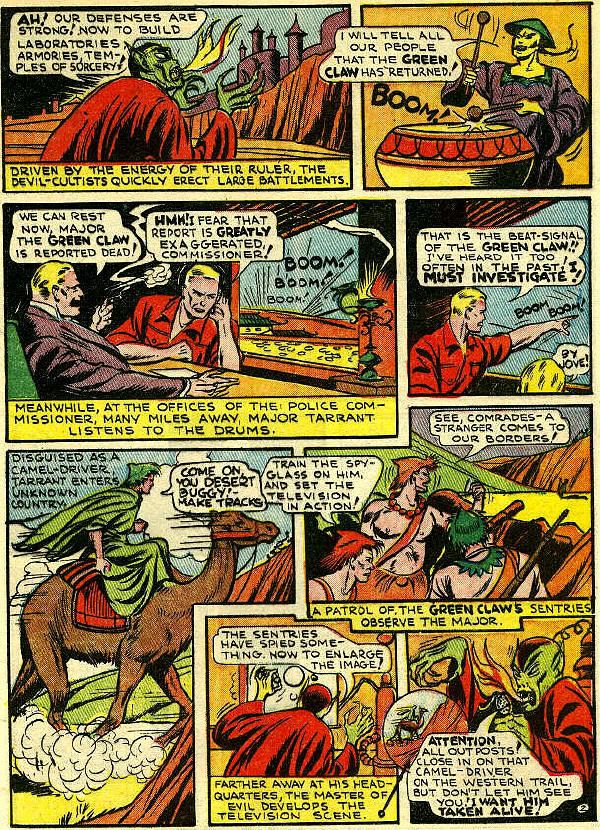
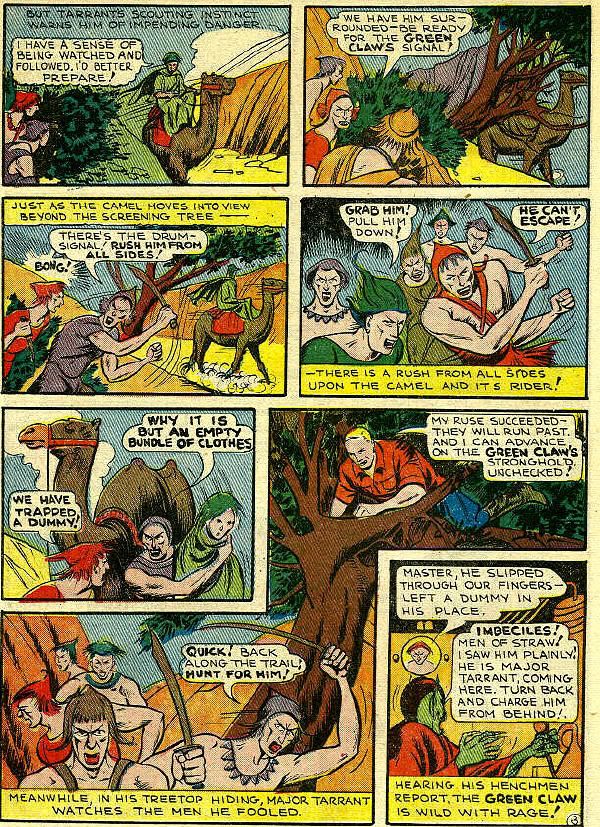
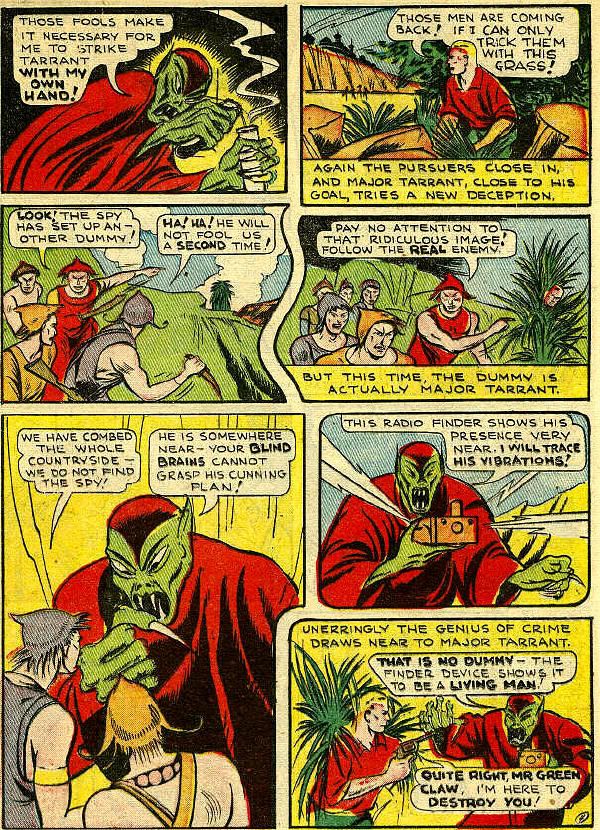
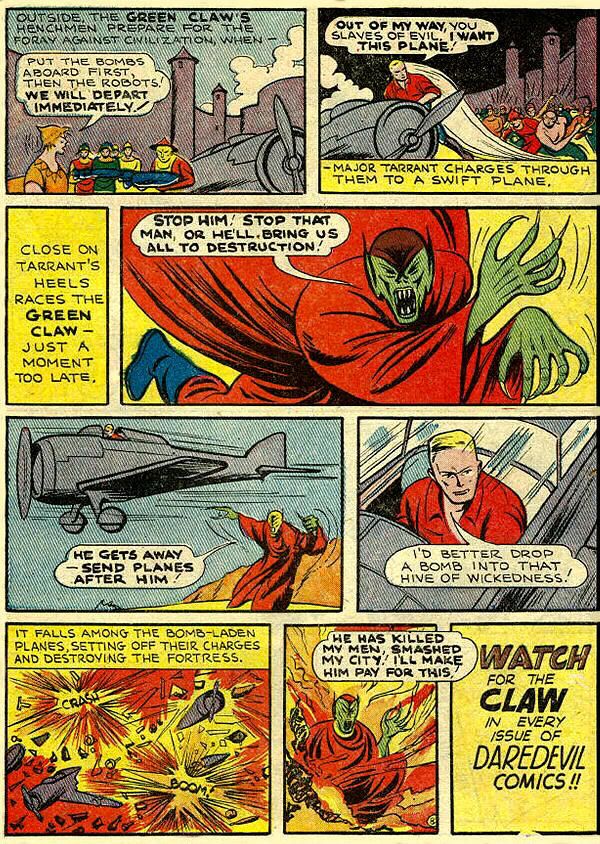
"The Green Claw" is scanned from Lev Gleason's Captain Battle Jr. #2, where it was reprinted from Silver Streak Comics #6. The cover of that 1940 issue of Silver Streak is scanned from my Flashback reprint, published by Alan Light in the mid-1970s.As far as I know, this is the only time the arch villain from Silver Streak, created by Plastic Man's Jack Cole, ever appeared as the Green Claw. There's no explanation as to why the name and color change, and by the next appearance he was back to being yellow. The Claw was a hideous caricature of an Asian stereotype, the insidious "yellow peril" Fu Manchu-styled villain. Coloring him green was an interesting choice, if not consistent with the rest of the series. It must've confused the readers of the day.

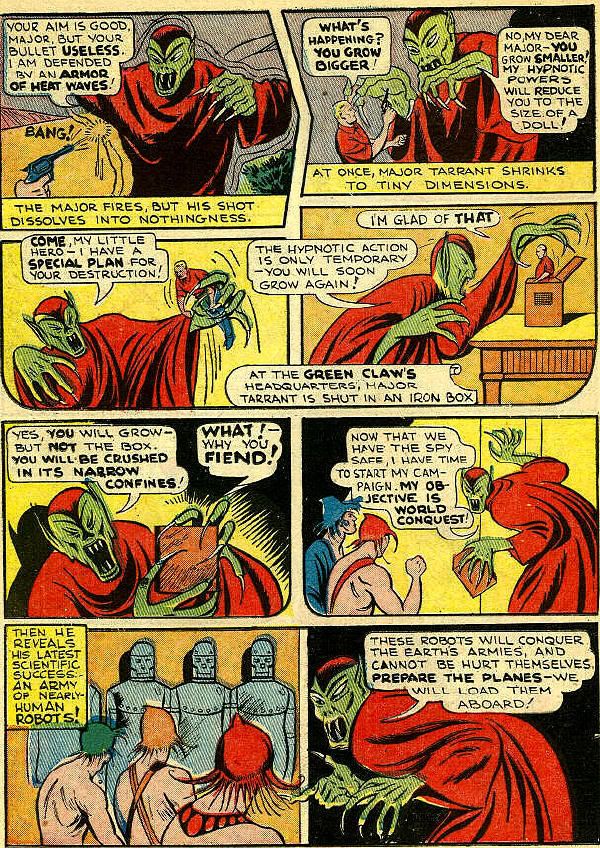
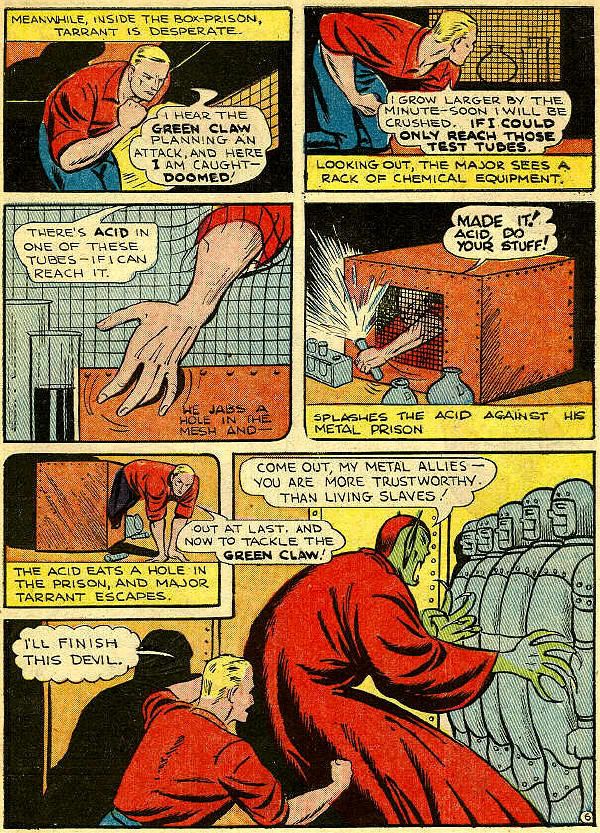
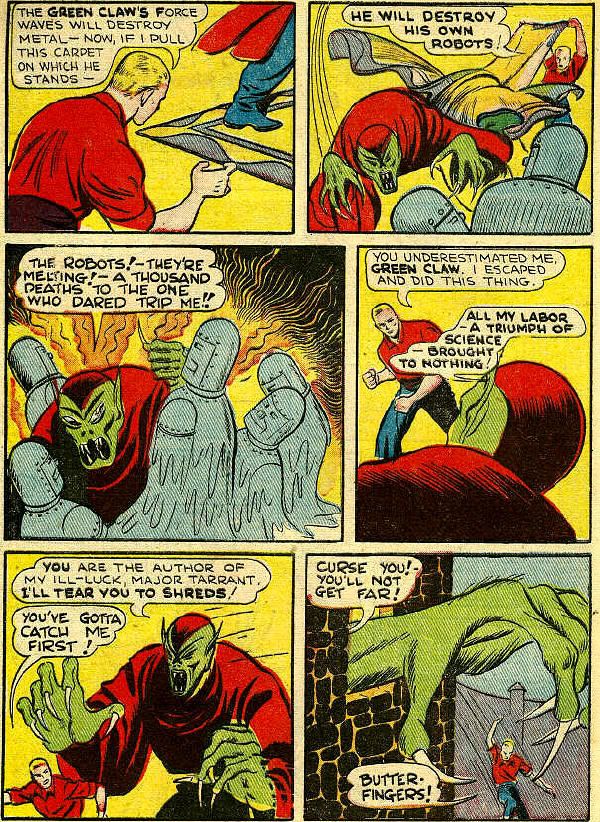
In this breathless tale, Major Tarrant, the (Green) Claw's nemesis, chases him down. The Claw has television, he has a version of GPS, some radar with which to find the major. He also has a power I've never seen before in comics, the power to hypnotize and make someone physically smaller. In this case The Claw sticks Major Tarrant into a tiny box, and gloating, tells him because of the confines of the box, when he begins to grow he'll die. Bahahaha! In Lee Falk's classic comic strip, Mandrake the Magician, Mandrake was able to shrink people with hypnosis, but they only thought they were shrunk. "The Green Claw" is such an absurd and silly story that this bit of hokum-pocus is just one more screwball element to a story you don't want to have to think about too much.

Page 1 / Page 2 / Page 3 / Page 4 / Page 5 / Page 6 / Page 7 / Page 8

More about

Người đăng: vanmai yeu em on Thứ Bảy, 11 tháng 11, 2006


Number 52


Jack Cole and Silver Streak, Part IV


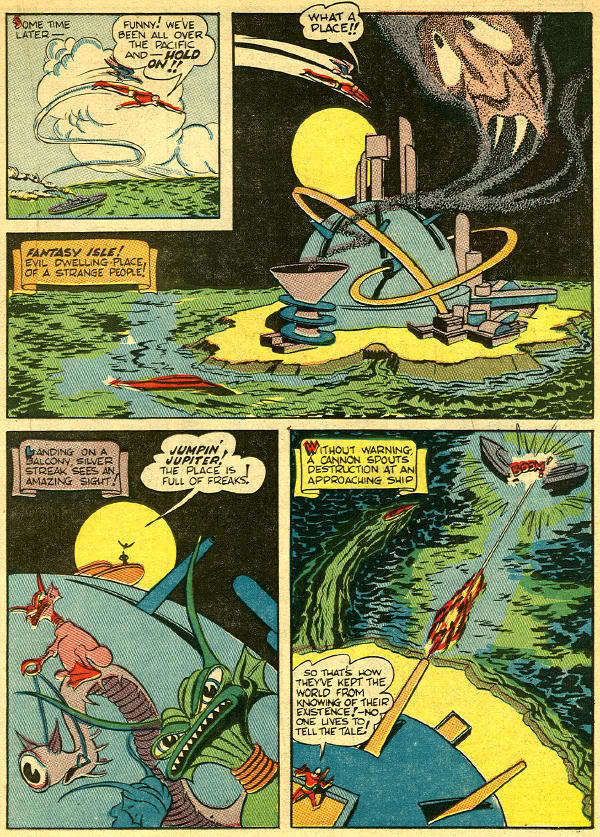
This is the last of the Silver Streak stories published in the one-shot, unnumbered issue of Silver Streak, published in 1946. The story itself was originally published in Silver Streak Comics #7 in 1940.

Previous postings of Jack Cole's Silver Streak were Pappy's Number 6, Pappy's Number 18, and Pappy's Number 36.


In his comic book days Cole was never far from his bigfoot art style of the 1930s. As a matter of fact, I don't think the superhero stuff came easy to him, not as easy as the cartoony stuff, that is. This story has some really weird cartoon characters. The premise of the story is ludicrous, but that was something of a hallmark of early Golden Age comic book stories.

From Silver Streak Cole went on to Plastic Man, Midnight, even The Spirit during Will Eisner's Army service. Cole did some horror and crime stories before wrapping up his comic book career and becoming Playboy's top cartoonist. He then created a syndicated newspaper comic strip, Betsy and Me, before shooting himself to death.

Jack Cole would have had a lot of good years of drawing in him and we are poorer for losing out on so much. The old Silver Streak Comics, with their cartoony art and bizarre stories, were very fun, but came nowhere close to showing the inspiring talent that was routine for Jack Cole just a few short years later.


More about

Người đăng: vanmai yeu em on Thứ Tư, 11 tháng 10, 2006


Number 36


Jack Cole and Silver Streak Part III


This story originally appeared in Silver Streak #6, September 1940, an issue called "scarce" in the Overstreet Comic Book Price Guide. The story was reprinted in the unnumbered Silver Streak, a one-shot published in 1946, reprinting the Silver Streak stories from issues 4-7 of the original comics series. That one-shot is the source of the scans of the story.

Prior stories from the one-shot comic are in Pappy's Number 6, and Pappy's Number 18.

This story presents some stereotyped Arabs, with racist overtones. The girl given to the sheikh for marriage is white, while the males are brown. This was a lot more common fictional device in those days before World War II. It was originally published 66 years ago, so I consider it an historical, pop culture look at people from other religions and countries, who were often stereotyped in pulp magazines, novels,
movies and even comic strips.

The Englishman is stereotyped also, but he's comic relief, not sinister, like the portrayal of the Arabs.

The Silver Streak episode is signed by "Ralph Johns," one of Cole's pseudonyms; the cover of Silver Streak #6 is signed by Cole using his own name. It doesn't depict Silver Streak, but The Claw, a racist portrayal of an Asian villain based on the then-popular idea of sinister "orientals", a la Fu Manchu.


More about

Người đăng: vanmai yeu em on Thứ Ba, 5 tháng 9, 2006


Number 18

Jack Cole and Silver Streak Part II

In Pappy's Number 6 I presented the first story from the rare Silver Streak "no number" edition from 1946. It reprints stories by cartoonist Jack Cole from issues 4 through 7 of the first run of Silver Streak Comics. Cole later went on to become famous for other things, including Plastic Man, and cartoons for Hugh Hefner's Playboy Magazine.

This particular episode of Silver Streak involves terrorists, who look suspiciously like Ku Klux Klansmen (a lot more prevalent as an object of terror in the 1940s than they are now). These terrorists are in on a plot to change the gold standard of the United States to a silver standard. Yeah, I know…it's a screwball plot, made even screwier by an ending about a businessman trying to corner the market in silverware. This being a comic book the plot is wildly simplistic…or is it? I guess what it reminded me of is businessmen that have been trying to gouge the public since time immemorial. In its own way it is prophetic about a company like Enron, which had the absolute audacity to screw the whole state of California!

The Silver Streak story is slambang action from beginning to end. It's a great example of Jack Cole in the days of his early career.

As always, the files are big, so while downloading you guys with dial-up put on your jogging suits and take a run around the block. "Can't spend all your time indoors reading comic books, y'know," as my mom used to say. "Oh yeah? Why not?" I used to say…but that's another story.


More about

Người đăng: vanmai yeu em on Chủ Nhật, 6 tháng 8, 2006


Number 6

Jack Cole and Silver Streak, Part I


It's fun to go back and look at the early work of the really great cartoonists and comic book artists. By the mid-to-late 1940s Jack Cole had risen to a level of comic sophistication with Plastic Man that still holds up 60 years later. But his earlier work, while showing flashes of the brilliance to come, is really more routine, what was expected in comic books of the time. He even signed it with a pseudonym.

Silver Streak--a Flash-like superhero--was a character Cole worked on early in his comic book career. The book I scanned this story from is a 1946 reprint of some work from about 1940, which accounts for its look, passé by the time it was republished. Comics came a long way in a very short period of time as artists experimented and the public voted on what they liked with their dimes.

Still, this issue of Silver Streak, a one-shot with no number, is a good one. I ran across my copy over 25 years ago. It's in rough shape, with a cover and first few leaves detached, but it's scarce in any condition. I'm including the cover, which wasn't drawn by Jack Cole, but by another of my favorite Golden Age artists, Dick Briefer (creator of the funny Frankenstein). This is bondage, boys and girls. Get a good look at the lady tied up, being tortured by a machine that promises "worry" (the very fact of being on this device would cause at least that), "mild pain," "shooting pains," "severe headache," or even "unbearable agony." But wait, there's even worse than unbearable agony, which is "near death," and "death." Luckily Silver Streak is coming into the scene, feet-first, to rescue her. What I can't figure out is, why is the monster with the axe smiling at Silver Streak?


The Silver Streak episode here is the first in the reprint comic, but the fourth Silver Streak story overall. The Overstreet Comic Book Price Guide says it's the first story with Silver Streak in a new costume, and that may have had something to do with its choice as a reprint.

I'm assuming Cole wrote the stories in the book, but there's really no way to tell. You can tell Cole writing by his use of gag situations, but the use of a gag where the matronly woman calls him anything but "Silver Streak," wears thin as fast as Silver Streak can run. The villain is disappointing looking, with a lame name of "Doc." Like other early comic book stories the action is propelled instantly. No subtleties here. Superman by Siegel and Shuster was an early template for this story, where Silver Streak fights giant spiders, saves a tied-up girl (oboy! More bondage!) from a fiery doom, and even rescues a farm boy from crushing death by speeding car, all in 11 pages.

It's all pretty breathless and energetic stuff. As time goes on I'll be scanning and presenting the other three stories in the book.


More about