Hiển thị các bài đăng có nhãn Harry Lucey. Hiển thị tất cả bài đăng

Number 1595: Aces up my sleeve

Người đăng: vanmai yeu em on Thứ Hai, 23 tháng 6, 2014

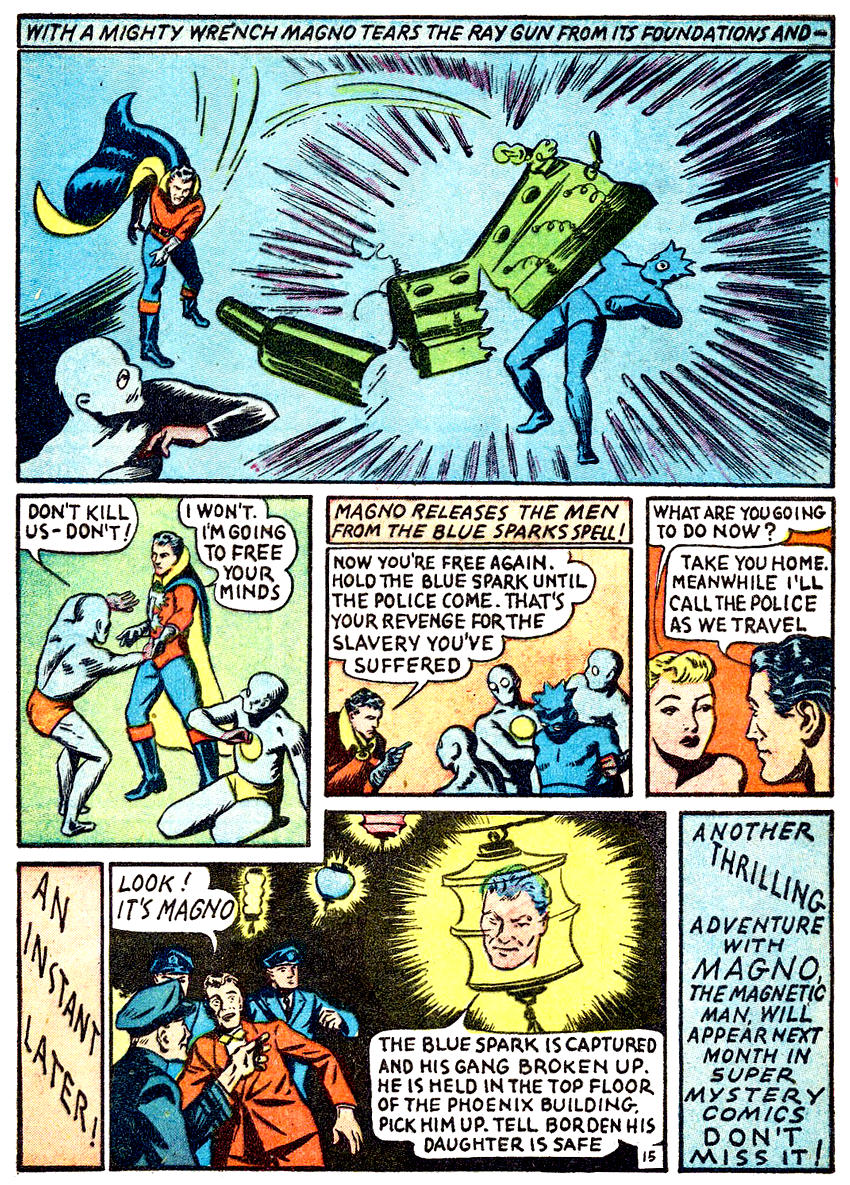
Today we begin a theme week, “Aces Up My Sleeve” week, featuring some very early (1940-41) stories from Ace Publications. Ace, a pulp publisher, entered the comics fray early on with the usual titles devoted to the usual superheroes. In the story today, Magno, the magnetic man.

What jumps out at me with this very early entry for Magno, from Super-Mystery #2 (1940), is not the Harry Lucey artwork, which is very good, but the eye-popping primary colors. Other publishers of the time also used bright colors (Quality and Fox come to mind), but I think this job rises above them, with its imaginative use of colors for an earth-boring machine (page 12). The colorist must have been having fun.


More about

Number 1393: “This guy ain’t human!” Introducing Flash Lightning

Người đăng: vanmai yeu em on Chủ Nhật, 30 tháng 6, 2013

Flash Lightning was born of the “mysterious East.” We find out the bare bones of his origin on page 1 of his introduction in Sure-Fire Comics #1 (1940), published by Ace. He was trained in Egypt. Whatever gave him his powers, by 1940 superheroes were basically old hat and the origin was just a means to an end. And the end was action, action, action! That’s exactly what happens to Flash as he goes right to work rescuing a beautiful girl’s dad from a life of slavery.

The Grand Comics Database lists Robert Turner as writer. There is an indexer note that the story is based on the May 1938 pulp magazine, Captain Hazzard. A lack of originality in the story is matched by swipes from Alex Raymond’s Flash Gordon by artist Harry Lucey. A year or so later Flash’s name became Lash Lightning, and while I can’t find official information on the reason for the change, it’s likely DC Comics’ character, the Flash, had something to do with it. Another name change came with the comic book title, which after four issues as Sure-Fire Comics became Lightning Comics. Like many other superheroes born in the wake of Superman, Flash/Lash Lightning disappeared shortly after the end of the war. Had I been in charge of him in 1946 I might have taken away the super powers and made Lash Lightning a private eye with a whip. He couldn’t be a cowboy, because Lash LaRue was already whipping up bad guys in the Western B-movies in which he starred.


More about

Number 1356: Sam Hill's Double Trouble

Người đăng: vanmai yeu em on Thứ Sáu, 26 tháng 4, 2013

Sam Hill, Private Eye was a short-lived series from Archie Comics. Sam, a bow-tie wearing keyhole-peeper, was a smartass, wise-cracking, two-fisted private eye in the tradition of the time. Sam had the advantage of being drawn by Harry Lucey, who was one of Archie’s top artists. He showed with this series he could draw more than teenage hijinks. He could draw just as sexy and as action-packed as the genre required.

This story, “The Double Trouble Caper,” is from Sam Hill #1 (1950).


In 2011 I showed another story starring Sam Hill. Click the cover pic to see it.


More about

Người đăng: vanmai yeu em on Thứ Hai, 30 tháng 1, 2012


Number 1097


We love Lucey


Harry Lucey was one of the best Archie artists. While Bob Montana was THE artist of the Archie newspaper comic strip, Lucey was the main artist for years on the comic books. He could tell a lot with an expression or a pose.

Sam Hill, Private Eye was another short-lived attempt by the publishers of Archie to supplement their teenage line with other comic book fare. Sam Hill lasted for seven issues in 1950-51, which is about par for Archie. Other comics, such as The Dover Boys, which I showed in Pappy's #870, also drawn by Lucey, had an even shorter run, only two issues. Since this issue of Sam Hill is the only one I have I can't tell you if it's typical of the series, but there really isn't anything in this comic, except for Harry Lucey's artwork, which makes it stand out for me from the run-of-the-mill private eye stories in popular fiction, comic books, radio or television.

Sam Hill seems especially tame when compared to Lucey's earlier work. Consider this Hangman story from Pappy's #572 or the first story in the first issue of Crime Does Not Pay in Pappy's #786.

From Sam Hill, Private Eye #4, 1951:


More about