Hiển thị các bài đăng có nhãn Harry Shorten. Hiển thị tất cả bài đăng

Number 1203: Sign of the Hangman

Người đăng: vanmai yeu em on Thứ Sáu, 3 tháng 8, 2012


The Hangman (Bob Dickering) had an interesting gimmick. When he cornered the guy he was after the shadow of the gallows fell on the felon's face. I wondered how he did that...then I watched one of those “reality” shows where we’re not supposed to think about a platoon of cameramen, lighting techs, sound guys, etc., following these “real” people around in their “real” daily endeavors. Maybe Hangman had a lighting guy who stood over his shoulder, and when the time was right would hold up a tiny gallows in front of a powerful light. Okay...so it’s a comic book and they don't have cameramen. I just needed to get that out, because Hangman's gimmick always bugged me, and if they explained it in any of the Hangman stories I've missed it (or forgotten).

This story, which comes from Pep Comics #34 (1942) is a good example of the series. Bob Fujitani, working in his early style with overtones of Will Eisner’s influence, drew some very dynamic and dramatic pages. There's even a scene of a guy getting shot through the head, which wasn't exactly typical of these stories, but gory stuff did happen. M.L.J. Magazines, Inc., publishers, was into the action, violence and horror that appalled parents and grownups across America. They also sold to servicemen who were more likely to handle this sort of thing, but it was the kids everybody worried about. After a time the line began concentrating on their teenage comics and out of bloody M.L.J. cleancut Archie Comics was born. Well, cleancut compared to this episode of Hangman. I remember some sexy stuff going on in Archie, but no one got a bullet through the brain.

I'm including a page on editor Harry Shorten. Shorten did comics, paperback book publishing, a comic strip (“There Oughta Be A Law” with Al Fagaly) and then comics again in the sixties with T.H.U.N.D.E.R. Agents. All of that was ahead of Shorten when this biography was written, but you can see from it that Shorten took to the industry early on.


More about

Người đăng: vanmai yeu em on Thứ Tư, 7 tháng 12, 2011


Number 1066


The "forgotten" attack on Pearl Harbor, 1940!


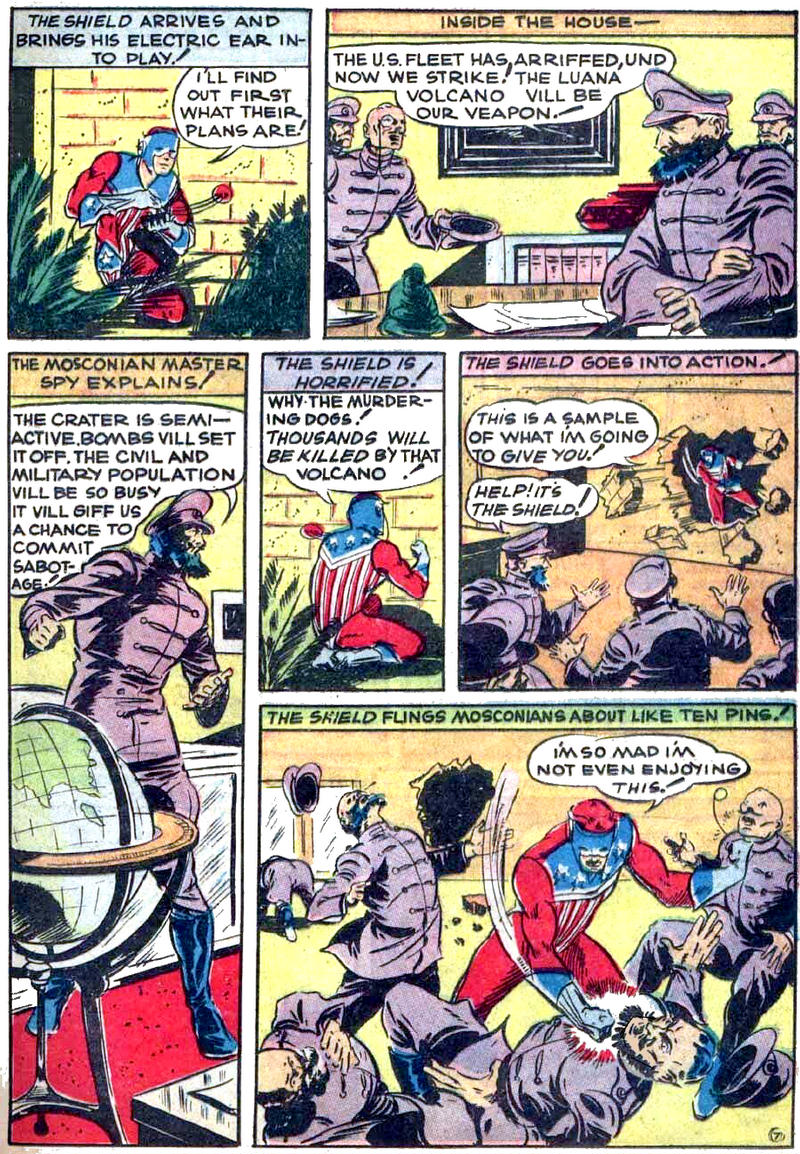
Pep Comics #4, 1940, tells the story of an attack on Pearl Harbor, almost two years before the attack by the Japanese, 70 years ago today.

The story is not that that surprising or even prophetic fiction. It was common knowledge at the time that Pearl Harbor, where the U.S. Pacific Fleet was stationed, was a likely enemy target. The Shield, America's first patriotic hero, kicks some butt. The fictitious Musconians are standing in for countries with which we were not yet at war.

Irving Novick drew the story, and Harry Shorten wrote it. The story features a crossover with the Wizard and Keith Kornell, the West Point cadet. As we learn at the end of the Shield's engagement with the Mosconian enemy, the Wizard and Kornell would be picking up the fight in the "current issue of Top-Notch Comics." I can figure out the ending of the saga without seeing it, but maybe the crossover worked in 1940 to separate some kids from their dimes.


The panel on page three showing a sailor identifying the Shield as "the guy what done a Steve Brodie!" threw me. Steve Brodie is the name of an inker for DC, whose work has shown up in four Boy Commandos stories on this blog. I did some research. The Steve Brodie referred to in the Pep Comics story was a daredevil who claimed to have jumped off the Brooklyn Bridge (and lived) in 1885. He died in 1901. You can read about that Steve Brodie here.
More about

Người đăng: vanmai yeu em on Chủ Nhật, 21 tháng 8, 2011


Number 1003


The Mist is a gas!


Black Hood was out of the superhero stable of MLJ Comics, which after a few years became Archie Comics. "MLJ Leads The Way" was an early slogan, and I'm not sure they led, but they were pretty good followers. Black Hood appears to be patterned after Batman--no super powers, but athletic--and has that square-jawed look that comes right out of the Bob Kane school. Like Batman, Black Hood had some wild adversaries, including the Mist, who could "vaporize his body." In this story Black Hood's savior, the Hermit (see Black Hood's origin in Pappy's #382, and the follow-up story in Pappy's #467), invents a liquid that turns the Mist's gas into a solid. It's a comic book, folks...anything goes.


The story is credited on the splash to Al Camy and Harry Shorten, from Top-Notch Comics #16, 1941:


I showed the very last Golden Age Black Hood story in two parts: part 1 in Pappy's #959 and part 2 in Pappy's #960.
More about

Người đăng: vanmai yeu em on Chủ Nhật, 5 tháng 7, 2009


Number 552


Dress me in a flag and salute me!


Yesterday was the 4th of July, so I thought I'd show a patriotic comic strip today. It's courtesy of my MLJ buddy, Nix, who is generous with his scans.

The Shield first appeared in Pep Comics #1, January 1940, but this later appearance, in Shield-Wizard Comics #1, is a more detailed story of his origin. References are made to the Black Tom explosion, which killed the Shield's dad. Ninety-three years after it happened it's an event nearly forgotten. In 1916 German agents blew up a munitions dump on Black Tom Island outside New York. Although not then at war with the U.S., the Germans blew it up to prevent it being the ammo supply to American allies. Officially sabotage, not a terrorist attack, it was the biggest explosion in the U.S. until the attacks on 9/11.

The Shield story also has the distinction of featuring none other than the Queen of the FBI, J. Edgar Hoover.

The Shield was written by Harry Shorten, who later on became a publisher. It was drawn by Irv Novick, who went on to a long career in comics, working into the 1970s. The Shield preceded Captain America's first appearance by a couple of months.


More about