Hiển thị các bài đăng có nhãn William Woolfolk. Hiển thị tất cả bài đăng

Number 1470: Kid Eternity and the Land of Amazons and wimpy men

Người đăng: vanmai yeu em on Thứ Hai, 11 tháng 11, 2013

 It is day two of our Week of Quality theme, presenting examples of the Quality Comics Group.

Kid Eternity, star of Hit Comics from 1942 to 1949 and his own book for 18 issues, had a gimmick. He would travel from his home in Eternity (another name for the afterlife, or heaven), with his buddy, Mr. Keeper. He would solve problems by invoking the word “Eternity!” at which time a (dead) character from history would appear to help out. Apparently in Eternity they don’t distinguish between dead real people or myths and legends. In this story from Kid Eternity #1 (1946), written by William Woolfolk and drawn by Al Bryant, Kid Eternity calls for Paul Bunyan and Sir Galahad. The other person he calls up, fireman Patrick Clancy, well, I don’t know if he was a real fireman or not. Frankly, I don’t care.

The main plot is another of these types of stories* brought back from a male-dominated, chauvinist era. In this case Mr. Keeper is worried because men who hardly have souls are appearing at the gates of Eternity. They’ve been browbeaten by women. Kid E. and Mr. K. travel to the Amazon where they encounter — you guessed it — Amazons, who keep their men tiny and unmanly. (I think page 6 is actually hilarious, where Sir Galahad invokes the knight’s code of chivalry against fighting women: “Page 45, paragraph 15," and the kept men of the Amazons worry about such things as dishwater hands and fixing beet soup.)

If I run into more of these types of stories I’ll post them. Even though most comic books were aimed at a male market, girls and women read them, also. It sends a message to both: guys, you’re in charge, and don’t forget it; gals, your man is in charge, and don’t you dare forget that.


**********

*For the classic “It’s a Woman’s World" from Mystery in Space #8, just click the picture:


More about

Number 1438: Mad Hatter shares the wealth

Người đăng: vanmai yeu em on Thứ Hai, 16 tháng 9, 2013

Mad Hatter was a short-lived comic, two issues, published in 1946. Superheroes were not having an easy go of it in the postwar comic book era, and Mad Hatter was no exception. The premise of the character, as shown here, isn’t much different than many others. A guy dresses up in panties and a cape and goes about fighting crime. The advantage to the strip, if there is one, is the creative team of William Woolfolk for the script, and Mort Leav for the art. Woolfolk once claimed he was the highest paid comic book writer of the 1940s, and I’ll take him at his word. Leav spent the latter 1940s drawing crime, western and romance comics for publisher Rae Herman.


I wonder if anyone noticed that the Golden City is a communist paradise? As De Leon, ancestor of the Spanish explorer who found it claims, “Our wealth belongs to all! From each we ask only what he can give and to each we grant whatever he may need!”

From Mad Hatter #2 (1946):


More about

Number 1401: Blackhawk and Torchy

Người đăng: vanmai yeu em on Chủ Nhật, 14 tháng 7, 2013

These two stories are from the next to last issue of Modern Comics. The title had changed from Military Comics, and it was in issue #1 that Blackhawk was born of World War II. The character and his gang survived the war, and became international troubleshooters and soldiers of fortune. [SPOILER ALERT: The Blackhawks also came up against plots where some fantastic trickery is involved, including this one where a spaceship and creatures from outer space are faked. Stories like these ignore the costs of such deception, which include creating and building, and in this one, the technology involved in making functioning robots with built-in microfilm cameras. Even if such a plot were to work the end result could not be worth what has been put into it. We accept the ridiculous flim-flam because it's a comic book. Just sayin'. END OF SPOILER] The artists are unknown to the Grand Comics Database, but William Woolfolk gets the nod for the script.

I’m also including the Torchy story from the issue. It’s drawn by Gill Fox. Torchy is fooled by an antique word and comedy results. The word, “gaiters,” I didn’t know, and I spend a lot of time with my nose in old books. See, comics can be educational as well as entertaining.

From Modern Comics #101 (1950):


More about

Number 1288: Island in the sky

Người đăng: vanmai yeu em on Thứ Sáu, 28 tháng 12, 2012

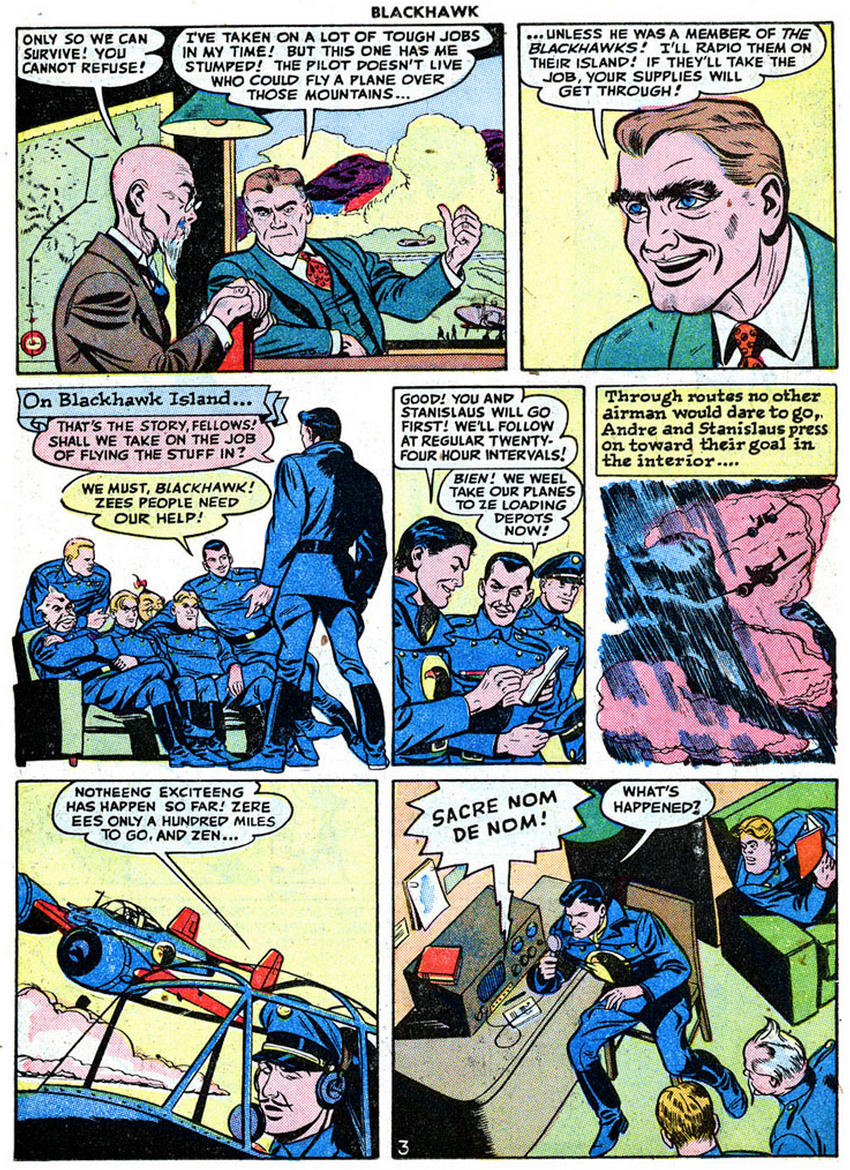
I like the idea of a “sky island,” a platform hovering high over earth, like a space station, only inside Earth's atmosphere. Others did too, because the motif shows up in science fiction plots, including stories featuring characters as disparate as Mickey Mouse and Flash Gordon. Here the characters are the Blackhawks, and the villain with the sky island is the Corsair, who uses Zeppelins to support his flying city.

That idea I can accept, or at least suspend my disbelief for a moment; it's the idea that the Blackhawks, in their private aircraft, are delivering supplies to a country in Indo-China I can't accept. So where in those aircraft are they putting said supplies? Ah, those comic book plots...

Bill Woolfolk is given credit by the Grand Comics Database for the writing, and the art is credited to Harry Harrison, of all people. That is a surprise to me. I haven't seen enough penciling by Harrison to be able to tell, although as usual in Quality Comics, pencils can be often nearly buried under an inker’s style, and that artist isn't identified.

The subject of identifying comic book writers and artists gives me a chance to give a plug to a deserving blog. I've learned quite a bit about identifiers for several writers and artists from Martin O'Hearn in his Who Created the Comic Books?. Martin is certainly knowledgeable, and I recommend his entertaining and informative blog.

From Blackhawk #15 (1947):


More about