Hiển thị các bài đăng có nhãn crime comics. Hiển thị tất cả bài đăng

Người đăng: vanmai yeu em on Thứ Sáu, 16 tháng 11, 2007


Number 219


Brother Rats


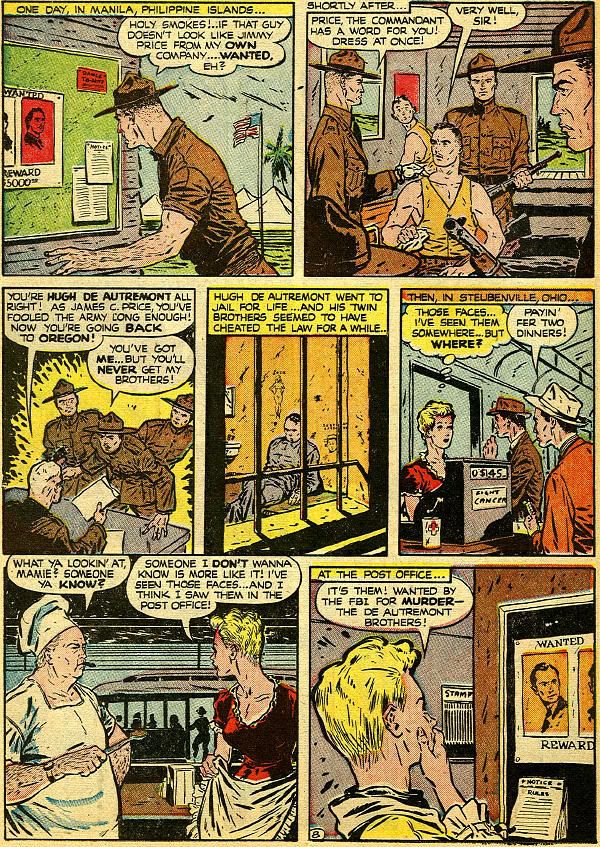
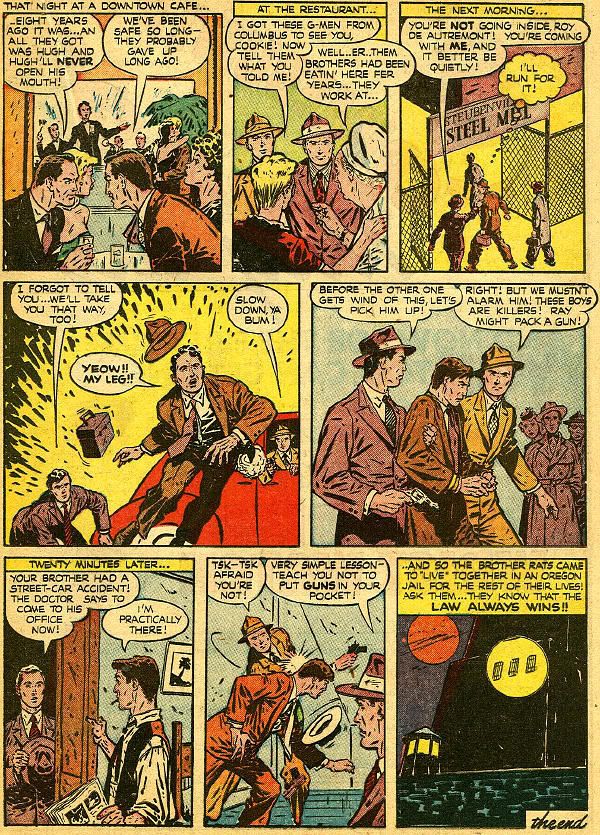
I haven't shown you a crime comics story in a while. I ain't forgot you muggs what likes these yarns about murderers and killers. Here's a good one about some bad brothers.

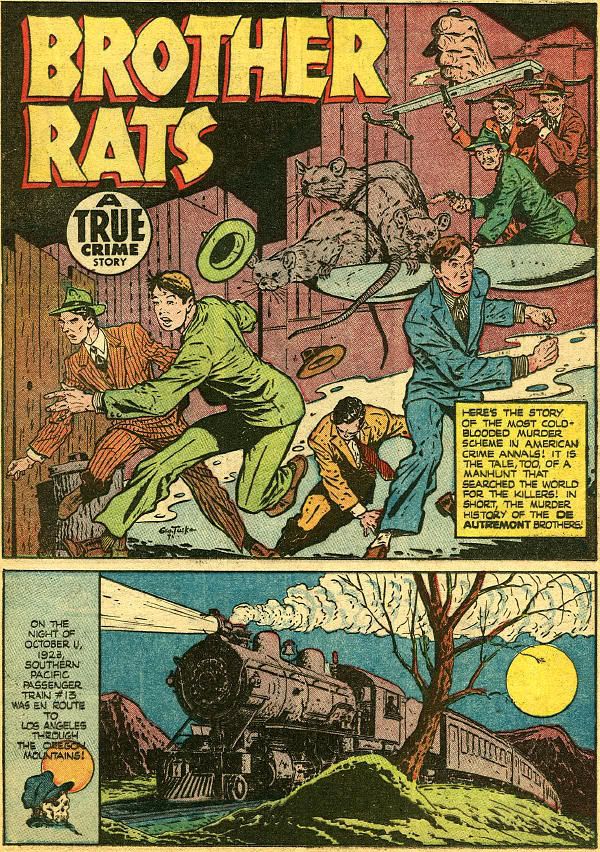
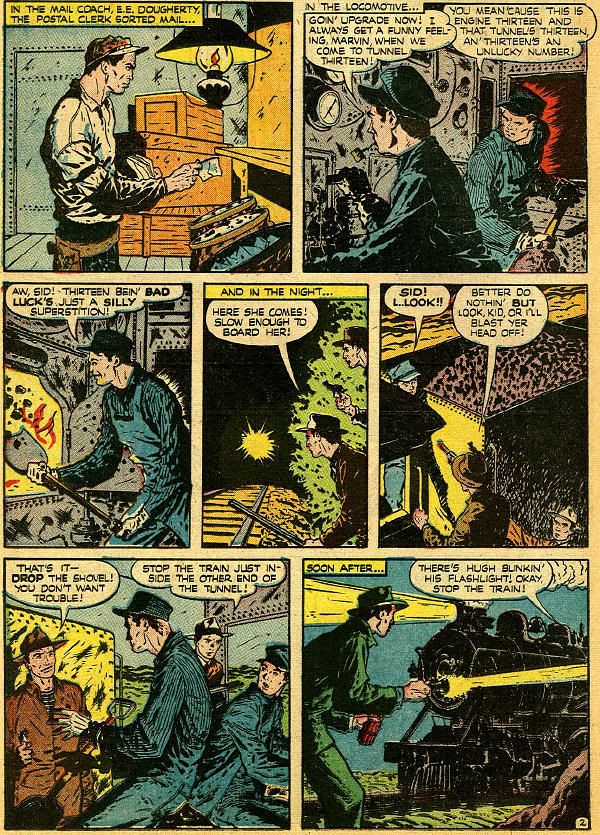
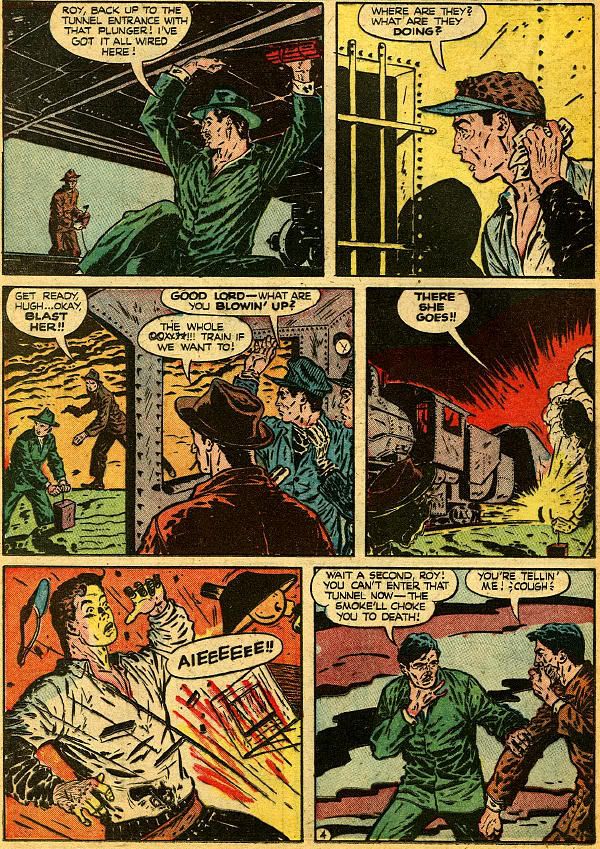
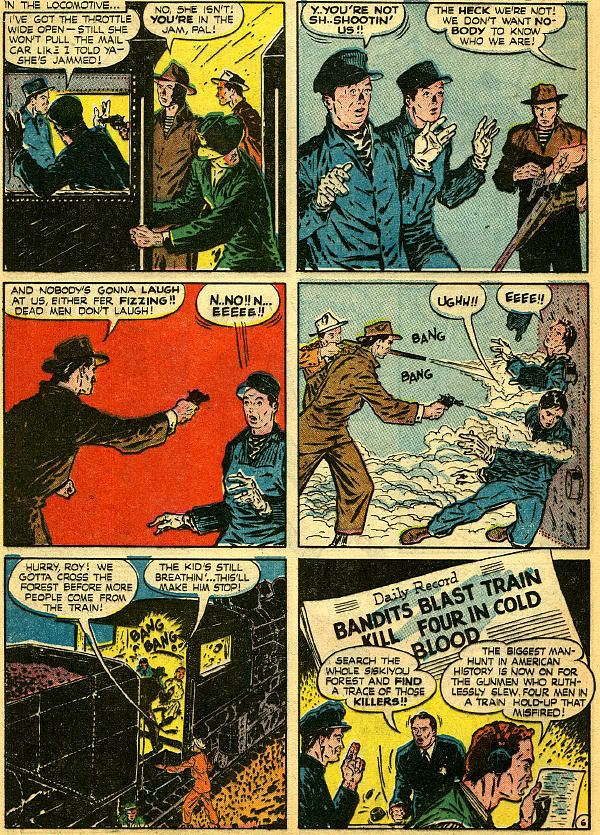
The last of the wild Western train robberies, committed in 1923, is told in "Brother Rats," from Crime Does Not Pay #49, January 1947. The great artwork is by George Tuska. Tuska worked in comic books practically from the beginning of the industry until the 1990s. To me, his finest work was during this postwar period. I love the symbolic splash panel for this story.

As for the DeAutremont brothers--and despite how it's spelled in the story, their name is spelled without a space between De and Autremont-- it took years, but justice was eventually served.

Page 1 / Page 2 / Page 3 / Page 4 / Page 5 / Page 6 / Page 7 / Page 8 / Page 9

More about

Người đăng: vanmai yeu em on Thứ Tư, 15 tháng 8, 2007


Number 176


Airboy Gets Ghastly!


When most Golden Age comics fans think of Graham Ingels they think of him as "Ghastly," a nickname earned during his time drawing some of the creepiest horror comics ever published for EC Comics. He well deserved that nickname. But Ingels was an artist who freelanced on various other genres of comics before he signed on at EC. This particular Airboy story, from Airboy Volume 5 Number 7, August 1948, although unsigned, is undoubtedly one of his.

Ingels, who was born in 1915, was about a decade older than his fellow EC artists. Ingels was a mature and polished cartoonist by the time he started his comics career. So it is with this Airboy story, a far-fetched story about criminals killing "bums," (now called "homeless persons"), secreting dope on their bodies and shipping them to their home cities where the dope can be claimed. The crime comics element is foremost in the story, and along with the later horror stories, was a milieu well suited to Ingels' style.

Airboy's dad shows up in this story. He isn't given a name, so is he Airdad?

The comic I scanned this from is from a copy reported unsold after it went off sale. The title strip had been razored off the cover, returned for credit to the distributor. The mutilated comic was then sold by an unscrupulous storeowner or news dealer, probably for 5¢. I used to see those sorts of displays in various stores in the early to mid-1950s. I think after a time they were shut down by local magazine distributors. My copy has tape holding the razored pages together through the first few pages of the story. I didn't do the taping, and I found this issue along with a couple of others in like condition. Fortunately, the tape's adhesive hasn't dried out, so the cellophane is still intact, not fallen off leaving a stained brown residue.

The cover, which I got off the Internet, is also by Ingels, and has a really nice graphic design. The coloring, and the silhouettes of the figures against the sunset make it stand out. It's likely influenced by Will Eisner, who had some very memorable Spirit splash panels set on piers like this.


More about

Người đăng: vanmai yeu em on Thứ Tư, 8 tháng 8, 2007


Number 172


From Those Wonderful Folks Who Brought You Organized Crime


Bob Fujitani, who signed his work "Bob Fuje," was one of the best illustrators in comics for many years. He started in the WWII era drawing characters like The Hangman, but after the war went to Charles Biro, illustrating some very memorable stories for Crime Does Not Pay and Crime and Punishment. Later in his career he illustrated Doctor Solar for Gold Key, but he was also helping with comic strips, doing other illustrative work. He was a busy, in-demand artist. I'll show more stories by Fujitani in the future.

"Dion 'Gimpy' O'Banion" is the "true life" story of a Chicago gangster. The story has some truth to it, but as with all of these types of stories, names are changed, incidents are exaggerated. Some of the facts in the story are true: O'Banion did have a limp; he was a florist; he did get killed by rival gangsters. A good overview of his crime career is told here.

O'Banion made his money in bootlegging, thanks to Prohibition. Comic books also came out of Prohibition. There's an alternate history of comic books that needs more exploration, but a good start is the book Men Of Tomorrow by Gerard Jones, which helps explain some of the murky ties some comic publishers had with the Mafia. It's a pretty interesting story, and that book is highly recommended. A mob connection isn't so surprising, really, since New York City was the home of comics publishing, also the home of the Five Families, extremely powerful in that era. There wasn't much they didn't have their fingers in if it made money, and there was money to be made in comic books, especially in distribution, printing and other business aspects.

In the meantime, the guys who made the least money were the ones who made the comic books great. So it was with Bob Fujitani. I doubt that Lucky Luciano could ever produce a comic book, but he could make sure he got his cut of the profits. Bob Fujitani's artwork would be a reason for someone to plunk down his dime for a comic. Fujitani got a page rate and no cut of the profits.

This particular story came from Crime and Punishment #5 (1948).


More about

Người đăng: vanmai yeu em on Thứ Ba, 15 tháng 5, 2007


Number 132


Doctor Of Evil!


No, not Austin Powers' Dr. Evil, but Joseph "Doc" Moran, who dug bullets out of bad guys during the gang period of the 1930s.

This is a story from Crime Does Not Pay #43, January 1946, drawn by Vernon Henkel, a true Golden Age comic book artist, who was there for the duration, from the very beginnings in the 1930s.

As told by Henkel in an interview in the fanzine Alter Ego #48, May 2005, he grew up interested in art and cartooning, and sent Quality Comics publisher, Everett "Busy" Arnold, an original comic book story. He was rewarded with a check and a steady art gig for quite a while. Like most journeymen comic book men of the era Henkel worked for various publishers over the years. He didn't work for Charles Biro for long, but long enough to do some memorable stories, including this lurid 6 2/3 pager about a notorious drunken quack who catered to the bank robber clientele.

As usual, the Crime Does Not Pay story jibes with real life only long enough to establish the story. Although they purported to be true stories, "truth" was fictionalized. For some reason while Dillinger gang member John Hamilton is called by name, the Barker-Karpis gang's name is changed to the "Russ Gobson Gang." Say what? Gobson? I can't imagine the publisher was worried about getting sued, since the only survivor of that gang in 1945, when the story was drawn was Alvin Karpis, then residing in Alcatraz.

In real life Moran was killed by Dock and Freddie Barker because he was blabbing all over town about handling money from a kidnapping by the Barker-Karpis gang. Besides whittling fingerprints off criminals, botching plastic surgery, and operating to get bullets out of desperadoes, Moran was also a money launderer. He came to a bad end, just like it was shown in the comic book. His body has never been found.

Check out the cover to this issue, in a scene inspired by James Cagney's popular gangster movie, Public Enemy.


"I'm a dirty rat and got what was coming to me." Yow! The Code of the Underworld! If I had been old enough to see that on the comic book racks my hands would be sweating and my head would fill with lust and desire to own it.


More about

Người đăng: vanmai yeu em on Thứ Tư, 11 tháng 4, 2007


Number 118


Bill Everett loses a button!


Mrs. Pappy walked through the living room while I was watching TV.

"Are you watching that CSI show again?" She sniffed. "What is it you like about this stuff?"

I confessed. "I'm hoping to learn enough that when I begin my life of crime I won't make the same mistakes the crooks make on these shows."

It's true. On CSI someone always leaves a fingerprint, DNA, or even epithelials at the scene of the crime. I wouldn't want to do that. I know I could never do jail time. In the heyday of the crime comic books of the 1940s and '50s parents groups complained loudly that crime comics glorified criminals and were actually blueprints for crime. Nowadays a kid doesn't have to read a comic book. He can just watch TV and get all the ideas he wants.

In this story from Lev Gleason's Crime and Punishment #31, October, 1950, the great Bill Everett* draws a story about a criminal who worries about leaving behind evidence, and finds his paranoia correctly placed.

It's a five-page short with great art and a great moral for all you wannabe criminals: don't get caught. Errrr, I mean, don't leave any evidence…errrrr, what I really mean is CRIME DOES NOT PAY! Heh-heh.

Click on thumbnails for full-size images.


*Formerly seen in Pappy's #8.
More about

Người đăng: vanmai yeu em on Chủ Nhật, 31 tháng 12, 2006


Number 76


Ears Karpik: The killer who believed in divide and conquer!


I suckered in on this story, believing it was based on a true person, and true story. As crime comics go, it's fairly typical. It came from Atlas Comics' Justice #16 from 1950, and details the harsh life of a criminal right up until his end. In most cases in a crime comic the end came in the form of death, which was their "he got his just desserts" theme. This is no exception.

The sucker punch came when I encountered an ending so preposterous, so unlikely that I said a mental "Wha-----?" and looked at the splash page again. It says "Based on a true story," but in the type under the bottom tier of panels it says that this "true-to-life story" is fictitious, and the usual legal boilerplate that would keep them from being sued in case some real guy named Ears Karpik should get offended.

The art is serviceable, with no artist identified by atlastales.com.

What I like about the story is the criminal dialogue, which crackles along with slang like "playing chicky" (being a lookout) or "listeners" (for ears). Where it falls short is in its last two pages, when it tries for the surprise ending, and the unintended surprise turns out to be how far a plot can be stretched before it breaks apart.


More about