Hiển thị các bài đăng có nhãn Hal Jordan. Hiển thị tất cả bài đăng

Darwin of the Guardians

Người đăng: vanmai yeu em on Thứ Sáu, 24 tháng 6, 2011


I confess I had not read this story in decades and it didn't make much of an impression on me back as a teen. But re-reading it last night, I have to confess I was flabbergasted.

The story starts with the Golden Age Green Lantern protecting Gotham City from a falling meteor. As it happens, the meteor hits a tree, which is about to fall on Doiby Dickles' taxi, Goitrude. GL is shocked when his protective beam deflects the tree, as his power ring has never worked on wood. He has an idea:

But when he reaches Hal Jordan, it turns out that his beam still doesn't work on wood. Hal suggests that he get the ring to tell him what really happened. It turns out the meteor wasn't a meteor, but a disembodied mind inside a packet of pure energy that was ten billion years old. The ring contacted the mind and learned it was from the planet Oa. The Oans were immortal and used their time to learn things:

But there was one forbidden subject:
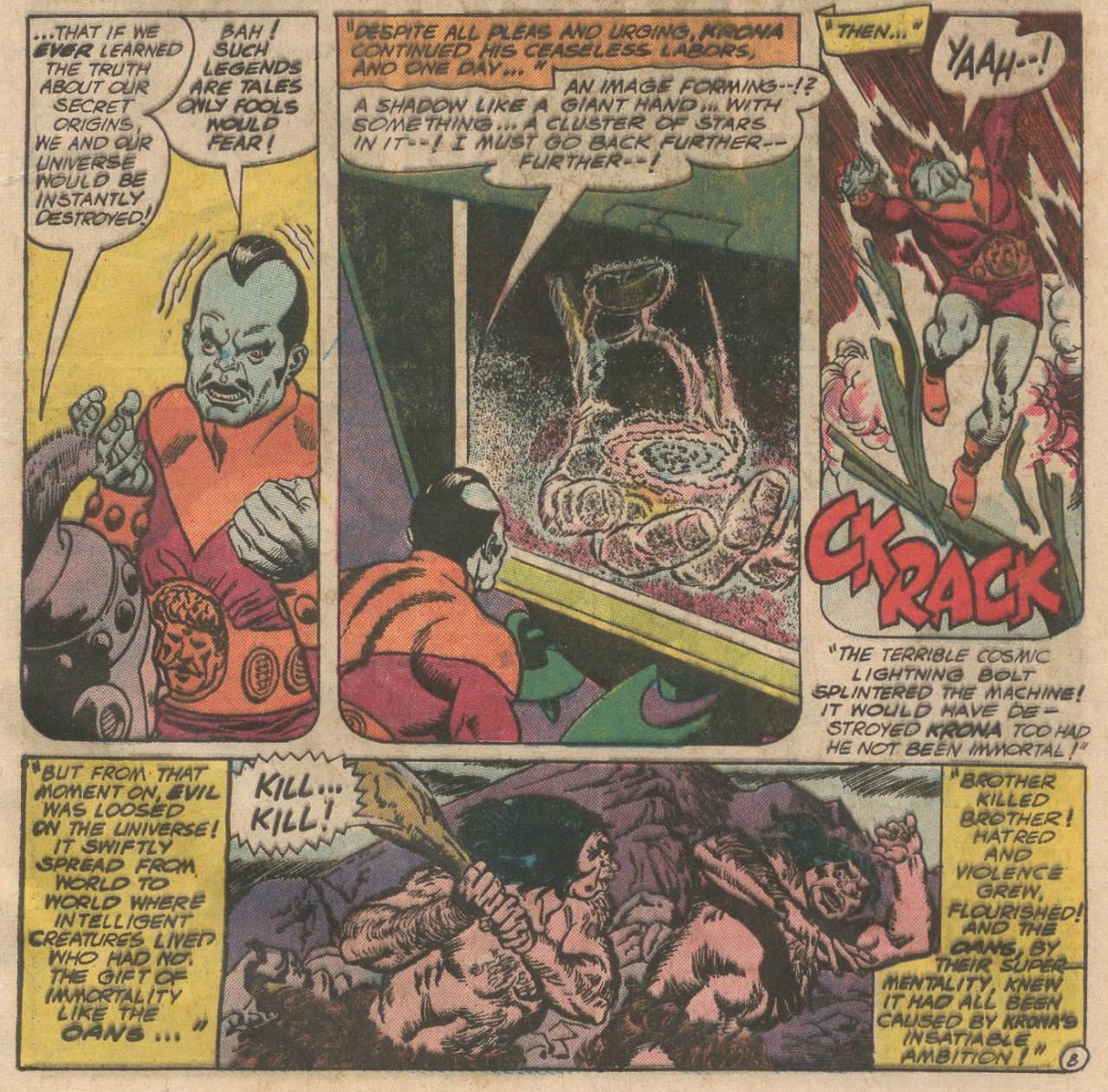
And right there I came to a screeching halt. The pursuit of knowledge about the Oans had led to the invention of evil? That doesn't make a whole lot of sense, and the "reasoning" behind it is the classic fallacy of post hoc ergo propter hoc (after this, therefore because of this). Krona insisted on continuing his pursuit of the origin of the Oans, and so they:

Since one of their fellows had unleashed evil on the universe, they started the Green Lantern Corps to battle the malignant forces.

When the GA Green Lantern's power beam contacted the mind of Krona, he used it to free himself and followed Alan Scott into our universe. The Oans, alerted to the danger, warn the two GLs that they cannot locate Krona by normal means, but to expect an outbreak of evil nearby. Sure enough:

After handling the various crises, the Oans summon the two GLs to their home planet, where the cover scene takes place. Hal does not accept his demotion gracefully:

And yet, a moment later he seems surprised that Alan's not laying down for him:

Via a flashback, we learn that Alan's body has secretly been taken over by Krona, and that the Guardians are being controlled by the GA Green Lantern's ring. But (and this is a key point) Hal doesn't know this yet. So his revolt against the Guardians and his battle with Alan are not excused by this knowledge.

Krona erects a yellow shield to protect himself and then kayos Hal, after which:

We can see that Krona is rather reckless with other people's lives but not his own.

But Alan's disembodied mind contacts Hal, wakes him up, and the two combine their willpower to defeat Krona, with the aid of some trickery; Hal uses the GA power ring rather than his own so that yellow won't work against it. Krona is sent back on his endless journey, but this time the Guardians make sure his orbit will never intersect any planet or star.

Comments: The story can be taken as an allegory to the book of Genesis, with Oa before Krona as the Garden of Eden, and Krona as Adam releasing evil by eating from the Tree of Knowledge. According to the letters column in GL #43, that was the way writer John Broome intended it:

But you can also read it as anti-science, and anti-Darwinian. That the Oans turn out to be correct in their ancient superstition against studying the origin of their species is hardly surprising. It's a basic principle in fiction that the Cassandras of doom are always proven right (as was the original Cassandra, who warned the Trojans against bringing the wooden horse into their walls). But I have a hard time believing that the Oans were justified in their original banishment of Krona. Given what happens in this story you can argue that the subsequent exile was merited, but you can also argue that ten billion years as a disembodied mind might be the cause of his callous disregard.
More about

Green Lantern #59: Guy Gardner

Người đăng: vanmai yeu em on Thứ Năm, 22 tháng 10, 2009


This story starts with Green Lantern visiting Oa, the planet of the Guardians, for a seminar in advanced Green Lanternship. Hal learns that the Guardians have a machine that can read the minds of dead people. They offer to show him the last thoughts of Abin Sur, the alien Green Lantern who crashed on Earth and offered Hal Jordan the chance to take his place. Abin Sur had two requirements for a suitable replacement. The candidate must be honest and he must be utterly without fear.

To Hal's surprise (and ours) it turns out there were two possibilities: Hal Jordan and Guy Gardner. But as Jordan was on the West Coast, while Gardner was back east, Abin Sur chose Hal. We get the familiar origin sequence:


Hal is intrigued. What would have happened if Guy Gardner had been chosen as Green Lantern? Well, funny you should ask, because the Guardians just happen to have a "What If" machine:


Of course the same type of machine features in two of my favorite Silver Age stories, The Second Life of Batman from Batman #127, and Superman's Other Life, from Superman #132.

Gardner's home base is "East City" continuing DC's coy tradition of fictional town names. Guy's occupation is quite a bit different from Hal's:


They both sure like to punch! We found he would have battled pretty much the same crime gallery: Sonar, the Shark, Black Hand, Dr. Polaris, and Sinestro are shown. But when the Gardner GL returns to Earth following his initial meeting with the Guardians, he takes a slightly different route, and this is where history starts to diverge. He encounters two robots battling, one orange and the other blue, and learns from them that they come from a planet where the Yellow Plague killed off all the adults, and where the children do not age normally, so they have divided into two warring factions.

When Guy first visits the planet he is controlled by the mental powers of the blue faction, but during a battle with the "Orangers" he breaks free and manages to shield his mind from control. After that, it's a pretty simple matter for the gym teacher to get the kids to behave properly, especially since his ring ensures they will start to mature.

Unfortunately:


Guy Gardner must summon another worthy individual, who just happens to be Hal Jordan. Again, this perfectly echoes the Batman and Superman tales, both of which ended with Bruce wearing a cowl and Kal in a cape.

There is a very nice bit at the end. Hal asks for permission to form a friendship with Earth's other Green Lantern and they hit it off after meeting at Guy's health club:


Comments: Cute idea, but it did not get developed in the Silver Age after this; Guy Gardner popped up in a Green Lantern/Green Arrow issue and then basically disappeared until the mid-1970s. But he would become a major character in his own right, with his personality more like the cover of this issue than the ending.
More about

Green Lantern's Dates With Carol Ferris

Người đăng: vanmai yeu em on Thứ Tư, 8 tháng 4, 2009

One of the oddities about the Green Lantern series in the Silver Age was the romantic triangle between Hal Jordan, Carol Ferris, and Green Lantern. Carol did not appear in the Green Lantern origin story in Showcase #22, but she popped up in the second story in that issue, and it was immediately clear that she and Hal were more than employer and employee:


But Hal's plans for romance take a downturn later in the story, as Carol's father announces that he and his wife are going on a tour around the world, and that she will be in charge of the plant during his absence. This results in a definite cooling of their relationship (as she must be responsible and not fall in love), and when she discovers that there's a new superhero in town he's permanently demoted to the "B" list:


And at the ball:


But inevitably danger arises, and GL has to run out on Carol in mid-kiss, putting him (temporarily) in her doghouse.

In the next issue, GL purposely dates quite a few women, making sure that the gossip columnists report it prominently. But rather than getting him in dutch with Carol (and helping Hal's chances), his trick only makes him more appealing, and when Hal mentions that he's struck up a friendship with GL, she puts him on the spot suggesting that they go out for dinner as a threesome. Hal realizes:


Well, Hal, it's your own stupid fault for dancing every dance with her and giving her that big kiss at the end as Green Lantern. But do you think he learned from his mistake? Nope, at the end of the story:


And so for the next few years, periodically we'd see scenes like this:


Perhaps the most embarrassing moment comes in Showcase #24, when Carol reveals that she had a dream where she married Hal, but was bitterly disappointed that GL didn't show up to stop the ceremony and sweep her away. But as she and Hal started on their honeymoon an emergency occurred requiring GL's presence and as Hal changed into the Emerald Gladiator Carol realized that she had married both Hal and GL at the same time. And this dream made her waking self wonder if perhaps they were the same man:


Now that's pretty cold. "I had this nightmare where I married you and Green Lantern didn't rescue me, but it turned out okay because you were Green Lantern yourself, so tell me, are you GL?"
More about

The Modern Silver Age

Người đăng: vanmai yeu em on Thứ Tư, 12 tháng 11, 2008

Although the Silver Age of Comics ended (in my estimation) about 38 years ago, the market is still served via Archive Editions (DC) or Masterworks (Marvel). In addition, several modern comic book series have been produced to provide new looks at the Silver Age characters. Three that I have specifically in mind are the Silver Age series produced by DC around 2000, 1963 by Alan Moore, and The New Frontier, released by DC in 2004.

I thought I would take a look at that last series over the next few days. I will say right up front that while the series has a few unfortunate flaws, it comes with my highest recommendation. It is a fine achievement in storytelling and captures the essence of the Silver Age while clearly reflecting modern sensibilities as well.

The name, "The New Frontier", refers to a phrase used by John F. Kennedy in his acceptance speech at the 1960 Democratic National Convention:

We stand at the edge of a New Frontier—the frontier of unfulfilled hopes and dreams. Beyond that frontier are uncharted areas of science and space, unsolved problems of peace and war, unconquered problems of ignorance and prejudice, unanswered questions of poverty and surplus.


In the title it evokes the same era in comics, as DC began the great revival of superheroes that became known as the Silver Age.

The story begins with the Losers, several of DC's Silver Age WWII characters, stranded on an island with a T-Rex. This evokes the rather oddball "WWII and dinosaurs" era of Star Spangled War Stories in the mid-1960s, although the Losers (Captain Storm, Gunner, Sarge & Pooch and Johnny Cloud) came along later. The T-Rex kills all but Johnny Cloud, who avenges his fellow losers:


It is basically a digression from the real story, but isn't that the point? The DC war comics of the 1960s are certainly nowadays considered a digression from the really interesting superhero era. Which gets underway in the second part of the first book, when a young man meets Colonel Chuck Yeager:


There is a moment in every great comic where the reader suddenly realizes that this is going to be really good. For me it came a few panels later, when it is revealed that the young lad who idolizes Col. Yeager is Hal Jordan. It's the missing piece of the puzzle, the moment where we understand why Hal became a test pilot for Ferris Aircraft in the Silver Age. It may seem minor, but an additional piece of characterization for one of DC's major SA characters that fits what we already know and yet adds depth to the character? Priceless.

This highlight is followed by a bit of tedious political correctness that has apparently become part of the DC mythos. We are told through an Iris West feature article that the Golden Age comic heroes of the DC Universe were banned and either retired or hunted down during the McCarthy-inspired "Red Scare" of the 1950s. This merges Earth-1 with Earth-2. We hear that Roy Raymond got caught up in the blacklist and that's why his show was canceled. We also learn that Richard Nixon was behind it all, and Superman was the enforcer of the edict against superheroes.

The negative of this nonsense is that it wasn't true. DC's Golden Age Superheroes were not forced to take a dirt nap by anything other than consumer (lack of) demand. Roy Raymond's series was canceled in 1961, well after the Hollywood Blacklist had been broken.

When this tedious bit is followed by the revelation that Hal has become a young fighter pilot in Korea, but that he refuses to shoot down enemy pilots, I resumed my skepticism that the story was going to prove pleasing. Fortunately I was wrong, but this was a silly attempt to shoehorn in the prohibition against killing. Perhaps we can buy Hal's refusal to become an ace, but how do we understand his commanding officer's acceptance of same?

The last part of the first issue weaves in Lois Lane and Jimmy Olsen. Hal actually does kill an enemy soldier, but solely because he cannot remember Korean for "The war is over."

Comments: This issue has some terrific moments but also slips into an annoyingly PC view of comic history at the end that actually had me wondering if it was worth continuing. If you get through the first book and are wondering as well, definitely read on. There will be more annoying moments, but the good parts outweigh the bad by a large margin.
More about