Hiển thị các bài đăng có nhãn Claw. Hiển thị tất cả bài đăng

Number 1282: The Claw and the Clawites

Người đăng: vanmai yeu em on Thứ Hai, 17 tháng 12, 2012

The Claw, here making his appearance from Daredevil Comics #27 (1944), was billed as “The World's Worst Villain.” The thought struck me when looking at him, he may not have been exactly the world's worst, but he was the tallest. I'm sure that if the Claw was around today some sharp sports agent would find a way to get him a multi-million dollar contract playing professional basketball.

I also like the little devils that do the Claw's bidding. But someone, for lack of a better name, came up with “Clawites.” It has a certain ring...the Claw and the Clawites. Could've been a rock band from the era in which I grew up.

Artwork on this tall tale is by Bob Q. Siege, who also worked for editors Charles Biro and Bob Wood on Crime Does Not Pay.


More about

Người đăng: vanmai yeu em on Chủ Nhật, 12 tháng 6, 2011


Number 963


The Claw's alter ego


In early February I was watching the History Channel's Pawn Stars program when I jolted up from my couch with recognition. A seller was presenting a World War II bomber jacket with the emblem of the Army Air Corps' 97th Flying Training Squadron, which they called the Devil Cat. It was really the Claw.

I went to the Internet and found the Devil Cat insignia, and you can see it above.

The Devil Cat may live, but "The Claw Dies!" is from Lev Gleason's Daredevil #16, from 1942. The Grand Comics Database credits Bob Wood with the artwork.


More about

Người đăng: vanmai yeu em on Thứ Năm, 13 tháng 12, 2007


Number 232


It's not easy being green


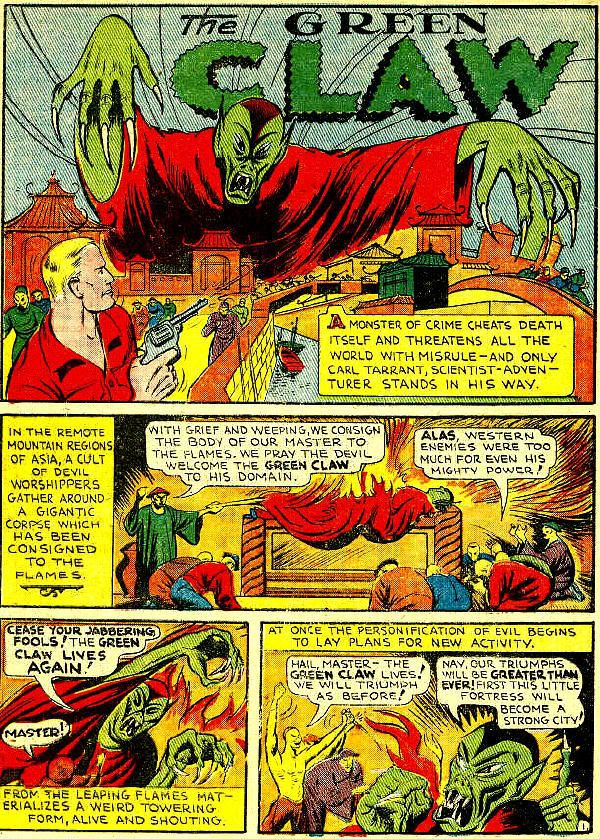
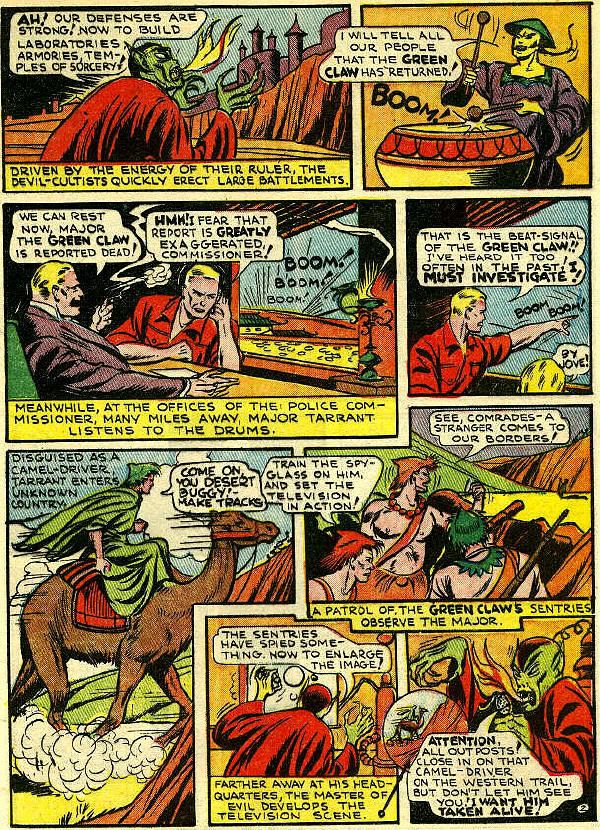
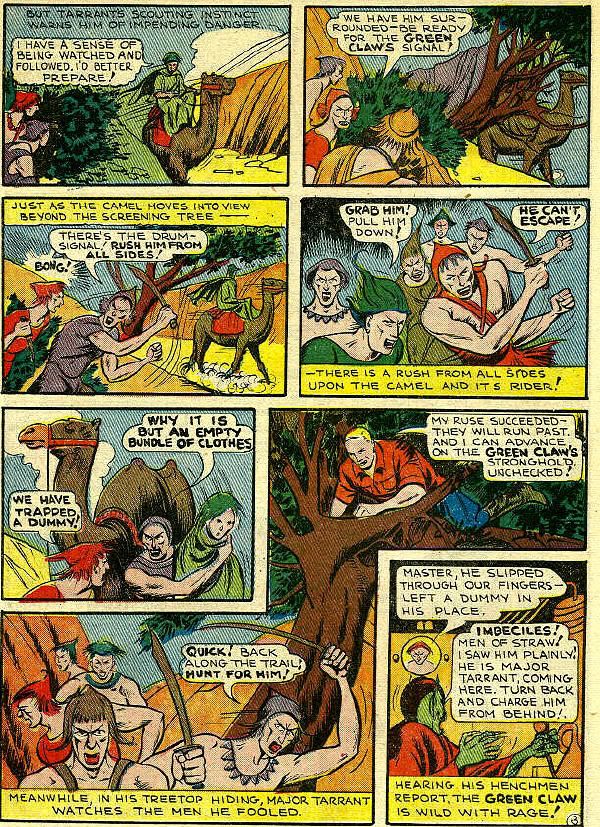
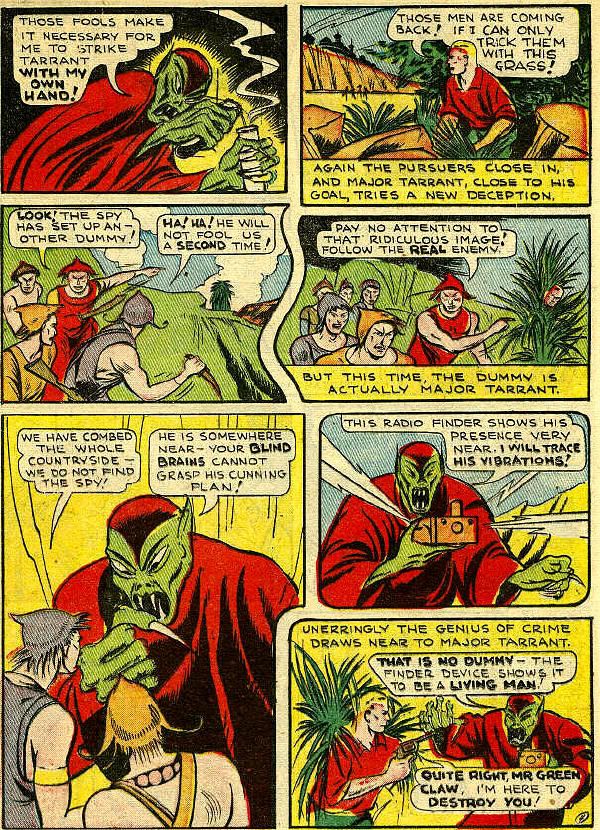
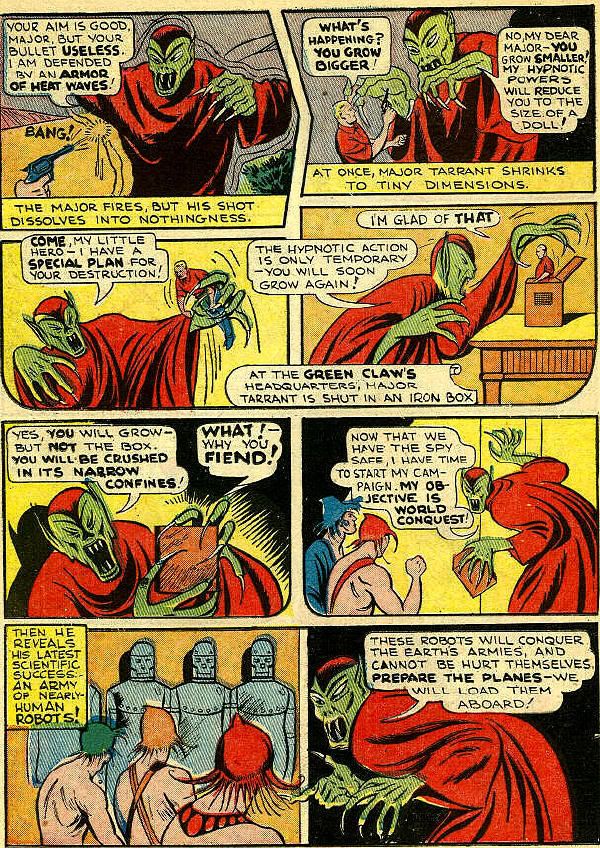
Pity the Green Claw. He's green, he's really, really tall, and his breath is so bad he shoots flames out of his mouth. No wonder he's in such a bad mood all the time. If ever a guy needed a woman…

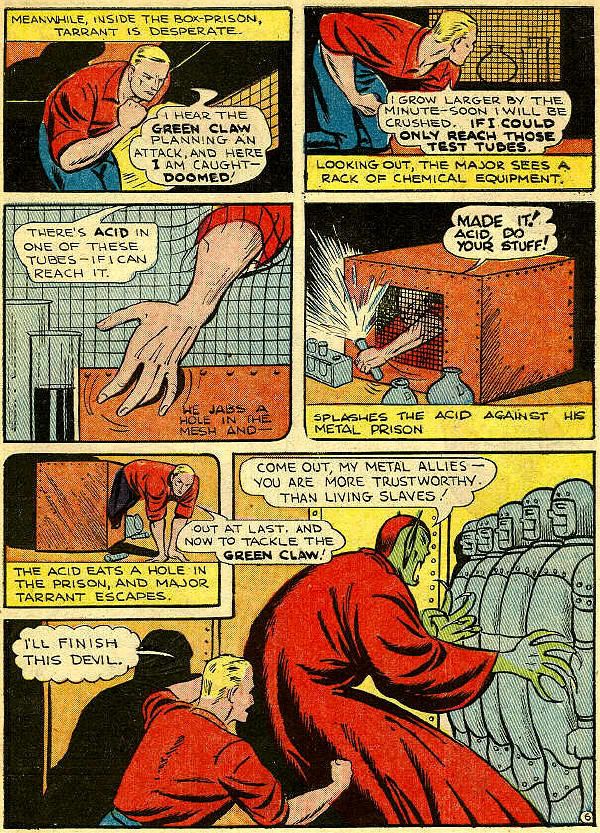
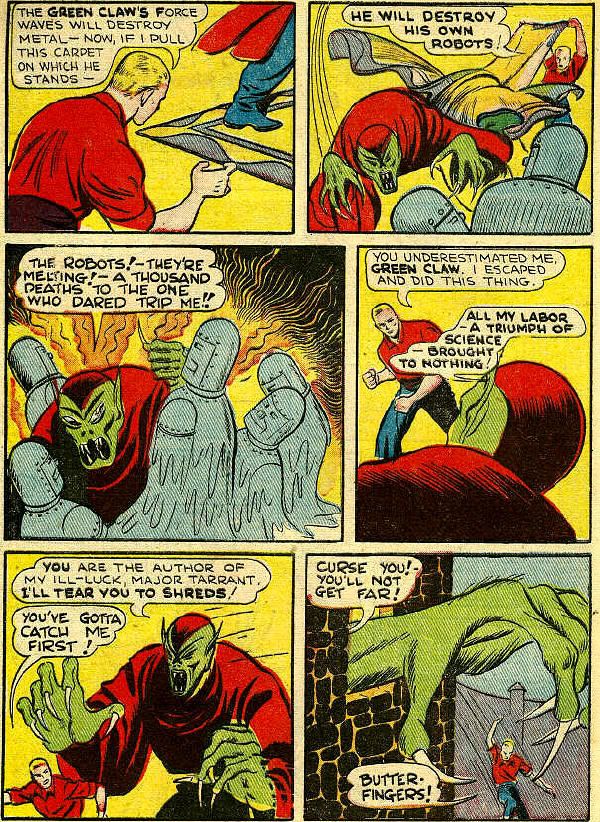
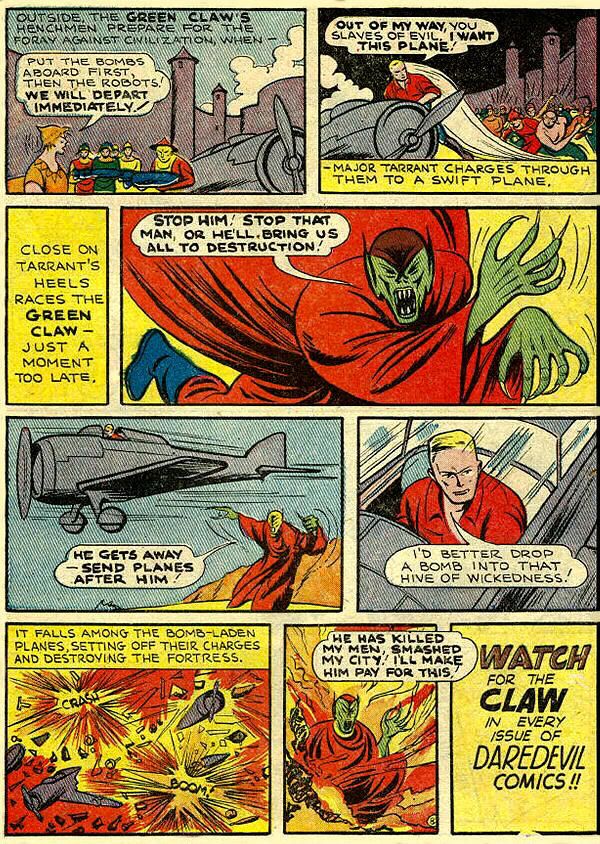
"The Green Claw" is scanned from Lev Gleason's Captain Battle Jr. #2, where it was reprinted from Silver Streak Comics #6. The cover of that 1940 issue of Silver Streak is scanned from my Flashback reprint, published by Alan Light in the mid-1970s.As far as I know, this is the only time the arch villain from Silver Streak, created by Plastic Man's Jack Cole, ever appeared as the Green Claw. There's no explanation as to why the name and color change, and by the next appearance he was back to being yellow. The Claw was a hideous caricature of an Asian stereotype, the insidious "yellow peril" Fu Manchu-styled villain. Coloring him green was an interesting choice, if not consistent with the rest of the series. It must've confused the readers of the day.

In this breathless tale, Major Tarrant, the (Green) Claw's nemesis, chases him down. The Claw has television, he has a version of GPS, some radar with which to find the major. He also has a power I've never seen before in comics, the power to hypnotize and make someone physically smaller. In this case The Claw sticks Major Tarrant into a tiny box, and gloating, tells him because of the confines of the box, when he begins to grow he'll die. Bahahaha! In Lee Falk's classic comic strip, Mandrake the Magician, Mandrake was able to shrink people with hypnosis, but they only thought they were shrunk. "The Green Claw" is such an absurd and silly story that this bit of hokum-pocus is just one more screwball element to a story you don't want to have to think about too much.

Page 1 / Page 2 / Page 3 / Page 4 / Page 5 / Page 6 / Page 7 / Page 8

More about

Người đăng: vanmai yeu em on Thứ Hai, 29 tháng 1, 2007


Number 87


The World's Worst Villain: The Claw


Even for an industry as short on subtlety as comics during the World War II era, The Claw feature in Daredevil, published by Lev Gleason under the Comic House imprint, was way over the top. And when I say way over, I mean it. The Claw could grow to fantastic heights, looking to be about 25' tall. A fairly good overview of The Claw in Daredevil is told here.

The Claw was created by Plastic Man creator, Jack Cole, but worked on by several artists during the time of its run. He also fought various heroes: Daredevil, Silver Streak and The Ghost. This particular episode, from Daredevil #11, June 1942, features The Ghost.

The Ghost shows up in a Colorado town because he has a hunch The Claw is somewhere close. I guess building a giant war machine as big as a building could be done without anyone knowing it, couldn't it? You'd think The Ghost might have seen it while he was flying around the area.  The Ghost, in his secret identity as Brad Hendricks, wearing a bright green suit and yellow fedora with bright red hat band, meets a saucy blonde counter gal in the local diner who gives him what-for because he's not in the Army. He says, "…well, someone has to stay home and take care of the girls…"

This was not only the character talking, but most likely the philosophy of Bob Wood, who gets the byline on the story. He was co-editor, with Charles Biro, of many Lev Gleason titles. Together they created Crime Does Not Pay, one of the most successful comics of all time. Reports by artists who knew them describe a couple of guys enjoying themselves on the town in wartime New York City. Biro was reported to be a ladies man who bragged about his conquests. Wood was described as being a mean drunk who beat women. His comeuppance came in 1958 when in an alcoholic rage he killed his girlfriend and went to prison. Wood’s artwork isn’t bad, but fun in that early forties style.


More about