Hiển thị các bài đăng có nhãn Ramona Fradon. Hiển thị tất cả bài đăng

Brave & Bold #57: DC's First Ambivalent Superhero

Người đăng: vanmai yeu em on Thứ Năm, 6 tháng 1, 2011


Up till this point, DC's superheroes had all pretty much relished their superpowers. And why not? Who wouldn't want to be able to zoom at super speed, or have a ring that obeys your every command, or shrink down to the size of an atom... provided, of course, that you could also be normal whenever desired.

Ben Grimm, aka the Thing from the Fantastic Four, changed all that. While he had extraordinary strength, his powers came with a curse: he looked like a pile of orange rocks 24-7. Granted, it's been done to death since, but in the early 1960s this was pretty revolutionary stuff. When the Thing was followed up by characters like the Hulk, Spiderman and the X-Men, it was clear that Marvel was onto something. Comics fans liked heroes with permanent problems, not just the temporary annoyance of a Mr Mxyzptlk or a brush with Red Kryptonite.

DC obviously took note and responded with Metamorpho. Rex Mason was a world-famous adventurer who traveled the globe. His employer was Simon Stagg, a wealthy, but unscrupulous tyrant, who also had a gorgeous daughter named Sapphire. Rex and Sapphire were engaged, much to the dismay of Stagg's brutish assistant, Java, an unfrozen caveman who was smitten with the young woman himself.

As the story begins, Rex is returning from a visit to the jungles of South America, where he was in search of the formula used by witch doctors to create their shrunken heads. He makes quite an entrance:

That turns out to be a gag he's pulled on Stagg and the mayor, who had planned a ceremony and speech to greet the famed traveler. Actually Mason had parachuted from the plane earlier and landed in Sapphire's convertible. When Stagg's goons order the pair back to the millionaire's mansion, they make the most of their time:

Cute bit, probably inspired by the James Bond flicks of the time. Stagg has a new assignment for Mason, one that will pay him enough for him to marry Sapphire:

However, when they locate the hidden pyramid, problems arise. At first, the pyramid glows red hot. Then later, after finding the Orb of Ra, Java turns on Rex:

When he recovers, Rex finds himself trapped:

After passing out from the heat, Rex is surprised to discover he's still alive, but dramatically changed:

He's still sealed inside the pyramid, but "a strange thought occurs to his confused brain" and he turns gaseous, seeping through the cracks to the outside.

Java has escaped in a backup plane. Rex quickly realizes that with his new powers he can fix his damaged machine:
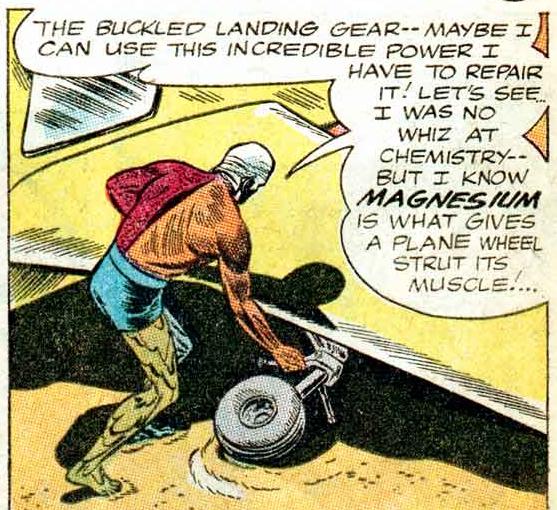
In the next chapter, Mason appears to have been boning up on those chemical lessons, as he seeks his revenge on Java and Stagg:

When Stagg tries to shoot him, Rex learns he's invulnerable to bullets in his new form. But not invulnerable to something else:

He and Stagg reach an uneasy truce. Stagg will try to help him get back to his normal state, and Rex will not destroy his castle. There follows a couple pages where Stagg experiments on Metamorpho, which functions mostly to define his powers. He's virtually invulnerable (except for that Orb of Ra) and he can change into almost any element found in the human body.

But Stagg is unable to reverse the incredible change. Java goes nuts and tries to burn down the castle, but Rex saves Sapphire, whose feelings have not changed:

She suggests that he use his powers for good until he can be changed back. Meanwhile, Daddy has hidden the orb in a shark tank he conveniently keeps in another part of the castle.

Comments: Entertaining origin issue, enlivened quite a bit by Ramona Fradon's artwork (embellished by longtime Batman inker Charles Paris). The story was written by Bob Haney. Oddly enough, when DC came up with their next conflicted superhero, he had a very similar quadrifurcated appearance:

There was at least one significant difference between Metamorpho and the Thing. While both were appalled at their freaky-freak McAlien freak appearance, Ben was capable of being irascible even about other things, while Rex remained pretty much happy-go-lucky except about his appearance.
More about

Người đăng: vanmai yeu em on Thứ Sáu, 17 tháng 4, 2009


Number 507


Puglyon's Crypt


I always liked Ramona Fradon's artwork; she worked on the Aquaman backup strip in the 1950s and into the early '60s, then drew Metamorpho. The last work I saw by her was on Super Friends in the 1970s. I thought she had one of those great old-fashioned styles, solid drawing and cartoony exaggeration when necessary. This story, from House of Secrets #116, February 1974, is one where that exaggeration plays a part. It doesn't look all Fradon to me, more like a collaboration of Fradon and Jerry Grandinetti. If it is then Grandinetti isn't credited, or maybe it was just Ramona being influenced by his style. Writer David Michelinie plays on the Poe-esque premature burial idea, but why set the story in 1923? I dunno. It's a good story, though. It observes Pappy's First Law of Horror Comics: "The main character shall be as awful and unredeemable as possible, to justify his horrible fate." Yet it is Code approved. By the early '70s, after twenty years and the rising age of comic book readers, the Code was backing down from prohibiting horror themes.


More about

Người đăng: vanmai yeu em on Thứ Hai, 10 tháng 9, 2007


Number 187


The Waterboys


Here's something you don't see anymore: a monster story combined with Cold War jitters. "The Merman Menace" is from Forbidden Worlds #5, published by the American Comics Group, dated March-April, 1952. The writer is unknown, but according to the Grand Comics Database, the artist is Lin Streeter, about whom I know little. About all I could learn about Streeter is that he was active in comics from the early '40s until at least the 1950s.

You've gotta love having a monster pumped full of adrenalin and benzedrine to get him back up to speed, so he can get revenge on the Reds. It's in the story, folks. I don't make this stuff up.


Just as this giant merman is a survivor of an underwater city, so is Aquaman a citizen of Atlantis. He was born of an Atlantean mom and an American dad. He can stay out of water for an hour but then he has to be submerged again. His adventures had to be short because of that hour time limit, no doubt.

I was given the DC phonebook-sized Showcase Presents Aquaman, and have enjoyed reading a story or two a night. I read Aquaman stories in Adventure Comics in the 1950s and enjoyed them then, too. Of course, at that time I didn't really discern how gimmicky the plots are. I should have, because that was DC Comics in a nutshell: all gimmicks, all the time. Something I appreciate even more than I did 50 years ago is the artwork of Ramona Fradon. Ms Fradon had an excellent semi-cartoony style, perfectly suited to the somewhat zany plots.* Her panels are full of action and her sea creatures are great. In the 1960s I liked her work on Metamorpho and in the 1970s on Super-Friends.

My favorite story (so far) in the book is "The Undersea Hospital," reprinted from Adventure Comics #262, cover-dated July 1959. In this outrageous tale Aquaman opens a "hospital" for his finny friends, splinting a broken tentacle (!) for his octopus friend, helping a dogfish who chased a catfish and got in trouble. You get the idea. At the end an outrageous story goes right off the outrageousness charts when Aquaman is shot by some bad guys. The sea creatures help him: swordfish-surgeons cut into him, and sucker fish suck out the bullets!


After a tryout in Showcase (the comic book) Aquaman got his own book and the stories went totally bonkers, as all DC Comics did, with science fiction monsters and menaces. The Aquaman artwork went from Fradon to another great artist, Nick Cardy.

The current Showcase series of volumes is bringing back all of the old DC characters, the gimmick plots, the ridiculous and stilted dialogue, just as we saw them in the 1950s and '60s. At an affordable price, too. I hope you're joining in the fun and nostalgia of these great black and white reprints.

*The editor was Mort Weisinger, who showed in Action Comics, Superman, Superboy, Jimmy Olsen, Lois Lane, etc., etc., how much mileage a comic book editor can get out of a few gimmicks. The writer on most of the Aquaman stories in Adventure Comics was Robert Bernstein, probably best known amongst Golden Age fans as writer of Psychoanalysis for EC Comics' New Direction. Apparently Bernstein had psychological problems, had psychoanalysis, and elements of it pop up even in the Aquaman stories.

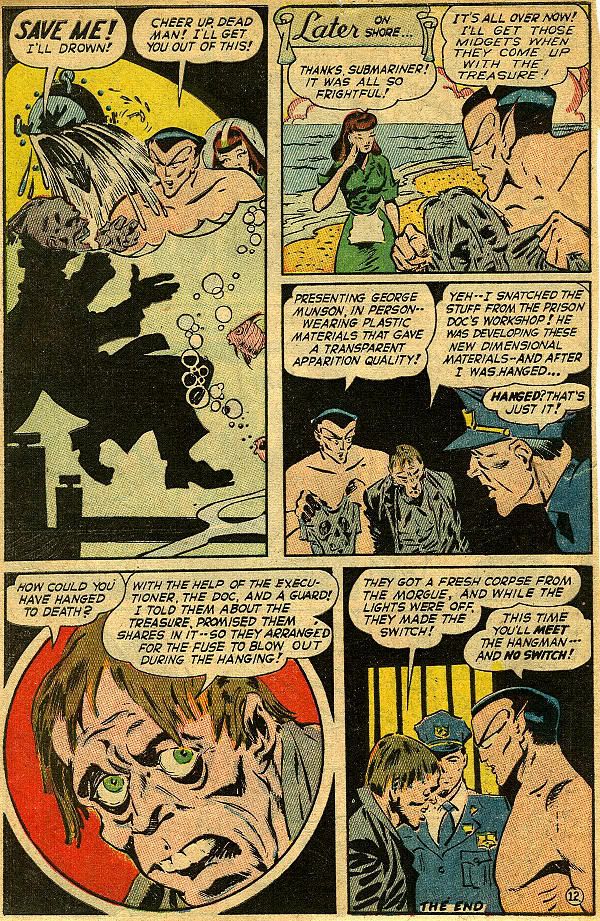
It's a bonus! If you've read this far then you deserve a treat. I'm enclosing an extra story about another famous half-fish, half-human hero. The story is from the late 1940s, and was part of the box full of comic book tear sheets I received years ago. I went through and assembled the complete stories, of which this is one. Comic title unknown, by a writer and artist unknown. (See note by reader Darci below.)


More about