Người đăng:
vanmai yeu em on Thứ Tư, 12 tháng 3, 2014
This is day three of our Week of Quality, featuring popular characters from Quality Comics of the forties.
“The Dress Suit Murders” from Doll Man Quarterly #9 (1946) is intriguing to me because we have what looks like a headless man committing murders, and because he is in evening wear, he is called not “the headless killer” (which would be my choice if I were writing the newspaper headlines that would accompany the lurid stories of his murder spree), but “Dress Suit.” That’s about as unlikely a name for a killer as any I can think of, but the name also provides a clue to the murderer.
The story is well-drawn, according to the GCD, by Dan Zolnerowich, who also did superior work for Fiction House. The cover illustrating the story is by Al Bryant.
**********
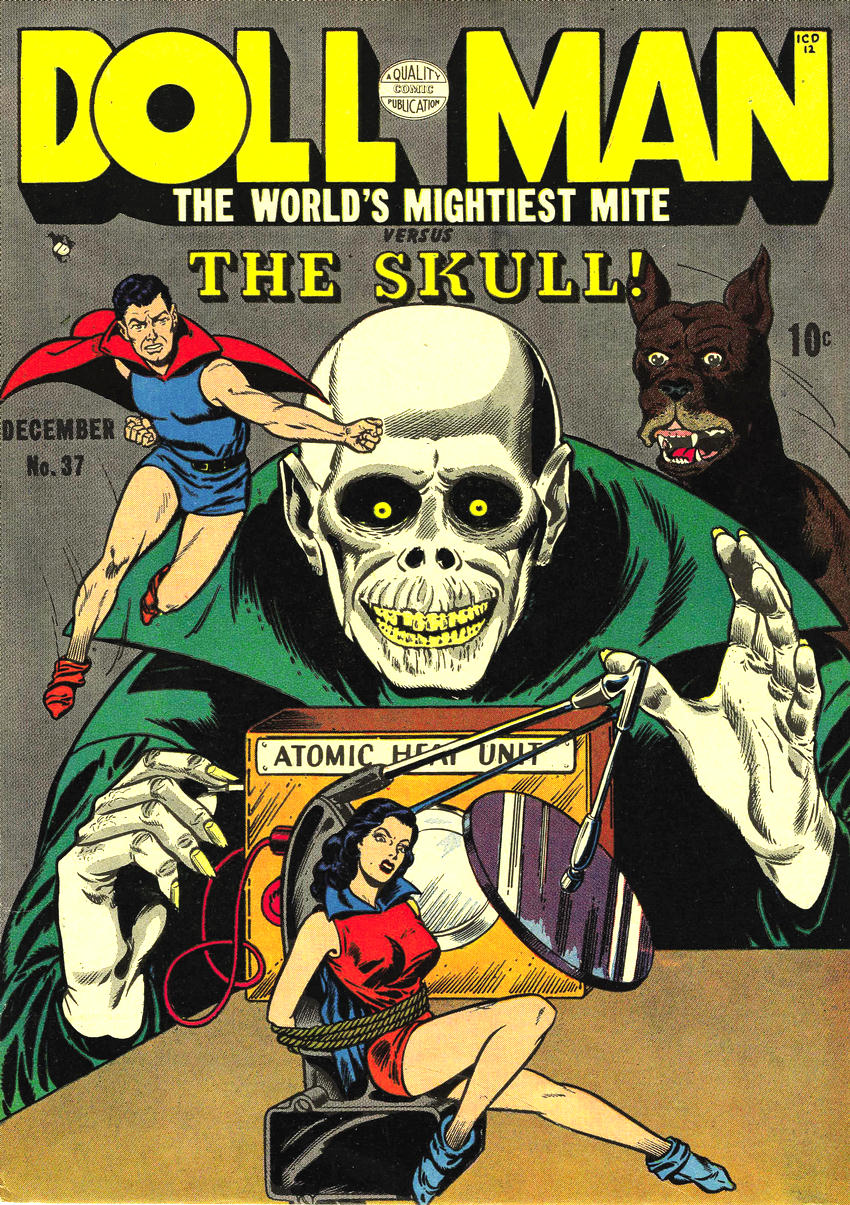
The origin of Doll Girl, from Doll Man #37 (1951):
Người đăng:
vanmai yeu em on Thứ Tư, 9 tháng 1, 2013
Years before Jurassic Park, Doll Man battled a reconstituted dinosaur skeleton which a scientist has mixed with a “gibbon brain” to create a hybrid furry prehistoric critter. This is the third of our Furry Fiends and Foes week, matching superheroes with hairy adversaries. In this adventure from Doll Man #9 (1946) we have the biggest creature of the week up against the smallest superhero.
Dan Zolnerowich is given credit by the Grand Comics Database for this well drawn story.
Người đăng:
vanmai yeu em on Thứ Tư, 11 tháng 7, 2012
Since this is an origin story, of Darrell (Doll Man) Danes' companion, Doll Girl, who is also Darrell's girlfriend, Martha Roberts, you'd think Martha's transition to the power of shrinking would get more than a lousy couple of panels. But it doesn't. For an origin it seems weak to me.
Why create a Doll Girl? I think it was difficult for the writers to combine a normal-sized woman with a tiny little guy like Doll Man. He wouldn't measure up when they got down to some serious sparking, would he? (Heh-heh.)
The Grand Comics Database does their question-mark crediting for this issue, listing Dan Zolnerowich ? for pencils and Chuck Cuidera ? for inking.
Người đăng:
vanmai yeu em on Chủ Nhật, 28 tháng 2, 2010
Number 692
Speed freaks!
A popular character like DC's The Flash was ripe for imitation. An early imitator from 1940 was Quicksilver, although the story below doesn't seem to show much in the way of super speed. It was toward the end of Quicksilver's run in National Comics #71, published by Quality. Don Markstein's Toonopedia has some observations on Quicksilver:
. . . There was no explanation of how he got his super power or why he put on a costume and mask to fight crime.
. . . he also didn't have a personal life or even a name other than Quicksilver (unless you count "The Laughing Robin Hood", which is what newspapers sometimes called him), and was never seen out of costume. He lived with his young Chinese servant, Hoo Mee, in a cave, fitted out with living quarters and a chemical lab, in Oakwood Park, which was located in an unnamed urban area.
This particular story was drawn in fine fashion by Dan Zolnerowich.
Johnny Quick was a knockoff of the Flash by DC Comics, themselves. Johnny was the creation of Mort Weisinger. Johnny said a magic formula for his speed. This episode is drawn by comic book journeyman Ralph Mayo. Again, from Toonopedia:
Johnny's real name was Johnny Chambers. An orphan, he'd been raised by a family friend, Professor Ezra Gill, a scientist who dabbled in Egyptology in his old age. In translating an ancient scrap of papyrus, Gill discovered a "speed formula", capable of bestowing blinding speed on its user. He considered himself past the stage of life where such a thing would be useful to him, and so passed it on to Johnny, to be used in the cause of justice.
It wasn't a "formula" in the usual sense, but worked more like a magic word. By saying "3X2(9YZ)4A", Johnny gained the power of super speed — to the point where he could even fly short distances, which may not have made sense aerodynamically but didn't seem to bother comic book readers of the time. Saying "Z25Y(2AB)6" would return him to normal.
The final story is a previously unpublished story of The Flash. They're scanned from the 100-page Super Special, The Flash #214, from 1972.