Hiển thị các bài đăng có nhãn Denny O'Neill. Hiển thị tất cả bài đăng

Showcase #83: Here Comes Bernie

Người đăng: vanmai yeu em on Chủ Nhật, 26 tháng 2, 2012

The second issue of the Nightmaster Showcase trial featured the art of Bernie Wrightson, who had just started his comic book career a month or so earlier.  Wrightson's style was obviously heavily influenced by Frank Frazetta, which made him particularly suited for the genre. Frazetta's magnificent illustrations had covered the recent Conan series of books published by Lancer/Ace.

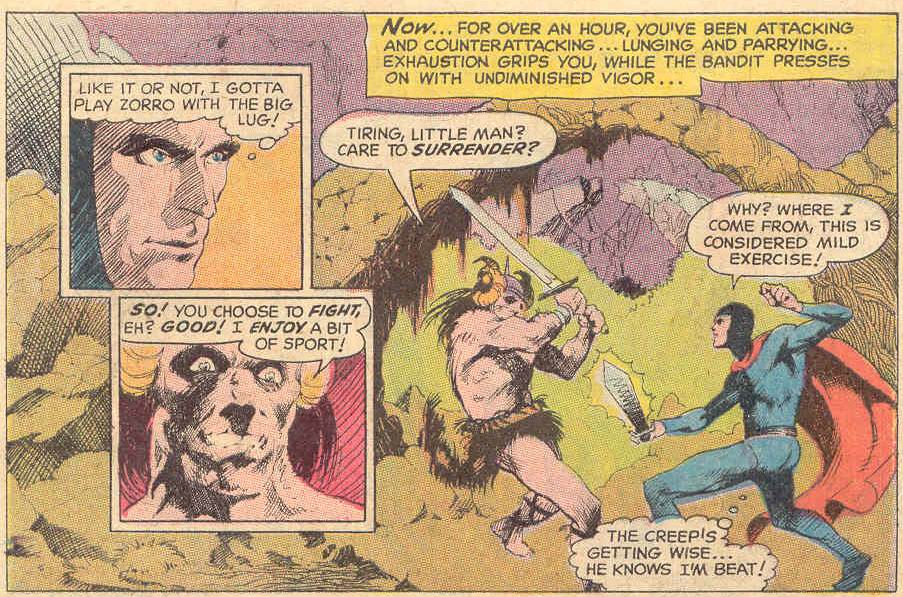
 The story takes up where the previous one left off.  Having learned the passwords from the Ice Witch, Nightmaster and his somewhat deranged guide, Boz, are trying to save Jan from the evil warlocks.  They run into a challenge from a Conan clone:
Note the unusual use of inks there; the straight lines on Nightmaster's face as compared to the cross-hatching on the barbarian's.  This is not original with Wrightson by any means, but it was a style associated with more mature and sophisticated artists, like Al Williamson.

Nightmaster manages to defeat the barbarian by throwing away his sword and using a little judo.  Because he refuses to take his opponent's life, the barbarian agrees to help him.  It turns out he has two additional companions for the party:
 They are sirens, whose voices have been stilled by the evil wizards and locked away in a chest.  So their goals coincide as well. Wrightson was known for drawing exceptionally beautiful women.  Probably his most famous issue had this mesmerizing cover:


They make it to the warlock stronghold, where they stop at an inn.  I guess the CCA was asleep at the switch again on the use of alcohol, as they order ale and:
There's the somewhat obligatory battle with some guards who show up:
Entering the warlock castle, they find the chest holding the voices of the two sirens.  Then they reach the roof, where a moonship is preparing to lift off:
I like the concept of a ship that sails through the air, powered by the light of the moon.  They manage to get over the gunwales before the craft escapes, and Nightmaster discovers that Jan is aboard:
They battle some enchanted warriors, who cannot be defeated, and thus they are forced back to the rails of the ship:
Very nice bit of sequential art there.  The story ends with the moonship sailing away, much to Nightmaster's frustration:
The combination of two of comics' brightest young talents certainly improved things over the previous issue.  This one is not quite perfect, but there are more than a few glimmers of potential that could have resulted in something special had the series been given the time to percolate and develop an audience.  Unfortunately, DC was under rising pressure due to the inflation of the late 1960s (in fact, this was the last 12-cent issue for Showcase) and so had no inclination to wait to see if this series would sell long-term.  Given the success that Marvel had with Conan the Barbarian only a year later, it seems quite likely that Nightmaster could have turned into a winner.

A bit of trivia here: Do you know the last series that Showcase launched into its own book?  It was Windy and Willy, which debuted one issue before Nightmaster.  Can you guess why?  Well, my guess is because DC recycled the old Many Loves of Dobie Gillis series for that comic (with only a few changes to update hairstyles and fashions), and thus it was cheaper to produce than a comic that required new stories and art.
More about

Showcase #82: DC Beats Marvel to Sword and Sorcery

Người đăng: vanmai yeu em on Thứ Tư, 22 tháng 2, 2012

As the 1960s drew to a close, DC found that the superhero genre was waning and began casting about for something to replace it. In fact, the last superhero comic launched by DC's Showcase title was the Hawk and the Dove in #75.

The timing for a sword and sorcery feature was excellent.  JRR Tolkien's Lord of the Rings series, initially published in 1954-55, had grown in popularity and become phenomenally successful in the late 1960s.  In addition, the Conan tales of Robert E. Howard had been reprinted by Lancer/Ace Books in 1966-67, to strong sales.

Better still, DC assigned a pretty good creative team to the series, with Denny O'Neill, soon to be considered one of the best young writers in comics, teamed up with accomplished penciller Jerry Grandinetti and Hall of Fame inker Dick Giordano.  What could possibly go wrong?

Well, for starters, O'Neill or his editor (Murray Boltinoff) decided to make the lead character a rock star:
Yes, adolescents and teens were fascinated by rock stars.  But real rock stars, with real hits, not some make-believe guitarist.  Note that the band, despite being called The Electrics, appear to be an acoustic band; that stand-up bass would not work in an electric band.  Also note that the story is told in the second person.  Although this is supposed to be more immediate, I always found it distancing.  Sorry, guys, but that is not me.

After the obligatory fight with some audience members who appear to be fraternity fascists (very common in the hippie Greenwich Village scene where the story opens), Jim Rook and his girlfriend Janet decide to check out the new restaurant:
And before you can say "John Carter" they are transported to another world, another dimension.

Now that part, I don't mind at all.  It doesn't fit with the Lord of the Rings or Conan, both of which featured characters living in their normal reality, but it does give us a lead character (like Carter) who is as baffled with this new world as we are.
As you can see, Grandinetti just doesn't have the style for the fantasy genre, unlike, for example, Joe Kubert, who did the terrific cover for this issue.

Jim meets a gnome king who explains that he has been summoned to this world because he is a descendent of a warrior from that world known as "Nacht" (German for night).  Nacht and another warrior named Brom had been given weapons of incredible power by some earlier king.  But Brom betrayed the king and it was only through Nacht's great courage that an attempted coup d'etat by him and Farben the Wizard was foiled.  However, Farben had banished Nacht to Earth and the battle between the Wizards and the gnomes (who had originally been human-like, but shriveled under the magical onslaught) had raged ever since.  Only recently had the gnomes been able to open up the dimensional portal and bring Jim into their world.  Can he save them from the final battle?

Well, despite insisting that he doesn't know swordplay, he picks up the weapon of power and before you know it, he's smiting like the dickens:

But when the fight is over, he wants to return to his own world, with his fiancee.
So now he must fight his way to the fair maiden, which requires an initial stop at the Ice Witch, who has the password.  He, and his mildly insane guide, Boz, try to make it to the top of her castle:
And once there, they surprisingly find Jan:
As you can probably guess, Boz has the right read on Jan; she's the Ice Witch herself.  They obtain the password, and it's on to the Wizards' stronghold to free Jim's girlfriend.  To be continued....

Comments:  There are some elements that work here, and some that fail.  Although I am an admirer of Grandinetti's artwork on the war comics, here he flounders.  Ah, but in the next issue, guess who took up the reins? But that, my friends, is where this post leaves off, and the next one will begin.
More about

Detective #395

Người đăng: vanmai yeu em on Thứ Năm, 24 tháng 6, 2010


Often cited by those who are big on dividing lines as marking the end of the Silver Age Batman, Detective #395 includes the first O'Neil/Adams team-up on Batman. It's a terrific story, amazingly illustrated, and is featured (deservedly) in many "Best of Batman" collections.

But the idea that this is far from the rest of the (late) Silver Age Batman is a bit silly. Following the demise of the Batman TV show in early 1968, Julius Schwartz found that he needed to reinvent yet again the character he'd inherited as editor just before Batmania hit. And this time he hit on the correct formula: Bring in strong artists like Irv Novick (and occasional guest stars like Adams and Gil Kane), and return Batman to the nighttime man of mystery that he had been in the early Golden Age. This he did starting with Batman #204-205's solid (if not classic) Operation Blindfold. The stories published in Batman and Detective from about mid-1968 on all are pretty high-quality, especially compared to what came before.

And it's not as if Adams hadn't been doing Batman in The Brave and the Bold for the last year or so, even if it's O'Neil's first crack at the Caped Crusader. So Secret of the Waiting Graves is not some bolt from the blue; it's a continuation of a trend that had been gathering for about 2 years at the time it was published.

The story begins with Bruce at a party being hosted by a wealthy Mexican couple, the Muertos. The party takes place in a graveyard at night. The first event is a balloon race (yeah, a balloon race in the dark), in which the balloon occupied by one Pedro Valdes, is attacked by hawks and shredded. The man seems fated to fall on the rocks below when suddenly:

Batman's momentum carries the two of them into the river below instead of death on the rocks. Notice how the camera angles are chosen to present the maximum action against a large backdrop?

As the story continues, we begin to understand that the Muertos are not as youthful as they appear:

It subsequently becomes obvious that Valdes himself is definitely a target for murder, when a pottery explodes next to him, revealing the presence of a sniper. Bruce is already suspicious of the Muertos for holding this party anyway, since they are normally hermits. It turns out that they are being kept alive by the Sybil flower, which causes insanity and, oh, by the way, hallucinations:

Anybody, what are they really talking about there? Anybody? Bueller?

Batman saves Valdes and torches the plants:

And they topple into the waiting graves.

Comments: There are some holes in the story. For starters, would the Muertos be so foolish as to have only one patch of the plants that keep them alive? And why would the graves be dug out for them to collapse into? But overall those are quibbles about a tale that certainly does appear to be leading the way into the Bronze Age, with more adult-oriented plots. Adams' art, as always, is spectacular.

The Robin story is a continuation of a two-part tale. It's rather ridiculous. Dick has arrived at Hudson University, only to find a demonstration going on at the registrar's office. The demonstrators are trying to get the Dean to call in the cops, but he is insistent that he will talk with the leaders. A squad car arrives anyway, and the cops inside rough up the protestors. But Dick quickly realizes that the police are phonies as their car has an inspection sticker on it. It's all a plot to give the demonstration ringleaders more credibility with the students, and it appears to be working.

The cops? They're communist infiltrators. No kidding:

Comments: Silly story, enlivened quite a bit by the Gil Kane art.
More about

In Memory of Arthur Reeves

Người đăng: vanmai yeu em on Thứ Năm, 8 tháng 10, 2009

As the Silver Age came to a close, a dramatic shift happened in the Batman stories. Gone were the aliens and the weird transformations that had marked the Schiff era, and the camp style of the Batman show. Gone too were Sheldon Moldoff and Bill Finger, Robin and the Batcave.

But with every subtraction comes an addition, and one of the major additions at the end of this era was Denny O'Neill, whose scripts would revitalize the character for the 1970s. O'Neill sensed that Batman needed an official antagonist outside of the criminal underworld, and so he came up with Arthur Reeves, the Public Works Commissioner of Gotham City.

Reeves fits in with several characters from fiction. He's something of a bumbler a la Inspector Lestrade of the Sherlock Holmes movies (Lestrade was less of a buffoon in the Conan Doyle stories). You could also compare him to McGonigle, a Gotham City cop who plagued Batman for a few stories in the 1940s, or to J. Jonah Jameson, Spiderman's longtime nemesis.

Reeves first popped up in Detective #399. In the story, Batman is demonstrating his fighting prowess to the Gotham City Police Academy, against a martial arts instructor. The martial artist loses his cool when Batman defeats him easily and they have a serious fight until Batman ends it with the haymaker. Reeves sputters angrily that he's never seen such a disgraceful exhibition, and asks why Batman has to wear a mask:


And that's not even Reeve's most famous humiliation; that comes in Batman #234's classic story, Half An Evil:


Reeves appeared in a fair number of Batman stories in the 1970s. In Batman #229, Julius Schwartz revealed the inspiration for the name, if not the character:


From the Wikipedia entry on Craig Kennedy:

Kennedy is a scientific detective at Columbia University similar to Sherlock Holmes and Dr Thorndyke. He uses his knowledge of chemistry and psychoanalysis to solve cases, and uses exotic (at the time) devices in his work such as lie detectors, gyroscopes, and portable seismographs. Craig Kennedy became the prototype for American scientific detectives and their adventures, influencing the creation of later characters such as Doc Savage and Batman.


Here's a link to a bunch of Craig Kennedy stories.

Public Works Commissioner Reeves popped up on at least several more occasions; according to the Batman Wikia, he eventually ran for mayor, got caught up with Boss Ruppert Thorne's web, and retired in disgrace. As a public works commissioner it had never made much sense that Reeves would be so involved with Police Department business, unless he had political ambitions.

Hat Tip to Fr. Dan, who mentioned Reeves in the comments section of the last post, giving me the idea to do this post.
More about